When it comes to transferring property ownership in Alabama, the Quitclaim Deed form plays a crucial role. This straightforward legal document allows one party, known as the grantor, to convey their interest in a property to another party, referred to as the grantee. Unlike other types of deeds, a Quitclaim Deed does not guarantee that the grantor holds clear title to the property; instead, it simply relinquishes any claim they may have. This can be particularly useful in situations such as divorce settlements, property transfers between family members, or clearing up title issues. Importantly, while the Quitclaim Deed is easy to prepare and execute, it is essential for both parties to understand the implications of the transfer. The form typically includes essential details such as the names of the parties involved, a description of the property, and the date of the transfer. Furthermore, it must be signed by the grantor and, in some cases, notarized to ensure its validity. Understanding these key aspects of the Quitclaim Deed can help individuals navigate property transactions more effectively and protect their interests.
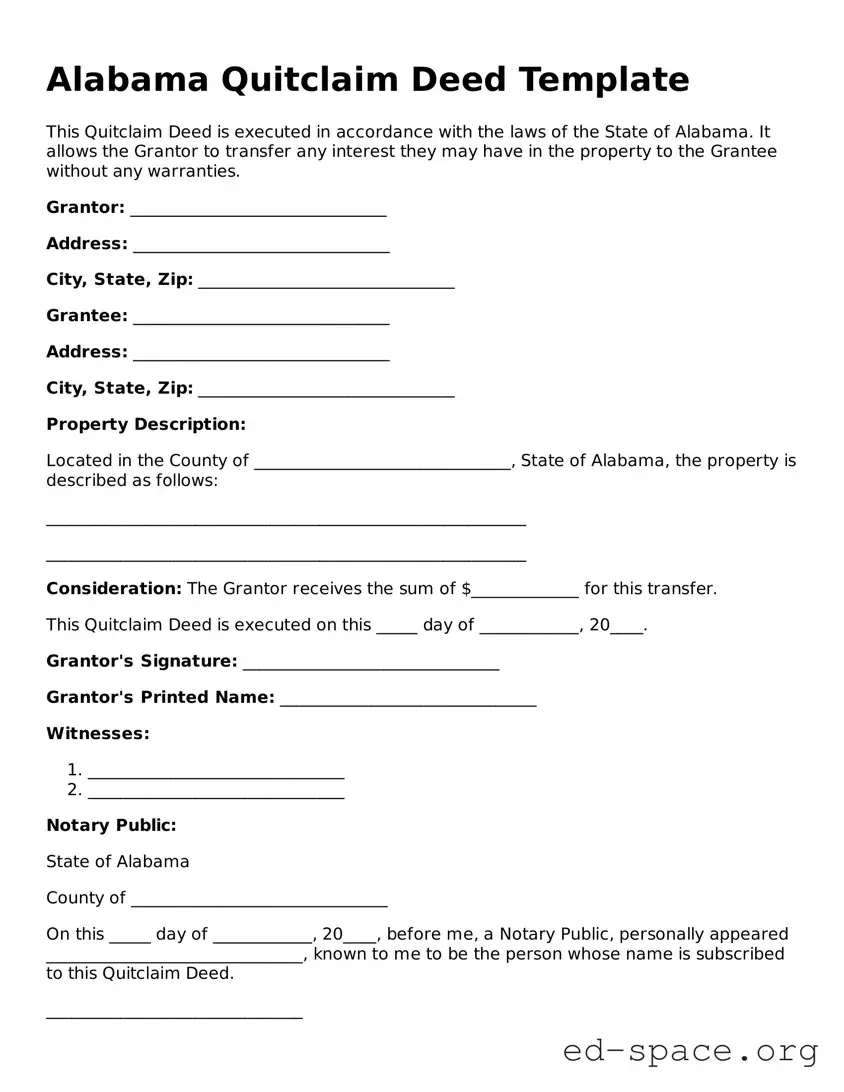
Alabama Quitclaim Deed Template
This Quitclaim Deed is executed in accordance with the laws of the State of Alabama. It allows the Grantor to transfer any interest they may have in the property to the Grantee without any warranties.
Grantor: _______________________________
Address: _______________________________
City, State, Zip: _______________________________
Grantee: _______________________________
Address: _______________________________
City, State, Zip: _______________________________
Property Description:
Located in the County of _______________________________, State of Alabama, the property is described as follows:
__________________________________________________________
__________________________________________________________
Consideration: The Grantor receives the sum of $_____________ for this transfer.
This Quitclaim Deed is executed on this _____ day of ____________, 20____.
Grantor's Signature: _______________________________
Grantor's Printed Name: _______________________________
Witnesses:
Notary Public:
State of Alabama
County of _______________________________
On this _____ day of ____________, 20____, before me, a Notary Public, personally appeared _______________________________, known to me to be the person whose name is subscribed to this Quitclaim Deed.
_______________________________
Notary Public Signature
My Commission Expires: ________________
| Fact Name | Description |
|---|---|
| Definition | A quitclaim deed is a legal document used to transfer ownership of real estate without any warranties. |
| Governing Law | The Alabama Quitclaim Deed is governed by Alabama Code Title 35, Chapter 4. |
| Parties Involved | The form involves two parties: the grantor (seller) and the grantee (buyer). |
| No Warranty | The grantor does not guarantee that they hold clear title to the property. |
| Use Cases | Commonly used in transfers between family members or to clear up title issues. |
| Signature Requirement | The deed must be signed by the grantor in the presence of a notary public. |
| Recording | To be effective against third parties, the deed should be recorded in the county where the property is located. |
| Consideration | The form does not require a specified monetary consideration to be valid. |
| Legal Advice | It is advisable to seek legal advice before using a quitclaim deed for property transfers. |
After completing the Alabama Quitclaim Deed form, you will need to file it with the appropriate county office. This will officially record the transfer of property ownership. Ensure that all information is accurate to avoid any issues during the filing process.
What is a Quitclaim Deed in Alabama?
A Quitclaim Deed is a legal document used to transfer ownership of real estate from one person to another in Alabama. Unlike other types of deeds, a quitclaim deed does not guarantee that the property title is clear or free of liens. Instead, it simply conveys whatever interest the grantor has in the property, if any. This type of deed is often used among family members or in situations where the parties know each other well, as it provides a quick way to transfer property without extensive title searches.
How do I complete a Quitclaim Deed in Alabama?
To complete a Quitclaim Deed in Alabama, you will need to gather the necessary information, including the names of the parties involved, a description of the property, and the date of the transfer. The deed must be signed by the grantor in the presence of a notary public. After signing, it’s important to file the deed with the appropriate county office to ensure the transfer is recorded officially. This step protects the new owner's rights and provides public notice of the change in ownership.
Are there any fees associated with filing a Quitclaim Deed in Alabama?
Yes, there are typically fees associated with filing a Quitclaim Deed in Alabama. These fees can vary by county, so it’s advisable to check with the local probate or land records office for specific amounts. In addition to filing fees, you may also need to consider costs for notary services and any potential taxes related to the transfer of property. It’s wise to budget for these expenses when planning to execute a quitclaim deed.
Can I use a Quitclaim Deed to remove someone from the title?
Yes, a Quitclaim Deed can be used to remove someone from the title of a property. If one co-owner wishes to relinquish their interest in the property, they can execute a quitclaim deed to the remaining owner(s). However, it’s important to note that this does not absolve the departing owner from any financial obligations related to the property, such as mortgage payments. Consulting with a legal advisor before proceeding can help clarify the implications of this action.
Is a Quitclaim Deed the same as a Warranty Deed?
No, a Quitclaim Deed is not the same as a Warranty Deed. A Warranty Deed provides a guarantee that the grantor holds clear title to the property and has the right to transfer it. In contrast, a Quitclaim Deed makes no such guarantees; it simply transfers whatever interest the grantor has, if any. This fundamental difference makes Quitclaim Deeds suitable for certain situations, but not for others where a clear title is essential.
Not including the correct names of the grantor and grantee. Ensure that the full legal names are used, as any discrepancies can lead to complications.
Failing to provide a legal description of the property. A general address is insufficient; a precise legal description is necessary for clarity and validity.
Omitting the date of execution. The deed must be dated to establish the timeline of the transfer.
Not signing the deed in front of a notary. A signature without notarization can render the deed ineffective.
Using an incorrect form version. Always ensure you are using the most current version of the Quitclaim Deed form as laws and requirements may change.
Neglecting to include the consideration amount. Even if the property is transferred as a gift, a nominal amount should be stated.
Failing to check local recording requirements. Each county may have specific rules regarding the submission and recording of the deed.
Not retaining copies of the completed deed. It is crucial to keep a copy for personal records and future reference.
When transferring property in Alabama, a Quitclaim Deed is often accompanied by several other important documents. Each of these forms serves a specific purpose in ensuring a smooth and legally sound transaction. Understanding these documents can help you navigate the process with confidence.
Each of these documents plays a vital role in the property transfer process. By being informed about them, you can ensure that your transaction is handled properly and that your rights are protected throughout the process.
The Quitclaim Deed is a legal document used to transfer ownership of property. It is important to understand that there are several other documents that serve similar purposes in property transactions. Below is a list of nine documents that share similarities with the Quitclaim Deed:
Understanding these documents can help individuals navigate property transactions more effectively and make informed decisions regarding their real estate interests.
Filling out a Quitclaim Deed form in Alabama is an important task that requires attention to detail. Here are some things you should and shouldn't do to ensure the process goes smoothly.
When dealing with real estate transactions in Alabama, the Quitclaim Deed form often comes up. However, several misconceptions surround this document. Here are eight common misunderstandings:
This is partially true. A Quitclaim Deed transfers whatever interest the grantor has in the property, but it does not guarantee that the grantor actually owns the property or has clear title.
While it is commonly used among family members, anyone can use a Quitclaim Deed. It is often used in divorce settlements, property transfers, or to clear up title issues.
This is a misconception. While the deed transfers ownership, it does not eliminate existing liens or mortgages on the property. The new owner may still be responsible for these debts.
These two types of deeds serve different purposes. A Warranty Deed provides a guarantee of clear title, while a Quitclaim Deed does not offer any warranties about the property’s title.
In Alabama, a Quitclaim Deed does need to be signed in front of a notary public to be legally binding. However, notarization alone does not ensure the transfer is effective unless properly recorded.
Once a Quitclaim Deed is executed and recorded, it cannot be revoked unilaterally. The grantor cannot simply take back the ownership transfer.
While it may seem quick, the speed of transfer depends on the recording process and local regulations. A Quitclaim Deed can be recorded swiftly, but it must still follow legal procedures.
This is misleading. A Quitclaim Deed is not recommended for transactions involving significant financial considerations or where a clear title is necessary. In such cases, a Warranty Deed is preferable.
Filling out and using the Alabama Quitclaim Deed form can be straightforward if you keep these key points in mind:
By following these steps, you can ensure a smoother process when using the Alabama Quitclaim Deed form.