Homepage Free Promissory Note Form for Alabama
Content Overview

The Alabama Promissory Note form is a crucial document for anyone involved in lending or borrowing money in the state. This form outlines the borrower's promise to repay a specific amount of money to the lender under agreed-upon terms. It typically includes details such as the loan amount, interest rate, payment schedule, and maturity date. Furthermore, it may specify any collateral securing the loan, ensuring the lender has a means of recovery if the borrower defaults. Understanding the elements of this form is essential for both parties to protect their interests and ensure clarity in the transaction. By clearly defining the rights and obligations of each party, the Alabama Promissory Note helps to create a legally binding agreement that can prevent misunderstandings and disputes in the future. Whether you're a seasoned lender or a first-time borrower, familiarity with this document can facilitate smoother financial interactions.

Document Preview

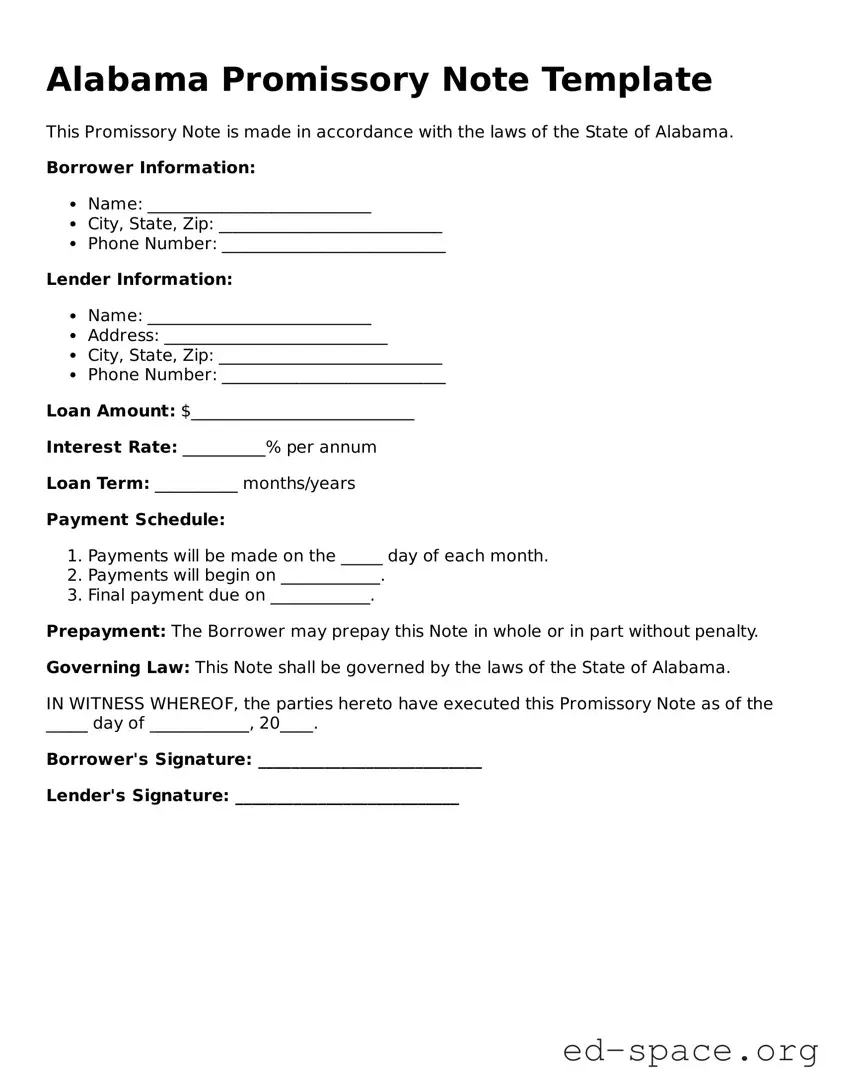
Alabama Promissory Note Template

This Promissory Note is made in accordance with the laws of the State of Alabama.

Borrower Information:

  • Name: ___________________________
  • City, State, Zip: ___________________________
  • Phone Number: ___________________________

Lender Information:

  • Name: ___________________________
  • Address: ___________________________
  • City, State, Zip: ___________________________
  • Phone Number: ___________________________

Loan Amount: $___________________________

Interest Rate: __________% per annum

Loan Term: __________ months/years

Payment Schedule:

  1. Payments will be made on the _____ day of each month.
  2. Payments will begin on ____________.
  3. Final payment due on ____________.

Prepayment: The Borrower may prepay this Note in whole or in part without penalty.

Governing Law: This Note shall be governed by the laws of the State of Alabama.

IN WITNESS WHEREOF, the parties hereto have executed this Promissory Note as of the _____ day of ____________, 20____.

Borrower's Signature: ___________________________

Lender's Signature: ___________________________

PDF Form Details

Fact Name Description
Definition An Alabama Promissory Note is a written promise to pay a specified amount of money to a designated person at a future date.
Governing Law The Alabama Uniform Commercial Code (UCC) governs promissory notes in Alabama.
Requirements The note must include the amount owed, the interest rate (if any), and the repayment terms.
Signatures Both the borrower and lender should sign the note for it to be legally binding.

Alabama Promissory Note: Usage Guidelines

After obtaining the Alabama Promissory Note form, it's important to ensure that all sections are accurately completed. This will help to avoid any potential issues later on. Follow these steps carefully to fill out the form correctly.

  1. Begin by entering the date at the top of the form. This is the date on which the note is being created.
  2. In the first section, write the name and address of the borrower. Make sure to include any relevant contact information.
  3. Next, provide the lender's name and address in the designated area. This should also include contact details.
  4. Specify the principal amount being borrowed. This is the total sum that the borrower agrees to pay back.
  5. Indicate the interest rate. Clearly state the percentage that will be applied to the principal amount.
  6. Detail the repayment terms. Include the schedule for payments, whether they are monthly, quarterly, or otherwise.
  7. In the next section, outline any collateral that secures the loan, if applicable. This might include property or other assets.
  8. Finally, both the borrower and lender should sign and date the form at the bottom. This confirms their agreement to the terms outlined in the note.

Your Questions, Answered

What is a Promissory Note in Alabama?

A Promissory Note is a written promise to pay a specified amount of money to a designated person or entity at a certain time or on demand. In Alabama, this document outlines the terms of the loan, including the principal amount, interest rate, payment schedule, and any penalties for late payments. It serves as a legal record of the agreement between the borrower and the lender.

Who can use an Alabama Promissory Note?

Any individual or business can use a Promissory Note in Alabama. It is commonly utilized by lenders and borrowers in personal loans, business loans, and real estate transactions. Whether you are lending money to a friend or financing a business venture, this document can help protect the interests of both parties involved.

What information is required in an Alabama Promissory Note?

An Alabama Promissory Note should include several key pieces of information. This includes the names and addresses of both the borrower and the lender, the principal amount of the loan, the interest rate, payment terms, due dates, and any collateral securing the loan. It may also specify what happens in case of default.

Is a Promissory Note legally binding in Alabama?

Yes, a Promissory Note is legally binding in Alabama, provided it meets certain requirements. Both parties must agree to the terms, and it should be signed by the borrower. Additionally, having the document notarized can strengthen its enforceability, although notarization is not a legal requirement.

Can a Promissory Note be modified after it is signed?

Yes, a Promissory Note can be modified after it has been signed, but both parties must agree to the changes. It is advisable to document any modifications in writing and have both parties sign the amended agreement to ensure clarity and enforceability.

What happens if the borrower defaults on the Promissory Note?

If the borrower defaults, the lender has the right to take legal action to recover the owed amount. This could include filing a lawsuit or pursuing other collection methods. The specific consequences of default should be outlined in the Promissory Note, including any fees or penalties that may apply.

Where can I obtain an Alabama Promissory Note form?

An Alabama Promissory Note form can be obtained from various sources. Many online legal document providers offer customizable templates. Additionally, local legal offices or libraries may have printed forms available. It is important to ensure that any form used complies with Alabama state laws.

Common mistakes

  1. Incomplete Information: Many individuals fail to fill out all required fields. Each section of the Alabama Promissory Note form is essential for establishing the terms of the agreement. Omitting details like the borrower’s name, the amount borrowed, or the repayment schedule can lead to confusion and potential legal issues.

  2. Incorrect Dates: Entering the wrong date can create significant complications. The date of the note is crucial as it marks the beginning of the repayment period. If the date is incorrect, it may affect the enforceability of the note and lead to misunderstandings about when payments are due.

  3. Lack of Signatures: Failing to include signatures from all parties involved is a common oversight. A promissory note requires the signature of both the borrower and the lender to be legally binding. Without these signatures, the document may not hold up in court.

  4. Ambiguous Terms: Using vague language when describing repayment terms can lead to disputes. It is vital to clearly outline the interest rate, payment schedule, and consequences of default. Ambiguity can result in differing interpretations, which may ultimately lead to legal challenges.

Documents used along the form

The Alabama Promissory Note is a crucial document for recording a loan agreement between a borrower and a lender. However, it is often accompanied by several other forms and documents that help clarify the terms of the loan, protect the interests of both parties, and ensure compliance with state laws. Below is a list of commonly used documents in conjunction with the Alabama Promissory Note.

  • Loan Agreement: This document outlines the specific terms and conditions of the loan, including interest rates, repayment schedules, and any collateral involved.
  • Security Agreement: If the loan is secured by collateral, this document specifies what the collateral is and the rights of the lender if the borrower defaults.
  • Disclosure Statement: This form provides important information about the loan, including the total cost, interest rates, and any fees associated with the loan.
  • Guaranty Agreement: In some cases, a third party may agree to guarantee the loan. This document outlines the obligations of the guarantor if the borrower fails to repay.
  • Amortization Schedule: This schedule details each payment over the life of the loan, showing how much of each payment goes toward interest and how much goes toward principal.
  • Loan Modification Agreement: If the terms of the loan change after the initial agreement, this document outlines the new terms and conditions agreed upon by both parties.
  • Default Notice: This document serves as a formal notification to the borrower that they have defaulted on the loan, outlining the consequences and potential actions the lender may take.
  • Release of Liability: Upon full repayment of the loan, this document releases the borrower from any further obligations under the promissory note.

Understanding these documents is essential for both borrowers and lenders. Each plays a significant role in ensuring a clear understanding of the loan terms and protecting the rights of all parties involved.

Similar forms

  • Loan Agreement: Like a promissory note, a loan agreement outlines the terms of borrowing money. It includes details such as the loan amount, interest rate, repayment schedule, and consequences for default.
  • Mortgage: A mortgage is a specific type of loan secured by real estate. It includes a promissory note that details the borrower's promise to repay the loan, along with a security agreement that gives the lender rights to the property if the borrower defaults.
  • Personal Guarantee: This document involves a person agreeing to repay another's debt if that person defaults. It is similar to a promissory note in that it establishes a personal obligation to pay a debt.
  • Installment Sale Agreement: This agreement allows a buyer to pay for a product over time. It includes a promise to pay, similar to a promissory note, but often involves the transfer of ownership after full payment.
  • Business Loan Agreement: This is a formal contract between a lender and a business. It details the loan amount, repayment terms, and interest, similar to a promissory note but tailored for business needs.
  • Lease Agreement: In a lease, a tenant agrees to pay rent over a specified period. While it primarily focuses on property use, it includes payment terms similar to those found in a promissory note.
  • Credit Card Agreement: This document outlines the terms of using a credit card, including repayment obligations. It shares similarities with a promissory note in that it establishes a borrower's commitment to repay borrowed funds.
  • Debt Settlement Agreement: This agreement outlines the terms under which a debtor agrees to pay a reduced amount to settle a debt. It reflects a promise to pay, akin to a promissory note, but often involves negotiation.
  • Forbearance Agreement: This document allows a borrower to temporarily reduce or suspend payments. It includes terms for repayment, similar to a promissory note, but focuses on easing financial burdens during hardship.
  • Loan Modification Agreement: This modifies the terms of an existing loan. It often includes changes to interest rates or repayment schedules, reflecting the same principles of obligation found in a promissory note.

Dos and Don'ts

When completing the Alabama Promissory Note form, it is essential to approach the task with care. Here are some important dos and don'ts to keep in mind:

  • Do ensure all information is accurate and up to date.
  • Do clearly state the loan amount and interest rate.
  • Don't leave any sections blank; fill out every required field.
  • Don't use ambiguous language that could lead to misunderstandings.

Misconceptions

Understanding the Alabama Promissory Note form can be challenging due to various misconceptions. Here are seven common misunderstandings, along with clarifications to help you navigate this important legal document.

  1. All Promissory Notes are the Same: Many believe that all promissory notes function identically. In reality, each state has specific laws and requirements that can affect the terms and enforceability of a note.
  2. A Promissory Note Must Be Notarized: While notarization can add an extra layer of security, it is not a legal requirement for a promissory note in Alabama. As long as the note is signed by the borrower, it is generally valid.
  3. Only Banks Can Issue Promissory Notes: This is a common myth. Individuals can create promissory notes for personal loans or transactions, not just financial institutions.
  4. Interest Rates Must Be Fixed: Some assume that all promissory notes must have a fixed interest rate. However, they can also include variable rates or even be interest-free, depending on the agreement between the parties.
  5. Promissory Notes Are Only for Large Loans: Many think that these documents are only necessary for significant amounts. In truth, they can be used for any loan amount, regardless of size.
  6. Once Signed, a Promissory Note Cannot Be Changed: This misconception suggests that a signed note is set in stone. In reality, parties can amend the terms of the note if both agree, provided they document the changes properly.
  7. A Promissory Note Guarantees Repayment: A promissory note is a promise to pay, but it does not guarantee that repayment will happen. If the borrower defaults, the lender may need to take legal action to recover the owed amount.

By understanding these misconceptions, individuals can better navigate the process of creating and enforcing an Alabama Promissory Note. Clarity on these points can lead to more informed decisions and smoother transactions.

Key takeaways

When filling out and using the Alabama Promissory Note form, there are several important points to keep in mind:

  • Ensure that all parties involved are clearly identified. This includes the borrower and the lender.
  • Specify the loan amount and the interest rate, if applicable. This clarity helps prevent misunderstandings.
  • Include a repayment schedule. Indicate when payments are due and the total duration of the loan.
  • Make sure to sign and date the document. Signatures from both parties are essential for the note to be valid.
  • Keep a copy of the signed note for your records. This can be important for future reference or in case of disputes.

Following these guidelines can help ensure that the promissory note serves its intended purpose effectively.