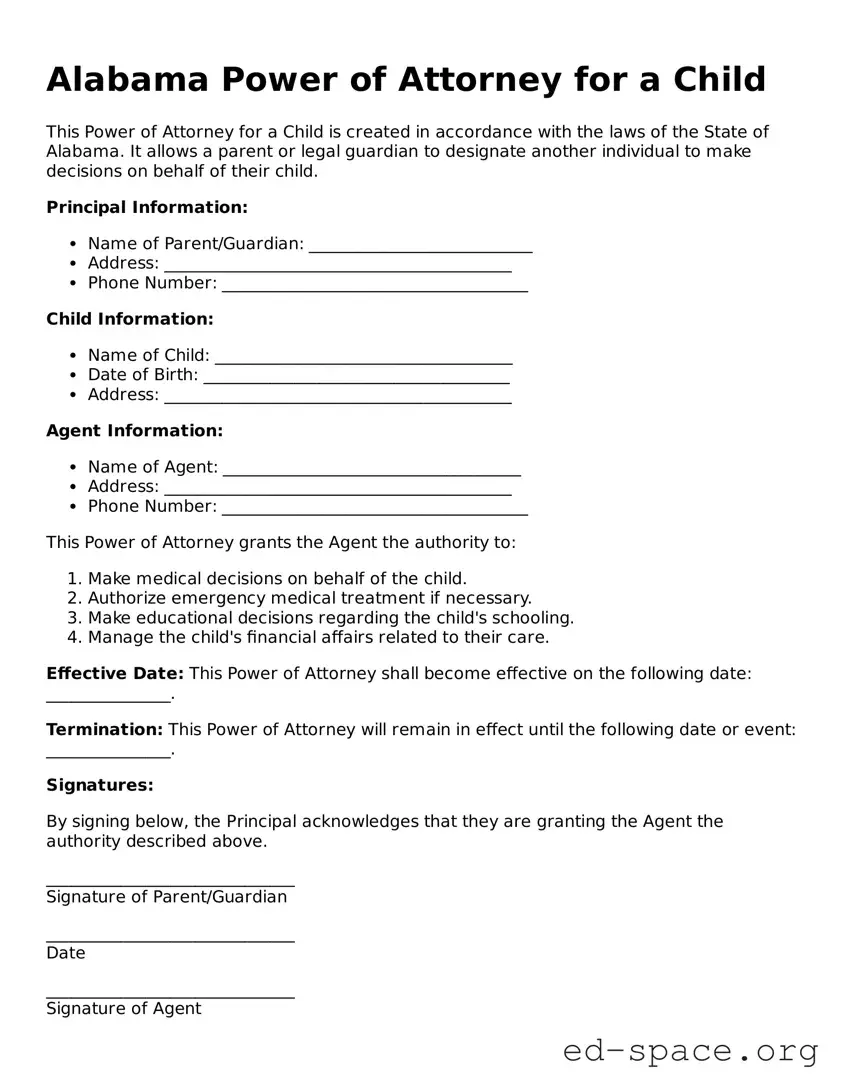
When it comes to ensuring the well-being of a child, having a Power of Attorney for a Child form in Alabama can be a crucial tool for parents and guardians. This form allows a designated individual to make important decisions on behalf of a child, covering areas such as education, healthcare, and general welfare. It is particularly useful in situations where parents may be temporarily unavailable, such as during travel or medical emergencies. By granting this authority, parents can ensure that their child’s needs are met without unnecessary delays. The form must be completed with specific information, including the names of the child and the designated agent, as well as the duration of the authority granted. Proper execution of this document involves notarization, which adds an extra layer of security and validity. Understanding the nuances of this form can help caregivers navigate the complexities of parental responsibilities with confidence.
Alabama Power of Attorney for a Child
This Power of Attorney for a Child is created in accordance with the laws of the State of Alabama. It allows a parent or legal guardian to designate another individual to make decisions on behalf of their child.
Principal Information:
Child Information:
Agent Information:
This Power of Attorney grants the Agent the authority to:
Effective Date: This Power of Attorney shall become effective on the following date: _______________.
Termination: This Power of Attorney will remain in effect until the following date or event: _______________.
Signatures:
By signing below, the Principal acknowledges that they are granting the Agent the authority described above.
______________________________
Signature of Parent/Guardian
______________________________
Date
______________________________
Signature of Agent
______________________________
Date
Witnesses:
______________________________
Signature of Witness 1
______________________________
Date
______________________________
Signature of Witness 2
______________________________
Date
This document should be kept in a safe place and copies should be provided to the Agent and any relevant parties.
| Fact Name | Details |
|---|---|
| Purpose | The Alabama Power of Attorney for a Child form allows a parent or guardian to grant temporary authority to another adult to make decisions for their child. |
| Duration | This power of attorney is typically valid for up to one year, but it can be revoked or extended as needed. |
| Governing Law | The form is governed by Alabama Code § 26-1A-1 et seq., which outlines the legal framework for powers of attorney involving minors. |
| Signatures Required | Both the parent or guardian and the adult receiving the authority must sign the form. Notarization is also recommended for validity. |
| Usage Scenarios | This form can be used for various situations, such as temporary guardianship during travel or medical emergencies. |
Filling out the Alabama Power of Attorney for a Child form requires careful attention to detail. This document allows a designated individual to make decisions on behalf of a child when the parent or legal guardian is unavailable. Follow these steps to ensure the form is completed correctly.
After completing the form, keep a copy for your records. The original should be given to the attorney-in-fact, who will use it as needed. Be sure to review the document periodically to ensure it remains up to date with any changes in circumstances.
What is the Alabama Power of Attorney for a Child form?
The Alabama Power of Attorney for a Child form is a legal document that allows a parent or legal guardian to grant another adult the authority to make decisions on behalf of their child. This can include decisions related to education, healthcare, and general welfare. The form is particularly useful when the parent or guardian is unavailable due to travel, work commitments, or other reasons.
Who can be designated as an agent in the Power of Attorney for a Child?
Any responsible adult can be designated as an agent in the Power of Attorney for a Child form. This could be a relative, family friend, or any trusted individual who is willing to take on the responsibilities outlined in the document. It is essential to choose someone who understands the child's needs and can act in their best interest.
Is the Power of Attorney for a Child form valid in all states?
While the Power of Attorney for a Child form is valid in Alabama, its acceptance may vary in other states. Each state has its own laws regarding powers of attorney, and it is advisable to check the specific regulations of the state where the child will be residing or traveling. This ensures that the document will be recognized and enforceable.
How long does the Power of Attorney for a Child last?
The duration of the Power of Attorney for a Child can be specified within the document. It can be set for a limited time or remain in effect until revoked by the parent or guardian. If no specific duration is indicated, it typically remains valid until the child reaches the age of majority, which is 19 years in Alabama.
What responsibilities does the agent have under this Power of Attorney?
The agent designated in the Power of Attorney for a Child has the authority to make decisions regarding the child's education, healthcare, and general welfare. This includes enrolling the child in school, making medical decisions, and overseeing day-to-day care. The agent must act in the best interest of the child and is expected to communicate regularly with the parent or guardian about significant decisions.
Do I need to have the Power of Attorney for a Child form notarized?
Yes, the Power of Attorney for a Child form must be notarized to be legally binding in Alabama. This step adds an extra layer of verification to the document, ensuring that the signatures are authentic and that the parties involved understand the implications of the agreement.
Can I revoke the Power of Attorney for a Child once it is established?
Yes, a parent or legal guardian can revoke the Power of Attorney for a Child at any time. To do so, it is advisable to provide written notice to the agent and any relevant parties, such as schools or healthcare providers, to ensure they are aware of the change. A formal revocation document can also be drafted to clarify the termination of the authority granted.
What should I consider before completing the Power of Attorney for a Child form?
Before completing the Power of Attorney for a Child form, consider the specific needs of your child and the qualities of the person you wish to designate as an agent. Evaluate the duration for which the authority is needed and ensure that the chosen agent is willing and capable of fulfilling the responsibilities. Additionally, discuss the arrangement with the agent to confirm their understanding and readiness to take on this role.
Failing to provide accurate information about the child. Parents or guardians should ensure that the child's full name, date of birth, and other identifying details are correctly filled out.
Not specifying the powers granted. The form should clearly outline what authority is being given to the agent. General statements can lead to confusion.
Omitting the duration of the power of attorney. It is essential to indicate how long the authority will last. Without a specified timeframe, the document may be deemed invalid.
Neglecting to sign and date the form. Both the parent or guardian and the agent must sign and date the document for it to be legally binding.
Forgetting to have the document notarized. In Alabama, notarization is often required for the power of attorney to be recognized. Skipping this step can render the form ineffective.
Using outdated forms. Always ensure that the most current version of the Alabama Power of Attorney for a Child form is being used. Laws and requirements can change.
Not discussing the arrangement with the child. It is important to communicate with the child about the power of attorney and what it means for them. This helps in ensuring that the child understands the situation.
When using the Alabama Power of Attorney for a Child form, there are several other documents that may be helpful to have on hand. These documents can provide additional support and clarity regarding the care and custody of a child. Here is a list of common forms and documents often used in conjunction with the Power of Attorney for a Child:
Having these documents prepared can help ensure a smooth transition of care and clarify the responsibilities of all parties involved. It is always advisable to consult with a legal professional to ensure that all necessary forms are completed correctly and in accordance with Alabama law.
The Power of Attorney for a Child form allows a designated individual to make decisions on behalf of a child. This document shares similarities with several other legal documents, each serving a unique purpose while facilitating decision-making and care for minors. Below are six documents that are comparable to the Power of Attorney for a Child form:
When filling out the Alabama Power of Attorney for a Child form, it's important to be careful and thorough. Here are some key do's and don'ts to keep in mind:
There are several misconceptions surrounding the Alabama Power of Attorney for a Child form. Understanding the facts can help clarify its purpose and use. Here are six common misconceptions:
This form can be used for various situations, not just emergencies. It allows parents to designate someone to make decisions regarding their child's care, education, and health when they are unavailable.
While biological parents typically have this authority, legal guardians or adoptive parents can also create a Power of Attorney for their children.
In reality, parents can revoke the Power of Attorney at any time as long as they provide proper notice to the appointed individual.
While notarization is recommended for added legal validity, it is not strictly required for the form to be effective in Alabama.
The Power of Attorney for a Child encompasses a wide range of decisions, including educational and financial matters, not just medical ones.
The authority granted by this form automatically ends when the child reaches the age of majority, which is 18 years old in Alabama.
Understanding these misconceptions can help ensure that parents and guardians make informed decisions regarding the care and management of their children's needs.
When considering the Alabama Power of Attorney for a Child form, it’s essential to understand its purpose and how to complete it correctly. Here are some key takeaways to keep in mind:
Understanding these key points will help ensure that you use the Alabama Power of Attorney for a Child form effectively and responsibly.