The Alabama Power of Attorney form serves as a crucial legal document that allows individuals to appoint someone else to make decisions on their behalf. This form can cover a wide range of responsibilities, from managing financial affairs to making healthcare decisions. It is important to understand that the authority granted can be broad or limited, depending on the specific needs of the individual. The person appointed, known as the agent or attorney-in-fact, can act in various capacities, including handling banking transactions, signing contracts, or even making medical decisions if the principal becomes incapacitated. In Alabama, the form must be signed in the presence of a notary public to ensure its validity. Additionally, the principal has the option to revoke the Power of Attorney at any time, provided they are still mentally competent. This flexibility allows individuals to maintain control over their affairs while ensuring that their wishes are honored even when they cannot speak for themselves.
Alabama Power of Attorney
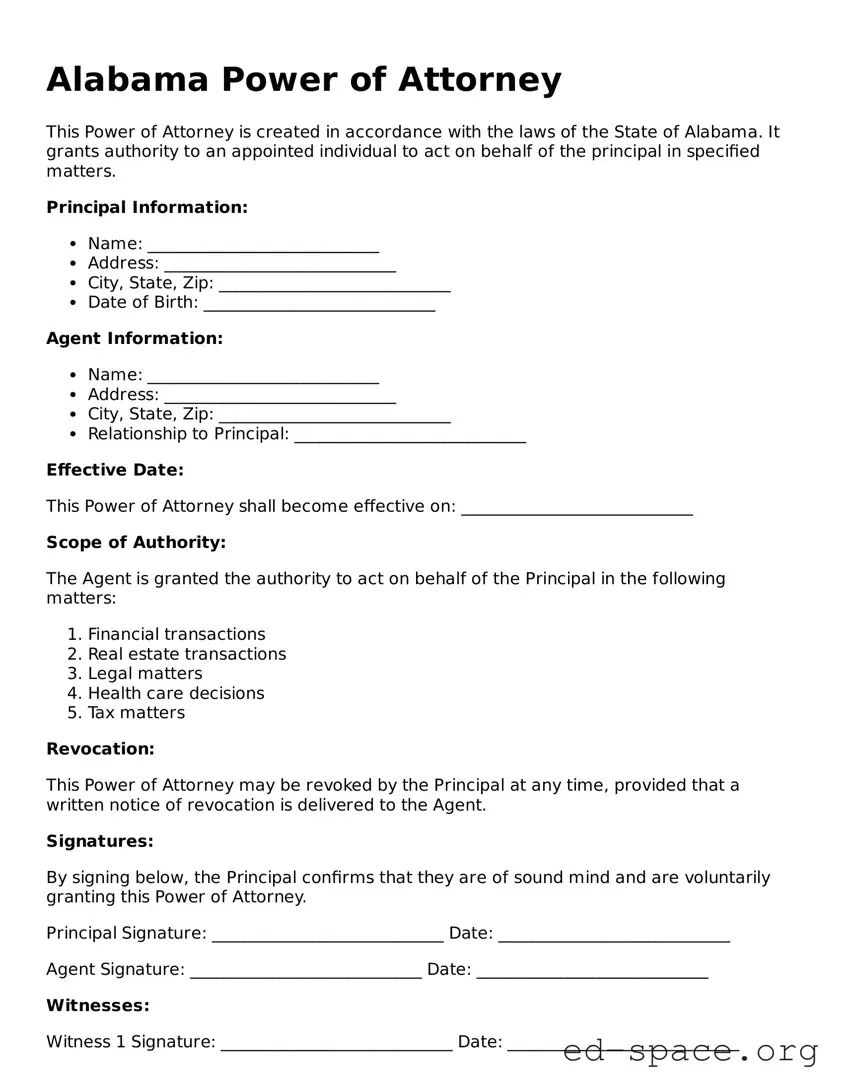
This Power of Attorney is created in accordance with the laws of the State of Alabama. It grants authority to an appointed individual to act on behalf of the principal in specified matters.
Principal Information:
Agent Information:
Effective Date:
This Power of Attorney shall become effective on: ____________________________
Scope of Authority:
The Agent is granted the authority to act on behalf of the Principal in the following matters:
Revocation:
This Power of Attorney may be revoked by the Principal at any time, provided that a written notice of revocation is delivered to the Agent.
Signatures:
By signing below, the Principal confirms that they are of sound mind and are voluntarily granting this Power of Attorney.
Principal Signature: ____________________________ Date: ____________________________
Agent Signature: ____________________________ Date: ____________________________
Witnesses:
Witness 1 Signature: ____________________________ Date: ____________________________
Witness 2 Signature: ____________________________ Date: ____________________________
This document must be signed in the presence of two witnesses or a notary public to be valid.
| Fact Name | Description |
|---|---|
| Definition | An Alabama Power of Attorney form allows an individual to appoint someone else to make decisions on their behalf. |
| Governing Law | The form is governed by the Alabama Uniform Power of Attorney Act, found in Alabama Code Title 26, Chapter 1A. |
| Types of Authority | It can grant broad or limited authority, depending on the needs of the principal. |
| Principal and Agent | The person granting authority is called the principal, while the person receiving it is the agent or attorney-in-fact. |
| Durability | A Power of Attorney can be durable, meaning it remains effective even if the principal becomes incapacitated. |
| Revocation | The principal can revoke the Power of Attorney at any time, as long as they are competent. |
| Signature Requirement | The principal must sign the document for it to be valid, and it may need to be notarized. |
| Agent's Responsibilities | The agent must act in the best interest of the principal and follow their wishes as outlined in the document. |
| Health Care Decisions | For health care decisions, a separate Health Care Power of Attorney form is recommended. |
| Filing | There is no requirement to file the Power of Attorney with a court, but it may be necessary to provide copies to relevant institutions. |
Filling out the Alabama Power of Attorney form requires careful attention to detail. Once completed, the form will allow you to designate someone to act on your behalf in legal and financial matters. Follow these steps to ensure the form is filled out correctly.
What is a Power of Attorney in Alabama?
A Power of Attorney (POA) in Alabama is a legal document that allows one person to authorize another person to act on their behalf in various matters. This can include financial transactions, healthcare decisions, and other legal actions. The person granting the authority is known as the principal, while the person receiving the authority is called the agent or attorney-in-fact.
What types of Power of Attorney are available in Alabama?
Alabama recognizes several types of Power of Attorney, including general, durable, and limited powers of attorney. A general POA grants broad powers to the agent, while a durable POA remains effective even if the principal becomes incapacitated. A limited POA restricts the agent's authority to specific tasks or situations.
How do I create a Power of Attorney in Alabama?
To create a Power of Attorney in Alabama, the principal must fill out a form that specifies the powers granted to the agent. The form must be signed by the principal and, in most cases, witnessed by two individuals or notarized. It is important to ensure that the document complies with Alabama state laws to be considered valid.
Can I revoke a Power of Attorney in Alabama?
Yes, a principal can revoke a Power of Attorney at any time as long as they are mentally competent. The revocation should be documented in writing, and it is advisable to notify the agent and any relevant institutions or parties that relied on the original POA.
What happens if the principal becomes incapacitated?
If the principal becomes incapacitated, a durable Power of Attorney remains effective, allowing the agent to continue making decisions on behalf of the principal. If the POA is not durable, it becomes void upon the principal's incapacity, and a court may need to appoint a guardian or conservator.
Are there any limitations on the powers granted in a Power of Attorney?
Yes, a principal can specify limitations in the Power of Attorney document. For instance, they may restrict the agent from making certain financial decisions or limit the scope of healthcare decisions. It is crucial to clearly outline any limitations to avoid confusion or misuse of authority.
Do I need a lawyer to create a Power of Attorney in Alabama?
While it is not legally required to have a lawyer to create a Power of Attorney in Alabama, consulting with one is advisable. A lawyer can help ensure that the document meets all legal requirements and accurately reflects the principal's wishes, minimizing potential disputes in the future.
Can an agent be held liable for their actions under a Power of Attorney?
An agent can be held liable if they act outside the authority granted in the Power of Attorney or if they engage in misconduct, such as self-dealing or failing to act in the principal's best interests. It is essential for agents to understand their responsibilities and act ethically while carrying out their duties.
How long does a Power of Attorney last in Alabama?
The duration of a Power of Attorney in Alabama depends on the type of POA created. A general or limited POA typically lasts until the principal revokes it, while a durable POA can remain in effect even after the principal becomes incapacitated. It is important to specify the duration in the document if needed.
Not Specifying the Powers Granted: One common mistake is failing to clearly outline the specific powers being granted. The form should detail whether the agent has authority over financial matters, healthcare decisions, or both. Ambiguity can lead to confusion or disputes.
Inadequate Identification of the Agent: It is crucial to provide complete and accurate information about the person designated as the agent. This includes their full name, address, and contact information. Without this, it may be difficult for institutions to recognize the agent's authority.
Not Including Successor Agents: Many individuals overlook the importance of naming a successor agent. If the primary agent is unable or unwilling to act, having a backup can ensure that your wishes are still honored. Failing to do so could leave your affairs in limbo.
Forgetting to Sign and Date: A Power of Attorney form is not valid unless it is signed and dated. Some people may neglect this step, thinking their intent is clear. Without a signature, the document holds no legal weight.
Neglecting Witness and Notary Requirements: In Alabama, certain Power of Attorney forms require witnesses and notarization. Skipping this step can invalidate the document. Ensuring compliance with these requirements is essential for the form to be legally recognized.
When considering the establishment of a Power of Attorney (POA) in Alabama, it is essential to understand that this document often works in conjunction with several other forms and documents. These additional documents can help clarify intentions, ensure proper management of assets, and provide guidance in various situations. Below is a list of commonly used forms alongside the Alabama Power of Attorney.
Understanding these associated documents can greatly enhance the effectiveness of a Power of Attorney. Each form serves a unique purpose and can provide clarity and direction during critical times. By preparing these documents, individuals can ensure their wishes are respected and that their affairs are managed according to their preferences.
The Power of Attorney (POA) form shares similarities with several other legal documents. Each serves a distinct purpose but often overlaps in function. Here’s a list of seven documents that are comparable to a Power of Attorney:
When filling out the Alabama Power of Attorney form, it’s essential to approach the task with care. Here’s a list of things you should and shouldn't do to ensure the document is completed correctly and serves its intended purpose.
By following these guidelines, you can help ensure that your Power of Attorney form is filled out correctly and meets your needs. Taking the time to be thorough will provide peace of mind for you and your loved ones.
Understanding the Alabama Power of Attorney form is essential for anyone considering its use. However, several misconceptions often arise regarding its purpose and functionality. Below is a list of common misconceptions:
This is not accurate. While many people associate Power of Attorney with financial decisions, it can also be used for healthcare decisions, legal matters, and other specific tasks as designated by the principal.
In reality, a Power of Attorney can be revoked at any time by the principal, as long as they are mentally competent. This flexibility allows individuals to change their designated agent if necessary.
This is misleading. Each state has its own laws and requirements regarding Power of Attorney forms. Alabama has specific rules that must be followed to ensure the document is valid.
This is incorrect. A Power of Attorney ceases to be effective upon the death of the principal. After this point, the estate will be managed according to the will or state intestacy laws.
While it is advisable to consult an attorney for guidance, individuals can create a Power of Attorney on their own using the appropriate forms, as long as they follow Alabama's legal requirements.
This is not true. The powers granted to the agent are defined in the Power of Attorney document. The principal can specify the extent of the agent's authority, which can be broad or limited.
Filling out and using the Alabama Power of Attorney form is an important step in designating someone to act on your behalf. Here are key takeaways to consider: