In the landscape of business formation, the Alabama Operating Agreement form plays a pivotal role for limited liability companies (LLCs) operating in the state. This essential document outlines the management structure, ownership percentages, and operational guidelines of the LLC, serving as a foundational blueprint for the business. It details the rights and responsibilities of members, ensuring clarity and minimizing disputes. Additionally, the agreement addresses important aspects such as profit distribution, decision-making processes, and procedures for adding or removing members. By establishing these parameters, the Operating Agreement not only protects the interests of all parties involved but also enhances the credibility of the business in the eyes of potential investors and partners. Understanding and properly drafting this form is crucial for anyone looking to create a successful LLC in Alabama, as it lays the groundwork for smooth operations and long-term sustainability.
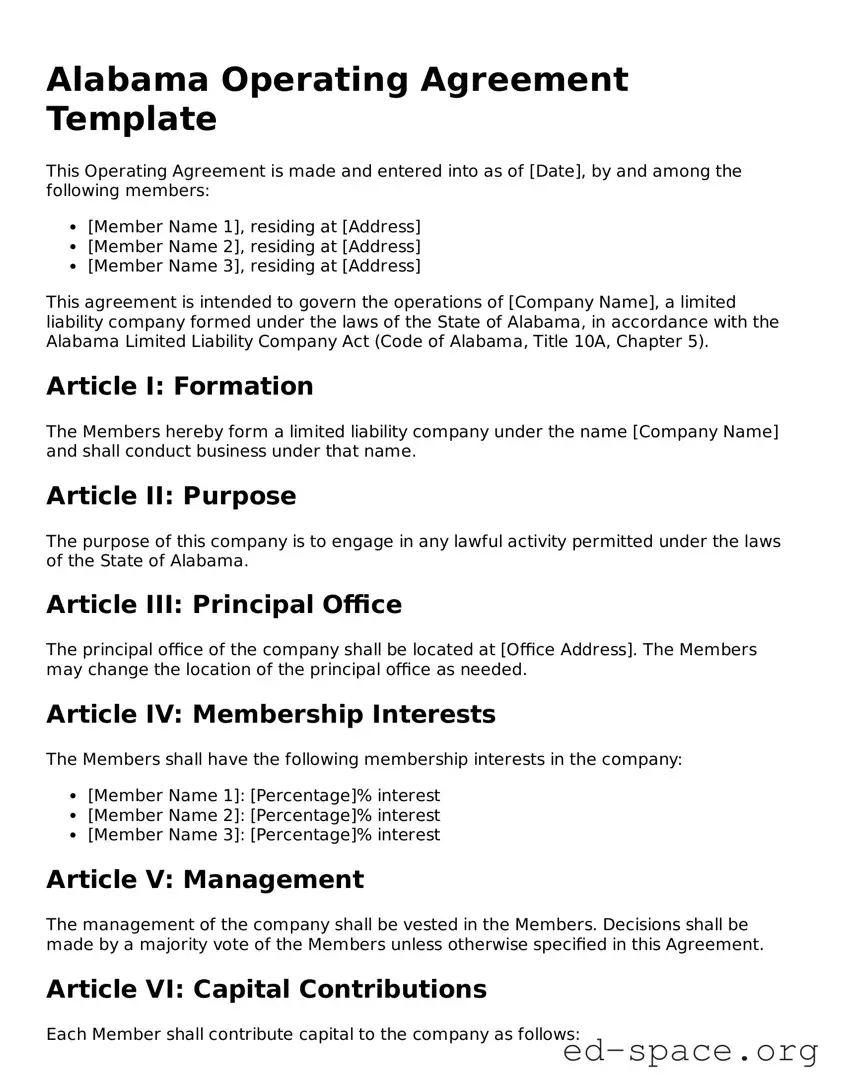
Alabama Operating Agreement Template
This Operating Agreement is made and entered into as of [Date], by and among the following members:
This agreement is intended to govern the operations of [Company Name], a limited liability company formed under the laws of the State of Alabama, in accordance with the Alabama Limited Liability Company Act (Code of Alabama, Title 10A, Chapter 5).
Article I: Formation
The Members hereby form a limited liability company under the name [Company Name] and shall conduct business under that name.
Article II: Purpose
The purpose of this company is to engage in any lawful activity permitted under the laws of the State of Alabama.
Article III: Principal Office
The principal office of the company shall be located at [Office Address]. The Members may change the location of the principal office as needed.
Article IV: Membership Interests
The Members shall have the following membership interests in the company:
Article V: Management
The management of the company shall be vested in the Members. Decisions shall be made by a majority vote of the Members unless otherwise specified in this Agreement.
Article VI: Capital Contributions
Each Member shall contribute capital to the company as follows:
Article VII: Distributions
Distributions of profits and losses shall be made to the Members in proportion to their respective membership interests, unless otherwise agreed upon.
Article VIII: Indemnification
The company shall indemnify each Member against any losses, expenses, or liabilities incurred in connection with the company, to the fullest extent permitted by Alabama law.
Article IX: Amendments
This Operating Agreement may be amended only by a written agreement signed by all Members.
Article X: Governing Law
This Agreement shall be governed by and construed in accordance with the laws of the State of Alabama.
IN WITNESS WHEREOF, the Members have executed this Operating Agreement as of the date first above written.
_____________________________ _____________________________
[Member Name 1] [Member Name 2]
_____________________________
[Member Name 3]
| Fact Name | Description |
|---|---|
| Purpose | The Alabama Operating Agreement outlines the management structure and operating procedures of a limited liability company (LLC) in Alabama. |
| Governing Law | This agreement is governed by the Alabama Limited Liability Company Act, specifically Title 10A, Chapter 5 of the Alabama Code. |
| Members' Rights | It details the rights and responsibilities of the members, including voting rights and profit distribution. |
| Management Structure | The agreement specifies whether the LLC will be member-managed or manager-managed, affecting how decisions are made. |
| Amendments | It includes provisions for how the Operating Agreement can be amended in the future, ensuring flexibility as the business evolves. |
| Duration | The document can outline the duration of the LLC, whether it is perpetual or for a specific term. |
| Indemnification | It may provide indemnification clauses to protect members and managers from certain liabilities incurred in the course of business. |
| Dispute Resolution | The agreement can include methods for resolving disputes among members, such as mediation or arbitration. |
Filling out the Alabama Operating Agreement form is an important step in establishing the guidelines for how your business will operate. This document outlines the roles, responsibilities, and ownership structure of your company. Once you complete this form, you'll have a clear framework for managing your business and making decisions.
What is an Alabama Operating Agreement?
An Alabama Operating Agreement is a legal document used by limited liability companies (LLCs) to outline the management structure and operational procedures of the business. This agreement serves as a blueprint for how the LLC will function, detailing the rights and responsibilities of its members. While not required by law in Alabama, having an Operating Agreement is highly recommended, as it helps prevent misunderstandings and disputes among members by clearly defining roles and expectations.
Why should I create an Operating Agreement for my LLC?
Creating an Operating Agreement is beneficial for several reasons. First, it provides a clear framework for how the LLC will operate, which can be especially important in avoiding conflicts. Second, it helps establish the limited liability status of the members, reinforcing the separation between personal and business assets. Additionally, having this document can enhance your credibility with banks and investors, as it demonstrates a level of professionalism and preparedness.
What should be included in the Alabama Operating Agreement?
An effective Operating Agreement should include several key components. Start with the basic information about the LLC, such as its name, principal address, and formation date. Next, outline the roles and responsibilities of each member, including how profits and losses will be distributed. It’s also important to specify how decisions will be made, how new members can be added, and the process for dissolving the LLC if necessary. Including provisions for dispute resolution can also be beneficial.
Is it necessary to file the Operating Agreement with the state?
No, you do not need to file your Operating Agreement with the state of Alabama. This document is kept internally among the members of the LLC. However, it is crucial to maintain a copy of the agreement and ensure that all members are familiar with its contents. Keeping this document updated is also important, especially if there are any changes in membership or operational procedures.
Can I modify my Operating Agreement after it has been created?
Yes, you can modify your Operating Agreement at any time. In fact, it is wise to review and update the agreement periodically to reflect any changes in the business or its members. To make modifications, all members should agree to the changes, and it’s best to document these amendments in writing. Keeping a record of the original agreement and any amendments will help maintain clarity and transparency among members.
Incomplete Information: One of the most common mistakes is failing to provide all required information. Each section of the form must be filled out completely. Leaving out details can lead to misunderstandings or disputes later on.
Incorrect Member Names: It's crucial to list the names of all members accurately. Misspellings or using nicknames can create confusion and may complicate legal matters down the line.
Failure to Specify Ownership Percentages: Members must clearly state their ownership percentages. Not doing so can result in disagreements over profit sharing and decision-making authority.
Ignoring the Voting Process: The Operating Agreement should outline how votes are conducted. Not including this information can lead to chaos when important decisions need to be made.
Neglecting to Include Dispute Resolution Methods: It's wise to have a plan for resolving conflicts. Failing to address this in the agreement can lead to prolonged disputes and costly legal battles.
Not Reviewing the Agreement Periodically: After the agreement is signed, it should not be forgotten. Regular reviews ensure that the document remains relevant and reflects any changes in the business or its members.
When forming a limited liability company (LLC) in Alabama, the Operating Agreement is a crucial document. However, there are several other forms and documents that are often used in conjunction with it. Each of these documents serves a specific purpose and helps ensure that your LLC is compliant with state laws and operates smoothly.
Understanding these documents and their purposes can help you navigate the process of forming and managing your LLC. Each plays a role in ensuring that your business is set up correctly and operates within the legal framework of Alabama.
The Operating Agreement is a crucial document for LLCs, but it shares similarities with several other legal documents. Here’s a list of six documents that are similar to the Operating Agreement and how they relate:
When filling out the Alabama Operating Agreement form, it’s important to approach the task carefully. Here are some essential do's and don'ts to consider:
When it comes to the Alabama Operating Agreement form, several misconceptions can lead to confusion. Here are six common misunderstandings:
Understanding these misconceptions can help business owners make informed decisions about their operating agreements and ensure smoother operations in their ventures.
When filling out and using the Alabama Operating Agreement form, it is essential to keep several key points in mind to ensure clarity and compliance. Here are five important takeaways:
Taking these steps will help ensure that your Alabama Operating Agreement is effective and serves the needs of your LLC.