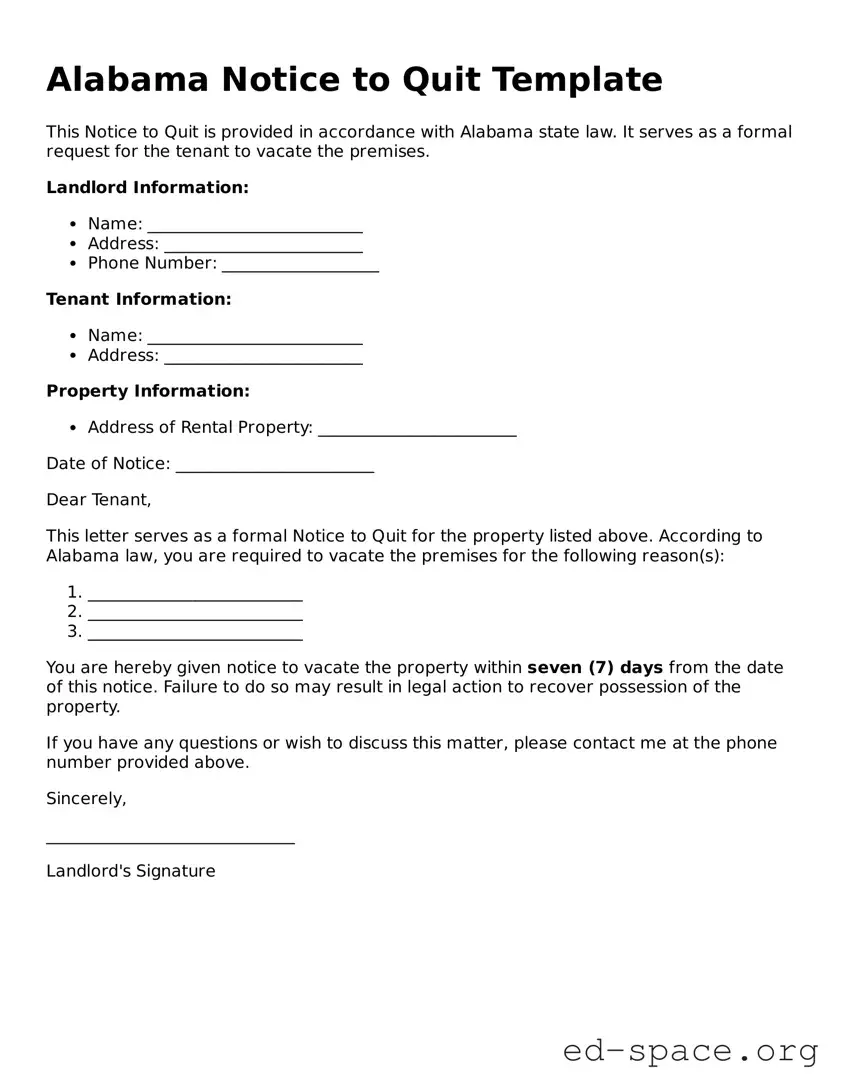
In Alabama, the Notice to Quit form serves as a crucial document in the landlord-tenant relationship, particularly when it comes to the process of eviction. This form is typically utilized by landlords to formally inform tenants that they must vacate the rental property, often due to non-payment of rent or violation of lease terms. The document outlines the specific reasons for the eviction and provides a timeline for the tenant to respond or leave the premises. It is important for landlords to ensure that the Notice to Quit is delivered properly and contains all necessary information, as failure to do so may lead to complications in the eviction process. Tenants, on the other hand, should understand their rights and the steps they can take in response to such a notice. By being informed about the Notice to Quit form, both parties can navigate this challenging situation more effectively, minimizing misunderstandings and potential legal disputes.
Alabama Notice to Quit Template
This Notice to Quit is provided in accordance with Alabama state law. It serves as a formal request for the tenant to vacate the premises.
Landlord Information:
Tenant Information:
Property Information:
Date of Notice: ________________________
Dear Tenant,
This letter serves as a formal Notice to Quit for the property listed above. According to Alabama law, you are required to vacate the premises for the following reason(s):
You are hereby given notice to vacate the property within seven (7) days from the date of this notice. Failure to do so may result in legal action to recover possession of the property.
If you have any questions or wish to discuss this matter, please contact me at the phone number provided above.
Sincerely,
______________________________
Landlord's Signature
| Fact Name | Details |
|---|---|
| Definition | The Alabama Notice to Quit form is a legal document used by landlords to notify tenants to vacate the rental property. |
| Governing Law | This form is governed by Alabama Code Title 35, Chapter 9. |
| Notice Period | Typically, a 7-day notice is required for non-payment of rent. |
| Delivery Method | The notice can be delivered in person, by mail, or posted on the property. |
| Contents Required | The notice must include the reason for eviction and the date by which the tenant must vacate. |
| Tenant Response | Tenants may respond to the notice or remedy the issue, such as paying overdue rent. |
| Legal Action | If the tenant does not comply, the landlord may file an eviction lawsuit. |
| Form Availability | The form can be obtained online or through legal stationery stores. |
| Importance | Using the Notice to Quit form properly is crucial for a lawful eviction process. |
After completing the Alabama Notice to Quit form, the next step involves delivering the notice to the tenant. This delivery must be done in a manner that ensures the tenant receives it, as this is crucial for the process to move forward. Follow the steps below to fill out the form accurately.
What is an Alabama Notice to Quit form?
The Alabama Notice to Quit form is a legal document used by landlords to notify tenants that they must vacate the rental property. This notice is typically issued when a tenant has violated the terms of their lease agreement or has failed to pay rent. The form serves as a formal communication, outlining the reasons for the eviction and providing a timeframe for the tenant to leave the premises.
How long does a tenant have to respond to a Notice to Quit in Alabama?
The timeframe for a tenant to respond to a Notice to Quit in Alabama can vary based on the reason for the eviction. Generally, if the notice is related to non-payment of rent, the tenant may have 7 days to either pay the overdue rent or vacate the property. For other lease violations, the tenant may have a longer period, often 14 days, to rectify the situation or leave. It is essential for tenants to carefully read the notice to understand the specific deadlines applicable to their case.
Can a landlord file for eviction without sending a Notice to Quit?
In Alabama, a landlord must issue a Notice to Quit before proceeding with an eviction. This notice acts as a prerequisite to filing an eviction lawsuit. Skipping this step can lead to delays in the legal process or dismissal of the eviction case. Therefore, landlords should ensure they follow the proper legal procedures to avoid complications.
What should be included in a Notice to Quit form?
A properly formatted Notice to Quit should include several key elements. First, it should clearly identify the parties involved, including the landlord's name and the tenant's name. The notice must specify the address of the rental property and detail the reason for the eviction. Additionally, the notice should state the timeframe the tenant has to vacate or correct the issue. Lastly, it is advisable to include the date the notice is served to establish a clear timeline.
What happens after a Notice to Quit is served?
Once a Notice to Quit is served, the tenant has the specified period to respond. If the tenant complies by vacating the property or resolving the issue, the matter is settled. However, if the tenant does not respond or refuses to leave, the landlord may proceed to file an eviction lawsuit in court. The court will then schedule a hearing to determine the outcome. It is important for both parties to understand their rights and responsibilities during this process.
Not including the correct tenant's name. Ensure you write the full name as it appears on the lease.
Failing to provide the correct address of the rental property. This should match the address on the lease agreement.
Not specifying the reason for the notice. Clearly state why you are issuing the Notice to Quit, such as non-payment of rent or lease violations.
Omitting the date of the notice. Include the date when you are delivering the notice to ensure clarity on timelines.
Not including the deadline for compliance. Specify how many days the tenant has to vacate the property.
Using unclear or ambiguous language. Make sure your message is straightforward to avoid confusion.
Failing to sign the notice. Your signature is essential to validate the document.
Not keeping a copy of the notice for your records. Always retain a copy to refer back to if needed.
Delivering the notice improperly. Ensure you follow the legal requirements for serving the notice, whether in person or by mail.
Ignoring local laws and regulations. Always check if there are specific rules in your area regarding Notices to Quit.
The Alabama Notice to Quit form is a crucial document in the eviction process, signaling to a tenant that they must vacate the rental property. This form is often used alongside other documents to ensure that all legal requirements are met during the eviction process. Below is a list of forms and documents that may be relevant when dealing with eviction situations in Alabama.
Understanding these documents can help landlords and tenants navigate the eviction process more effectively. Each form plays a specific role in ensuring that both parties are aware of their rights and responsibilities throughout the proceedings.
The Notice to Quit form is an important document in the context of landlord-tenant relationships. It serves as a formal notification that a tenant must vacate the rental property. Several other documents share similarities with the Notice to Quit form, primarily in their function of communicating important information regarding tenancy. Below is a list of ten documents that are similar to the Notice to Quit form, along with explanations of their similarities.
Each of these documents plays a crucial role in the management of rental agreements and tenant relationships. They help ensure clear communication and provide a framework for addressing issues that may arise during a tenancy.
When filling out the Alabama Notice to Quit form, it’s important to approach the task with care. This document serves as a formal notice to a tenant regarding their lease. Here are some key do's and don'ts to consider:
Understanding the Alabama Notice to Quit form is crucial for both landlords and tenants. However, several misconceptions can lead to confusion. Here are five common misunderstandings:
This is incorrect. A Notice to Quit is simply a formal request for a tenant to vacate the property. It does not mean that the eviction process has begun.
Ignoring the notice can have serious consequences. If the tenant does not respond or vacate, the landlord may proceed with eviction proceedings.
While personal service is one option, Alabama law allows for the notice to be sent via certified mail, making it more convenient for landlords.
Landlords must have a valid reason to issue a Notice to Quit, such as non-payment of rent or lease violations. It cannot be arbitrary.
In reality, it is just the first step. After serving the notice, landlords must follow specific legal procedures to complete the eviction process.
When dealing with the Alabama Notice to Quit form, it is essential to understand its purpose and proper usage. Here are five key takeaways to keep in mind: