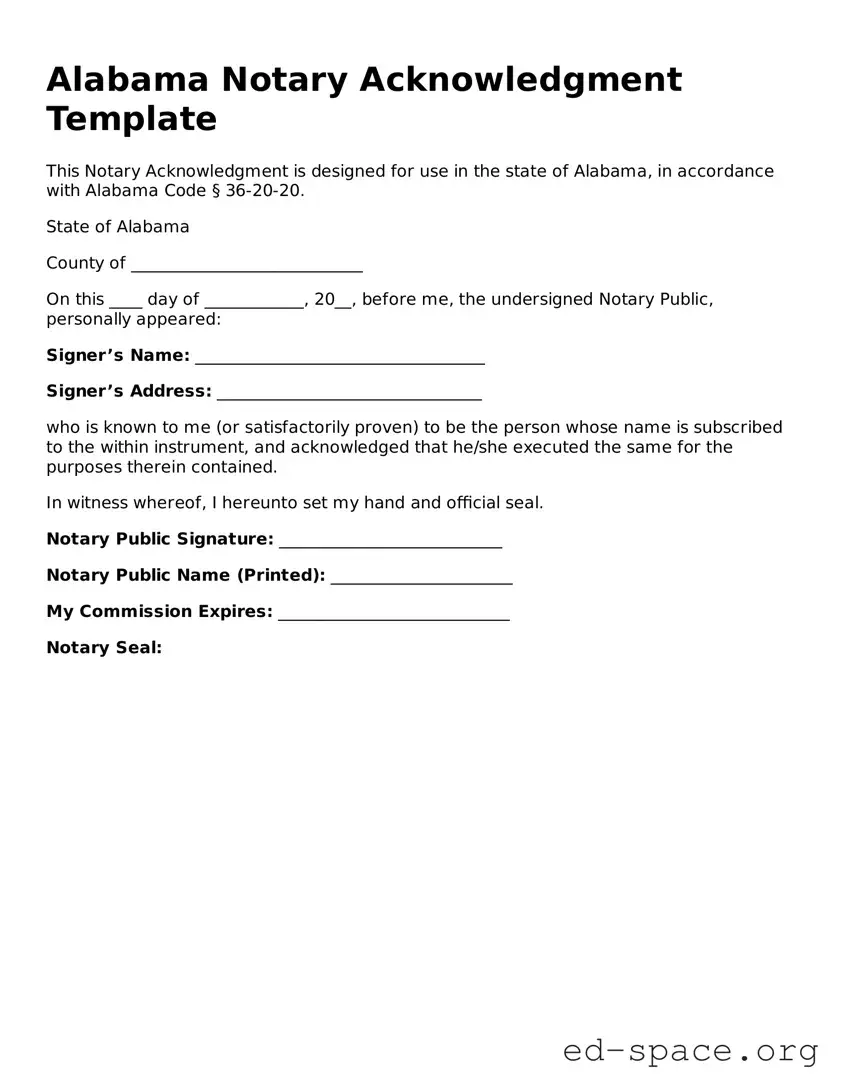
The Alabama Notary Acknowledgement form plays a crucial role in various legal and official processes across the state. This simple yet essential document serves to confirm that a person has willingly signed a specific document in the presence of a notary public. By providing a signature and seal, the notary verifies the identity of the signer, ensuring that the signing was done voluntarily and without any coercion. It's important to note that this form is often required for documents such as deeds, contracts, and affidavits, making it a key element in maintaining the integrity of legal transactions. Additionally, understanding how to properly fill out and use this form can save time and prevent issues down the line. Whether you are a notary, a signer, or someone involved in a legal process, knowing the ins and outs of the Alabama Notary Acknowledgement form is essential for smooth and efficient dealings.
Alabama Notary Acknowledgment Template
This Notary Acknowledgment is designed for use in the state of Alabama, in accordance with Alabama Code § 36-20-20.
State of Alabama
County of ____________________________
On this ____ day of ____________, 20__, before me, the undersigned Notary Public, personally appeared:
Signer’s Name: ___________________________________
Signer’s Address: ________________________________
who is known to me (or satisfactorily proven) to be the person whose name is subscribed to the within instrument, and acknowledged that he/she executed the same for the purposes therein contained.
In witness whereof, I hereunto set my hand and official seal.
Notary Public Signature: ___________________________
Notary Public Name (Printed): ______________________
My Commission Expires: ____________________________
Notary Seal:
| Fact Name | Details |
|---|---|
| Purpose | The Alabama Notary Acknowledgment form is used to verify the identity of a signer and confirm that they willingly signed a document. |
| Governing Law | This form is governed by the Alabama Code Title 36, Chapter 20, which outlines the powers and duties of notaries public in Alabama. |
| Signer's Presence | The signer must be present in front of the notary at the time of the acknowledgment to ensure authenticity. |
| Notary's Role | The notary public is responsible for completing the acknowledgment section, which includes their signature and seal. |
| Legal Importance | Using this form can help prevent fraud and ensure that documents are legally binding in Alabama. |
After obtaining the Alabama Notary Acknowledgement form, the next step involves accurately completing it to ensure that it meets legal requirements. This form is essential for verifying the identity of the signer and confirming that they willingly signed a document. Follow the steps below to fill out the form correctly.
What is an Alabama Notary Acknowledgement form?
The Alabama Notary Acknowledgement form is a legal document that verifies the identity of a signer and confirms that they willingly signed a document in the presence of a notary public. This form is essential for ensuring the authenticity of signatures on various legal documents, such as contracts, deeds, and affidavits.
Who can serve as a notary public in Alabama?
In Alabama, any resident who meets specific eligibility requirements can become a notary public. Applicants must be at least 18 years old, a U.S. citizen or legal resident, and must not have been convicted of a felony. Additionally, individuals must complete a notary training course and obtain a surety bond before being appointed.
What information is included in the Notary Acknowledgement form?
The Notary Acknowledgement form typically includes the name and address of the signer, a description of the document being signed, the date of the acknowledgment, and the notary’s signature and seal. This information helps to establish the legitimacy of the document and the identity of the signer.
Is the Notary Acknowledgement form required for all documents?
No, not all documents require a Notary Acknowledgement. However, it is often necessary for documents that need to be filed with government agencies or used in legal proceedings. Always check the specific requirements for the type of document you are working with.
How does one complete the Notary Acknowledgement form?
To complete the Notary Acknowledgement form, the signer must appear before the notary public and provide valid identification. The notary will then fill out the form, including details about the signer and the document, and will sign and seal it. It is important to ensure that all information is accurate before signing.
Can a notary public refuse to notarize a document?
Yes, a notary public can refuse to notarize a document if they have concerns about the identity of the signer, if the signer appears to be under duress, or if the document does not meet legal requirements. Notaries have a duty to act in accordance with the law and to protect the integrity of the notarization process.
How long is a Notary Acknowledgement valid in Alabama?
The Notary Acknowledgement itself does not have a specific expiration date. However, the underlying document may have its own validity period. It’s advisable to check the requirements related to the specific document to ensure it remains valid for its intended purpose.
Can I use an Alabama Notary Acknowledgement form in another state?
Generally, a Notary Acknowledgement form from Alabama may not be accepted in another state. Each state has its own notary laws and requirements. If you need a notarization in another state, it’s best to consult a notary public in that state to ensure compliance with local laws.
Where can I obtain an Alabama Notary Acknowledgement form?
Alabama Notary Acknowledgement forms can often be obtained from various sources, including legal stationery stores, online legal document providers, or directly from a notary public. It’s important to ensure that the form you obtain complies with Alabama’s legal requirements.
What should I do if I have more questions about the Notary Acknowledgement process?
If you have further questions about the Notary Acknowledgement process, consider reaching out to a local notary public or legal professional. They can provide guidance tailored to your specific situation and help clarify any uncertainties you may have.
Failing to include the date of the acknowledgment. This is a critical component, as it indicates when the notarial act was performed.
Not providing the signer's name clearly. It is essential that the name matches the identification presented to the notary.
Omitting the type of document being acknowledged. This helps clarify the purpose of the notarization and ensures proper record-keeping.
Using an incorrect notary seal. Each state has specific requirements regarding notary seals, and using one that does not meet these standards can invalidate the acknowledgment.
Neglecting to sign the form in the appropriate section. The notary must sign where indicated, as this confirms their role in the acknowledgment process.
Forgetting to include the notary's commission expiration date. This date is vital for ensuring that the notary's authority is still valid at the time of the acknowledgment.
Providing an incomplete address for the notary. The form should include the notary's complete address to ensure transparency and accountability.
Not having the signer present during the acknowledgment. The signer must be physically present to verify their identity and willingness to sign the document.
When working with the Alabama Notary Acknowledgement form, several other documents are commonly used to ensure proper legal procedures are followed. Each of these documents serves a specific purpose in the notarization process. Below is a list of these documents, along with brief descriptions of each.
Each of these documents plays a crucial role in various legal processes. Familiarity with them can help ensure that all necessary paperwork is in order when notarization is required.
When filling out the Alabama Notary Acknowledgment form, it is important to follow specific guidelines to ensure accuracy and compliance. Here are five things you should and shouldn't do:
Misconceptions about the Alabama Notary Acknowledgement form can lead to confusion. Here are four common misunderstandings:
Many people believe that notaries can create or alter legal documents. In reality, notaries serve as impartial witnesses to the signing of documents but do not provide legal advice or draft documents.
Some individuals think every document needs to be notarized. However, notarization is only necessary for specific documents, such as deeds and powers of attorney, where verification of identity is crucial.
It is a common belief that notaries can notarize documents for anyone, regardless of their relationship. In truth, notaries must not have a personal interest in the transaction to ensure impartiality.
Some assume that a notary's signature alone guarantees a document's validity. While notarization adds a layer of authenticity, it does not validate the content of the document itself.
When filling out and using the Alabama Notary Acknowledgement form, there are several important points to keep in mind. Below are key takeaways that will help ensure the process is smooth and compliant.
By keeping these takeaways in mind, individuals can navigate the process of using the Alabama Notary Acknowledgement form more effectively.