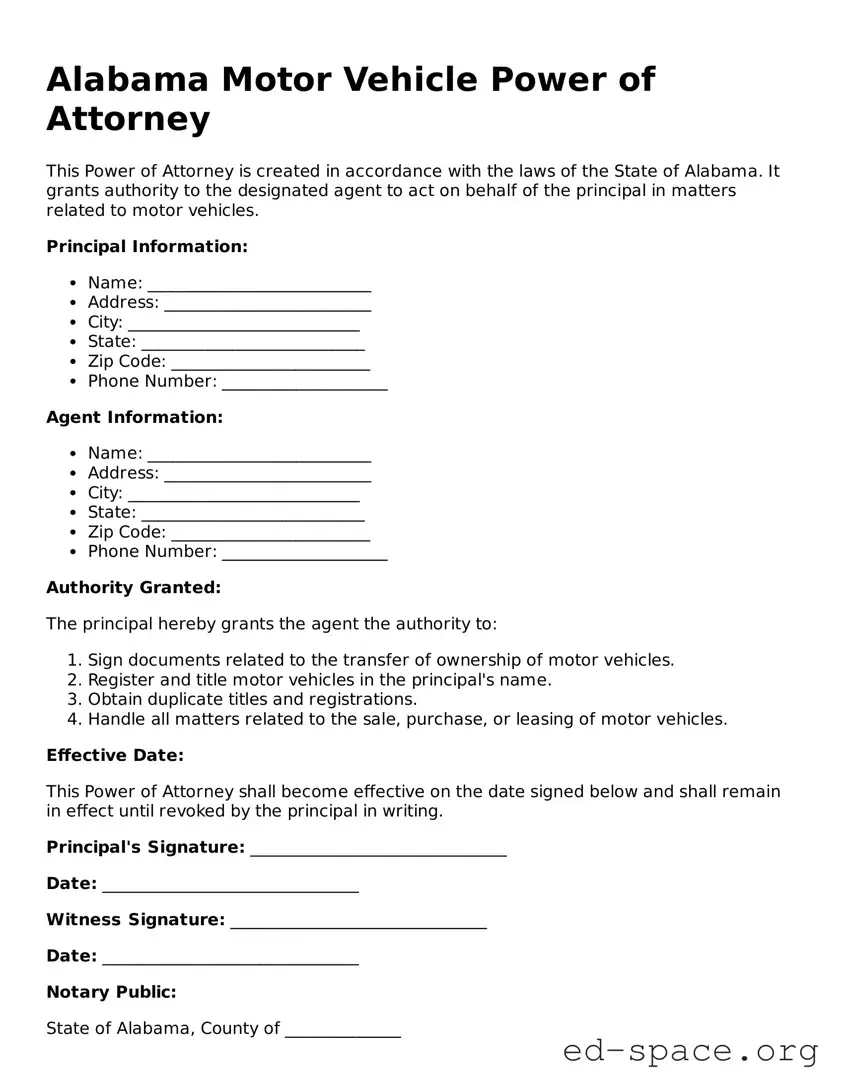
The Alabama Motor Vehicle Power of Attorney form serves as a crucial document for individuals who wish to delegate authority regarding their motor vehicle transactions. This form allows a designated agent to act on behalf of the vehicle owner in various matters, including the sale, transfer, or registration of a vehicle. By completing this form, the vehicle owner can ensure that their chosen representative has the legal authority to handle specific tasks, which may include signing documents, submitting applications, or interacting with the Department of Revenue. It is important to note that the form must be filled out accurately and signed by the vehicle owner to be valid. Additionally, the agent's responsibilities are clearly outlined, providing a framework for the extent of their authority. Understanding the requirements and implications of this form can facilitate smoother transactions and help avoid potential legal complications.
Alabama Motor Vehicle Power of Attorney
This Power of Attorney is created in accordance with the laws of the State of Alabama. It grants authority to the designated agent to act on behalf of the principal in matters related to motor vehicles.
Principal Information:
Agent Information:
Authority Granted:
The principal hereby grants the agent the authority to:
Effective Date:
This Power of Attorney shall become effective on the date signed below and shall remain in effect until revoked by the principal in writing.
Principal's Signature: _______________________________
Date: _______________________________
Witness Signature: _______________________________
Date: _______________________________
Notary Public:
State of Alabama, County of ______________
Subscribed and sworn to before me this _____ day of __________, 20__.
Notary Public Signature: _______________________________
My Commission Expires: _______________________________
| Fact Name | Details |
|---|---|
| Purpose | The Alabama Motor Vehicle Power of Attorney form allows an individual to appoint someone else to handle motor vehicle transactions on their behalf. |
| Governing Law | This form is governed by the Alabama Code Title 32, Chapter 8. |
| Signatures Required | The form must be signed by the principal (the person granting authority) and may require notarization. |
| Revocation | The power of attorney can be revoked at any time by the principal, provided they notify the agent and any relevant parties. |
| Agent Responsibilities | The appointed agent can perform tasks such as signing titles, registering vehicles, and handling related paperwork. |
| Duration | The authority granted lasts until the specified tasks are completed or until revoked by the principal. |
| Usage Scenarios | This form is commonly used when the principal cannot be present for vehicle transactions, such as during a sale or transfer. |
Filling out the Alabama Motor Vehicle Power of Attorney form is a straightforward process that allows you to designate someone to act on your behalf regarding vehicle-related matters. Once you complete the form, you can submit it to the appropriate authorities to ensure your designated agent can carry out the necessary tasks effectively.
What is a Motor Vehicle Power of Attorney in Alabama?
A Motor Vehicle Power of Attorney (POA) in Alabama is a legal document that allows one person, known as the "principal," to authorize another person, called the "agent," to act on their behalf regarding matters related to motor vehicles. This can include tasks like signing documents for the sale or transfer of a vehicle, applying for title transfers, or handling registration issues. Essentially, it grants the agent the authority to make decisions and take actions related to the principal's vehicle as if they were the principal themselves.
Who can be designated as an agent in the Motor Vehicle Power of Attorney?
In Alabama, the agent can be any competent adult. This can be a family member, friend, or even a professional, such as an attorney or a car dealership representative. It's important to choose someone you trust, as this person will have significant authority over your vehicle-related matters. The agent must be willing to accept this responsibility and act in your best interest.
How do I complete the Motor Vehicle Power of Attorney form?
To complete the Motor Vehicle Power of Attorney form, you will need to fill in specific information, including your name, the name of the agent, and details about the vehicle, such as the make, model, and VIN (Vehicle Identification Number). After completing the form, both you and the agent must sign it. It’s advisable to have the signatures notarized to enhance the document's validity, especially if it will be used in official transactions.
Is the Motor Vehicle Power of Attorney revocable?
Yes, the Motor Vehicle Power of Attorney can be revoked at any time by the principal. If you decide to revoke the POA, you should do so in writing and notify the agent and any relevant parties, such as the Department of Motor Vehicles (DMV) or any institutions that may have been relying on the document. This ensures that the agent no longer has authority to act on your behalf.
Do I need to file the Motor Vehicle Power of Attorney with the state?
No, you do not need to file the Motor Vehicle Power of Attorney with the state of Alabama. However, it is essential to keep a copy of the document for your records and provide a copy to the agent. If the agent needs to use the POA for vehicle transactions, having the document readily available will help facilitate the process.
Incomplete Information: One common mistake is not filling out all required fields. Missing information can lead to delays or rejection of the form. Ensure that all sections are completed, including names, addresses, and vehicle details.
Incorrect Signatures: Signatures must match the names on the form. Sometimes, individuals may forget to sign or may use a different name. Always double-check that the signature aligns with the printed name.
Failure to Notarize: In Alabama, certain documents require notarization. Neglecting to have the form notarized can invalidate it. Confirm whether notarization is necessary for your specific situation.
Not Understanding the Authority Granted: It’s essential to clearly understand what powers are being granted. Some people may unintentionally give too much authority or not enough. Review the options carefully to ensure they align with your intentions.
When dealing with vehicle transactions in Alabama, several forms and documents may accompany the Alabama Motor Vehicle Power of Attorney. Each document serves a specific purpose in facilitating the transfer or management of vehicle ownership and related matters.
Using the appropriate forms and documents ensures a smooth transaction process when dealing with vehicle matters in Alabama. Each document plays a vital role in protecting the interests of all parties involved.
When filling out the Alabama Motor Vehicle Power of Attorney form, it's important to approach the task with care. Here are five things you should and shouldn't do:
By following these guidelines, you can help ensure that your Power of Attorney form is completed correctly and efficiently.
The Alabama Motor Vehicle Power of Attorney form is a crucial document for anyone needing to delegate authority for vehicle-related transactions. However, several misconceptions can lead to confusion. Here are nine common misunderstandings:
Many believe that only legal professionals can draft this document. In reality, individuals can create a Power of Attorney as long as they understand the requirements and implications.
While this form is specifically designed for vehicle matters, a Power of Attorney can be used for various purposes, such as managing finances or making medical decisions, depending on how it is structured.
This is not true. A Power of Attorney can be revoked at any time by the principal, as long as they are mentally competent to do so.
While notarization can enhance the document's credibility, it is not always required. Check local regulations to determine the specific requirements for validity.
Not all powers are granted by default. The principal must specify the exact powers they wish to delegate, ensuring clarity in the authority given.
This misconception arises from the belief that all Powers of Attorney are temporary. However, a Power of Attorney can remain in effect until revoked or until the principal passes away, unless otherwise stated.
It is possible to designate multiple agents. However, it’s important to clearly outline their roles and responsibilities to avoid confusion.
While many choose to appoint family members, anyone can serve as an agent, as long as they are trustworthy and capable of handling the responsibilities involved.
This form is beneficial for anyone who may need assistance with vehicle transactions, regardless of age. It can help streamline processes during times of need.
Understanding these misconceptions can help individuals effectively utilize the Alabama Motor Vehicle Power of Attorney form, ensuring that their needs are met without unnecessary complications.
Filling out and utilizing the Alabama Motor Vehicle Power of Attorney form can seem daunting, but understanding the key aspects can simplify the process. Here are some important takeaways to keep in mind: