Homepage Free Medical Power of Attorney Form for Alabama
Article Guide

The Alabama Medical Power of Attorney form serves as a vital legal document that empowers individuals to designate a trusted person to make healthcare decisions on their behalf in the event they become incapacitated. This form is essential for ensuring that a person's medical preferences are honored when they are unable to communicate their wishes. It allows individuals to appoint an agent who can make decisions regarding medical treatment, access medical records, and communicate with healthcare providers. The form typically requires the signature of the principal, the person granting authority, as well as witnesses to validate the document. Additionally, it is important for the designated agent to understand the principal's values and preferences to make informed decisions that align with their wishes. By completing this form, individuals can gain peace of mind knowing that their healthcare choices will be respected, even if they are unable to voice them directly.

Document Preview

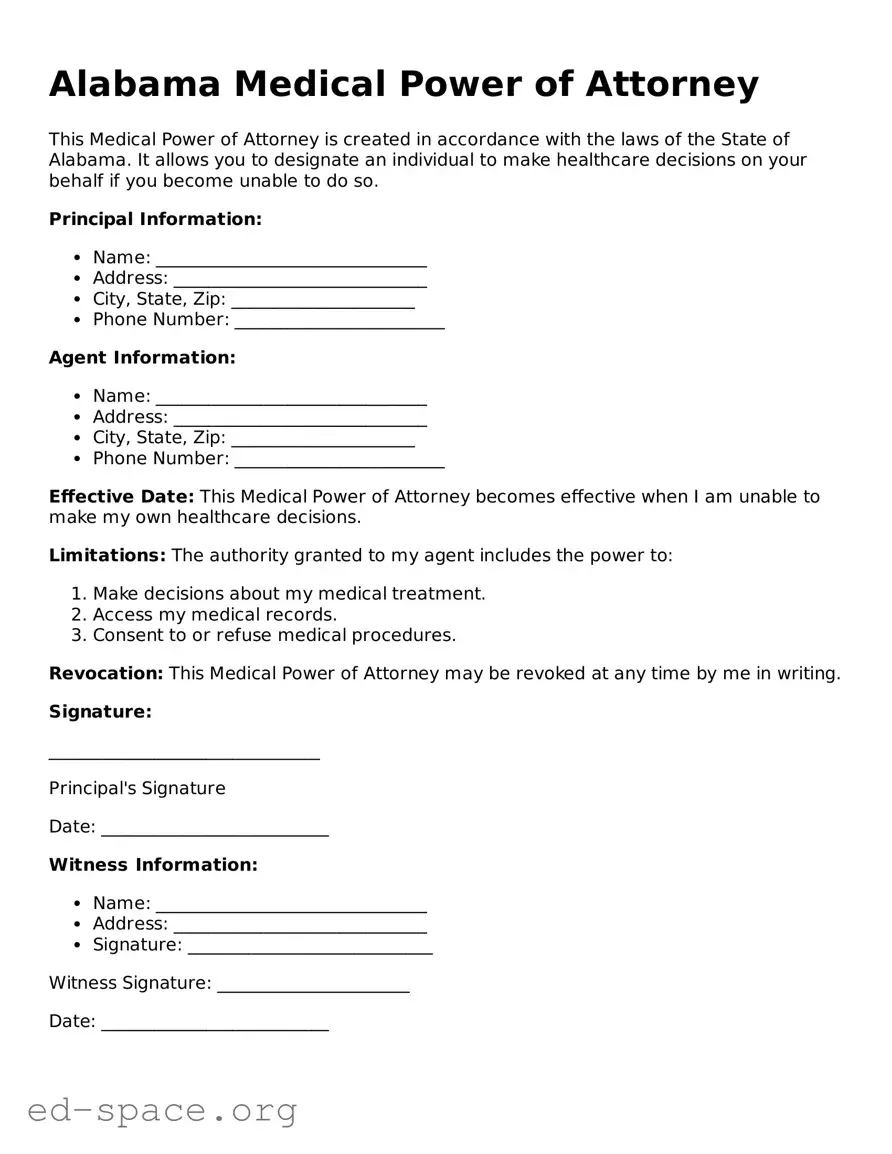
Alabama Medical Power of Attorney

This Medical Power of Attorney is created in accordance with the laws of the State of Alabama. It allows you to designate an individual to make healthcare decisions on your behalf if you become unable to do so.

Principal Information:

  • Name: _______________________________
  • Address: _____________________________
  • City, State, Zip: _____________________
  • Phone Number: ________________________

Agent Information:

  • Name: _______________________________
  • Address: _____________________________
  • City, State, Zip: _____________________
  • Phone Number: ________________________

Effective Date: This Medical Power of Attorney becomes effective when I am unable to make my own healthcare decisions.

Limitations: The authority granted to my agent includes the power to:

  1. Make decisions about my medical treatment.
  2. Access my medical records.
  3. Consent to or refuse medical procedures.

Revocation: This Medical Power of Attorney may be revoked at any time by me in writing.

Signature:

_______________________________

Principal's Signature

Date: __________________________

Witness Information:

  • Name: _______________________________
  • Address: _____________________________
  • Signature: ____________________________

Witness Signature: ______________________

Date: __________________________

PDF Form Details

Fact Name Details
Purpose The Alabama Medical Power of Attorney form allows individuals to designate someone to make healthcare decisions on their behalf if they become unable to do so.
Governing Law This form is governed by the Alabama Code, specifically Title 22, Chapter 8, which outlines laws regarding health care decisions and powers of attorney.
Eligibility Any adult who is of sound mind can create a Medical Power of Attorney in Alabama.
Signature Requirement The form must be signed by the principal (the person granting the power) and should be witnessed by two individuals or notarized.
Revocation The principal can revoke the Medical Power of Attorney at any time, as long as they are still competent to make decisions.
Effective Date The power granted by this form becomes effective when the principal is declared incapacitated by a physician.

Alabama Medical Power of Attorney: Usage Guidelines

Completing the Alabama Medical Power of Attorney form is a straightforward process that enables you to designate someone to make healthcare decisions on your behalf if you become unable to do so. Following the steps below will ensure that the form is filled out correctly and meets the necessary requirements.

  1. Obtain the Alabama Medical Power of Attorney form. You can find it online or request a physical copy from a legal professional.
  2. Begin by filling in your full name and address at the top of the form. This identifies you as the principal.
  3. Designate your chosen agent by providing their full name, address, and relationship to you. This person will act on your behalf.
  4. Clearly outline any specific powers you wish to grant to your agent. This could include decisions about medical treatment, procedures, or end-of-life care.
  5. Include any limitations or instructions regarding your healthcare preferences, if applicable.
  6. Sign and date the form at the designated area. This signature confirms your intent and agreement to the document.
  7. Have the form witnessed by two individuals who are not related to you and who will not benefit from your estate. Their signatures will validate the document.
  8. Consider having the form notarized for added legal assurance, although it is not required in Alabama.
  9. Make copies of the completed form for your records and distribute copies to your agent and any healthcare providers involved in your care.

Your Questions, Answered

What is a Medical Power of Attorney in Alabama?

A Medical Power of Attorney in Alabama is a legal document that allows you to appoint someone you trust to make healthcare decisions on your behalf if you become unable to do so. This person, often referred to as your agent or proxy, can make choices about your medical treatment, access your medical records, and communicate with healthcare providers. It ensures that your wishes regarding medical care are respected even when you cannot voice them yourself.

Why is it important to have a Medical Power of Attorney?

Having a Medical Power of Attorney is crucial because it provides clarity and direction for your healthcare decisions. In the event of a medical emergency or serious illness, your appointed agent can act quickly, ensuring that your preferences are honored. Without this document, family members may face confusion or conflict over your care, leading to delays in treatment or decisions that may not align with your values.

Who can be appointed as my agent for a Medical Power of Attorney?

You can appoint any competent adult as your agent for a Medical Power of Attorney in Alabama. This can be a family member, friend, or trusted advisor. However, it's important to choose someone who understands your healthcare preferences and is willing to advocate for your wishes. Additionally, your agent should be someone who can handle the emotional and practical challenges that may arise in medical situations.

How do I create a Medical Power of Attorney in Alabama?

To create a Medical Power of Attorney in Alabama, you must complete a specific form that complies with state laws. This form should clearly outline your choices and designate your agent. While you can find templates online, it’s wise to consult with a legal professional to ensure that the document meets all requirements. After filling out the form, you must sign it in the presence of a notary public or two witnesses who are not related to you or named in the document.

Can I revoke my Medical Power of Attorney?

Yes, you can revoke your Medical Power of Attorney at any time as long as you are mentally competent. To do this, you should create a written notice of revocation and inform your agent and any healthcare providers who may have a copy of the original document. It's also a good idea to destroy any copies of the original Medical Power of Attorney to prevent confusion.

Is a Medical Power of Attorney the same as a Living Will?

No, a Medical Power of Attorney and a Living Will serve different purposes. A Medical Power of Attorney appoints someone to make healthcare decisions for you, while a Living Will outlines your wishes regarding specific medical treatments, particularly at the end of life. Both documents are important for comprehensive healthcare planning, and many individuals choose to have both in place to ensure their wishes are fully respected.

Common mistakes

  1. Not Choosing the Right Agent: Individuals often select someone who is not suited for the role. The agent should be someone trustworthy, capable of making healthcare decisions, and willing to advocate for the principal's wishes.

  2. Failing to Specify Preferences: Some people neglect to clearly outline their medical preferences. It's important to provide detailed instructions regarding treatment options, end-of-life care, and other healthcare decisions.

  3. Inadequate Witness Signatures: The form requires the signatures of two witnesses. Failing to have the correct number of witnesses or choosing individuals who do not meet the legal requirements can invalidate the document.

  4. Not Updating the Document: Life circumstances change. Failing to review and update the Medical Power of Attorney when significant life events occur—such as marriage, divorce, or the death of an agent—can lead to complications.

  5. Ignoring State-Specific Requirements: Each state has its own laws regarding Medical Power of Attorney forms. Some individuals overlook specific Alabama requirements, which may affect the validity of the document.

  6. Assuming the Document is Permanent: Many believe that once the form is completed, it cannot be changed. In reality, individuals can revoke or amend their Medical Power of Attorney at any time, as long as they are mentally competent.

Documents used along the form

When preparing a Medical Power of Attorney in Alabama, it is often helpful to consider additional documents that can complement your healthcare planning. These forms can ensure that your medical preferences are honored and that your loved ones are equipped to make decisions on your behalf if necessary. Below is a list of commonly used forms that work well alongside the Medical Power of Attorney.

  • Advance Healthcare Directive: This document outlines your wishes regarding medical treatment in situations where you may not be able to communicate your preferences. It often includes instructions about life-sustaining treatments and organ donation.
  • Living Will: A living will specifies the types of medical treatment you would or would not want at the end of your life. It serves as a guide for your healthcare providers and loved ones during critical moments.
  • Durable Power of Attorney for Finances: This form allows you to designate someone to manage your financial affairs if you become incapacitated. It ensures that your financial obligations are met while you are unable to handle them yourself.
  • HIPAA Release Form: This document grants permission for healthcare providers to share your medical information with designated individuals. It is essential for ensuring that your loved ones can access your medical records when needed.
  • Do Not Resuscitate (DNR) Order: A DNR order instructs medical personnel not to perform cardiopulmonary resuscitation (CPR) if your heart stops beating. This document is crucial for those who wish to avoid aggressive life-saving measures.
  • Healthcare Proxy: Similar to a Medical Power of Attorney, this document allows you to appoint someone to make healthcare decisions on your behalf if you are unable to do so. It may be used in conjunction with other healthcare directives.
  • Organ Donation Registration: This form allows you to express your wishes regarding organ donation after your death. By registering your preferences, you can help ensure that your wishes are respected.

Having these documents in place can provide peace of mind, knowing that your healthcare and financial preferences are clearly communicated. It is wise to review these forms periodically and discuss them with your loved ones to ensure everyone understands your wishes. This proactive approach can help alleviate stress during difficult times.

Similar forms

  • Durable Power of Attorney: This document allows someone to make financial decisions on your behalf if you become incapacitated. Like the Medical Power of Attorney, it grants authority to act when you cannot.
  • Living Will: A Living Will outlines your preferences for medical treatment in situations where you cannot communicate. It complements the Medical Power of Attorney by providing guidance on your wishes.
  • Healthcare Proxy: Similar to a Medical Power of Attorney, a Healthcare Proxy designates someone to make healthcare decisions for you. This document focuses specifically on health-related matters.
  • Advance Healthcare Directive: This document combines elements of a Living Will and a Medical Power of Attorney. It provides instructions for medical care and appoints someone to make decisions on your behalf.
  • Do Not Resuscitate (DNR) Order: A DNR order specifies that you do not want resuscitation if your heart stops. It works alongside a Medical Power of Attorney by clarifying your end-of-life preferences.
  • Patient Advocate Designation: This document allows you to appoint someone to advocate for your medical needs. It shares similarities with a Medical Power of Attorney in terms of representation in healthcare settings.
  • Organ Donation Authorization: This document expresses your wishes regarding organ donation. It can work with a Medical Power of Attorney to ensure your healthcare agent knows your preferences.
  • Financial Power of Attorney: While focused on financial matters, this document allows someone to manage your financial affairs. It is similar in that it grants authority to act on your behalf when you are unable.
  • End-of-Life Care Plan: This plan outlines your wishes for care at the end of life. It can be used in conjunction with a Medical Power of Attorney to ensure your healthcare agent understands your desires.
  • Informed Consent Form: This document is used to ensure that you understand and agree to medical procedures. While not a decision-making tool, it relates to the authority granted in a Medical Power of Attorney.

Dos and Don'ts

When filling out the Alabama Medical Power of Attorney form, it’s important to be careful and thorough. Here are some do's and don'ts to keep in mind:

  • Do clearly identify the person you are appointing as your agent.
  • Do ensure that the form is signed in the presence of a notary public.
  • Do discuss your wishes and preferences with your agent ahead of time.
  • Do keep a copy of the completed form for your records.
  • Don't leave any sections of the form blank; fill out all required information.
  • Don't appoint someone who may have conflicting interests in your medical decisions.
  • Don't forget to review and update the document as your wishes or circumstances change.

Misconceptions

When it comes to the Alabama Medical Power of Attorney form, there are several misconceptions that can lead to confusion. Here’s a list to clarify some common misunderstandings:

  1. It only applies to end-of-life decisions. Many people believe that a Medical Power of Attorney is only relevant when a person is near death. In reality, it can be used for any medical decisions when someone is unable to communicate their wishes.
  2. It must be notarized to be valid. While notarization can add an extra layer of authenticity, Alabama law does not require the Medical Power of Attorney to be notarized. It must be signed by the principal and two witnesses.
  3. Family members automatically have the authority to make medical decisions. This is not always true. Without a Medical Power of Attorney, family members may face legal hurdles when trying to make decisions on behalf of a loved one.
  4. Once created, it cannot be changed. This is a common misconception. A Medical Power of Attorney can be revoked or modified at any time, as long as the principal is mentally competent.
  5. It is the same as a living will. While both documents deal with medical decisions, a Medical Power of Attorney specifically designates someone to make decisions, whereas a living will outlines the individual’s wishes regarding medical treatment.
  6. It only applies to medical decisions. This form primarily addresses medical decisions, but it can also cover related matters, such as the release of medical records and information.
  7. Anyone can be a designated agent. In Alabama, the designated agent must be at least 19 years old and capable of making decisions on behalf of the principal.
  8. It is only necessary for older adults. People of all ages can benefit from having a Medical Power of Attorney. Accidents and unexpected illnesses can happen to anyone.
  9. Once signed, it is in effect indefinitely. The Medical Power of Attorney remains effective until the principal revokes it, becomes competent again, or passes away.
  10. It is a one-size-fits-all document. Each Medical Power of Attorney can be tailored to fit the specific wishes and needs of the individual, making it a personal and customizable document.

Understanding these misconceptions can help individuals make informed decisions about their medical care and the care of their loved ones.

Key takeaways

Filling out and using the Alabama Medical Power of Attorney form is an important step in ensuring your healthcare wishes are respected. Here are some key takeaways to keep in mind:

  • Choose a trusted agent: Select someone who understands your values and will advocate for your healthcare preferences.
  • Be clear about your wishes: Clearly outline your medical treatment preferences to guide your agent in making decisions on your behalf.
  • Complete the form correctly: Ensure all sections of the form are filled out accurately to avoid any potential issues in the future.
  • Sign and date the document: Your signature is crucial. Make sure to date the form, as this indicates when your wishes were established.
  • Review periodically: Regularly revisit your Medical Power of Attorney to ensure it still reflects your current wishes and circumstances.

Taking these steps seriously can provide peace of mind, knowing that your healthcare decisions will be in trusted hands when needed.