When it comes to making decisions about your healthcare in Alabama, a Living Will is an essential tool that allows you to express your wishes regarding medical treatment in the event that you become unable to communicate those wishes yourself. This legal document empowers individuals to outline their preferences for end-of-life care, ensuring that their values and desires are respected during critical moments. The Alabama Living Will form typically covers key aspects such as the types of medical interventions you would want or refuse, including life-sustaining treatments, resuscitation efforts, and palliative care options. By clearly stating your intentions, you can relieve your loved ones from the burden of making difficult decisions on your behalf. Additionally, this form may include provisions for appointing a healthcare proxy, someone you trust to advocate for your medical choices if you cannot do so yourself. Understanding the nuances of the Alabama Living Will form is vital for anyone looking to take control of their healthcare decisions and ensure that their personal beliefs are honored in times of need.
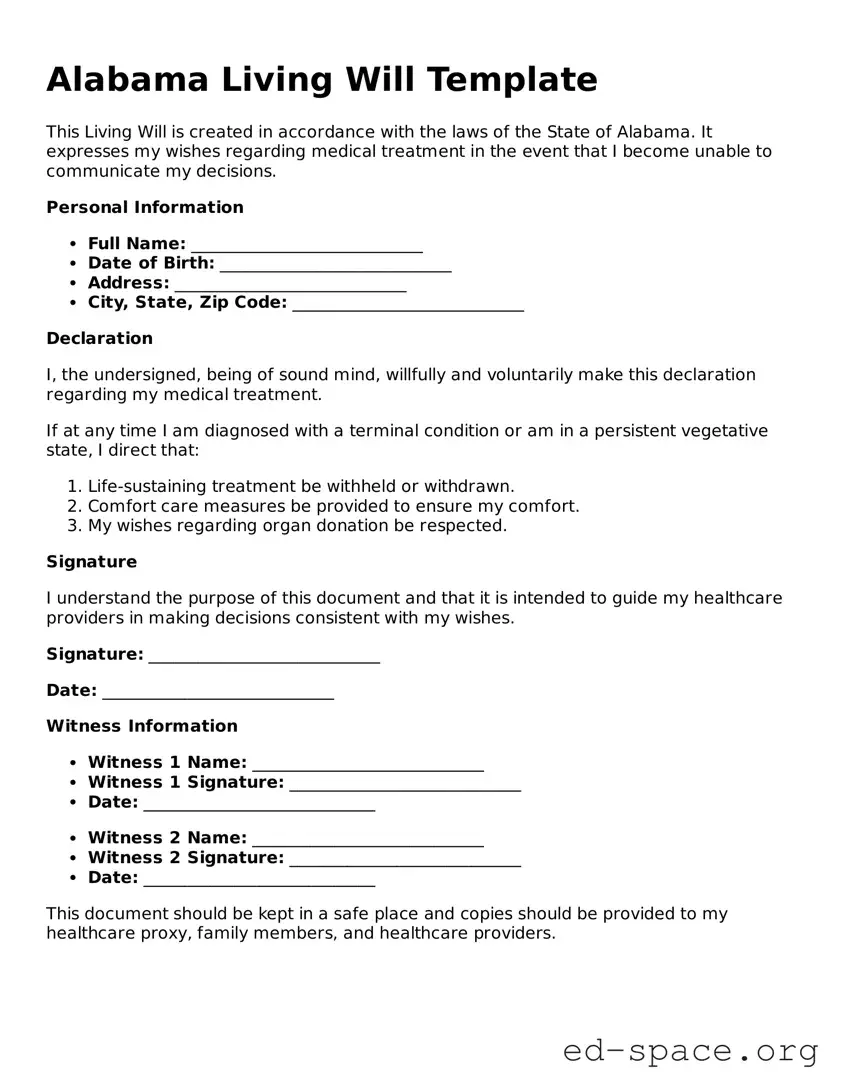
Alabama Living Will Template
This Living Will is created in accordance with the laws of the State of Alabama. It expresses my wishes regarding medical treatment in the event that I become unable to communicate my decisions.
Personal Information
Declaration
I, the undersigned, being of sound mind, willfully and voluntarily make this declaration regarding my medical treatment.
If at any time I am diagnosed with a terminal condition or am in a persistent vegetative state, I direct that:
Signature
I understand the purpose of this document and that it is intended to guide my healthcare providers in making decisions consistent with my wishes.
Signature: ____________________________
Date: ____________________________
Witness Information
This document should be kept in a safe place and copies should be provided to my healthcare proxy, family members, and healthcare providers.
| Fact Name | Details |
|---|---|
| Definition | A Living Will is a legal document that outlines a person's preferences for medical treatment in case they become unable to communicate their wishes. |
| Governing Law | The Alabama Living Will is governed by the Alabama Code, specifically Title 22, Chapter 8, Article 6. |
| Requirements | To be valid, a Living Will must be signed by the individual and witnessed by two adults who are not related to the individual or beneficiaries of their estate. |
| Revocation | A Living Will can be revoked at any time by the individual, either verbally or in writing, as long as they are of sound mind. |
| Use in Healthcare | Healthcare providers are required to honor the directives specified in a Living Will, ensuring that the patient's wishes are respected. |
Filling out the Alabama Living Will form is an important step in ensuring your healthcare wishes are respected. Once you have completed the form, it should be signed and witnessed according to state requirements to ensure its validity.
What is a Living Will in Alabama?
A Living Will is a legal document that outlines your wishes regarding medical treatment in case you become unable to communicate your preferences. It specifically addresses situations where you may be facing a terminal illness or a persistent vegetative state, allowing you to express your desire for or against life-sustaining treatments.
Who can create a Living Will in Alabama?
Any competent adult who is at least 19 years old can create a Living Will in Alabama. It is important that you understand the implications of your decisions when drafting this document.
How do I create a Living Will in Alabama?
To create a Living Will, you must complete the Alabama Living Will form. This form can be obtained online or through legal offices. After filling it out, you must sign it in the presence of two witnesses or a notary public to ensure its validity.
What should I include in my Living Will?
Your Living Will should clearly state your wishes regarding medical treatments, including whether you wish to receive or refuse life-sustaining measures. You may also include preferences regarding pain relief and organ donation. Being specific helps ensure that your wishes are honored.
Can I change or revoke my Living Will?
Yes, you have the right to change or revoke your Living Will at any time, as long as you are mentally competent. To revoke it, you can destroy the document or create a new one that explicitly states your new wishes.
Do I need a lawyer to create a Living Will?
No, you do not need a lawyer to create a Living Will in Alabama. However, consulting with a legal professional can provide guidance and ensure that your document meets all legal requirements.
What happens if I do not have a Living Will?
If you do not have a Living Will and become unable to communicate your wishes, your family or healthcare providers may have to make decisions on your behalf. This can lead to disagreements or decisions that may not align with your personal values.
Is my Living Will valid in other states?
While many states recognize Living Wills, each state has its own laws. If you move or travel to another state, it is advisable to check that state’s requirements to ensure your Living Will remains valid.
What if my wishes change over time?
It is natural for your wishes to evolve. You can update your Living Will whenever necessary. Just ensure that the new document is properly signed and witnessed to replace the previous one.
How can I ensure my Living Will is honored?
To ensure that your Living Will is honored, share copies with your healthcare providers, family members, and anyone involved in your care. Discuss your wishes openly with them, so everyone understands your preferences.
Not clearly stating their wishes. A living will should explicitly outline the medical treatments one does or does not want. Ambiguities can lead to confusion and conflict.
Failing to sign and date the document. Without a signature and date, the living will may not be considered valid, leaving one's healthcare decisions unaddressed.
Not having witnesses. In Alabama, the presence of two witnesses is required for the living will to be legally binding. Failing to include witnesses can render the document ineffective.
Using outdated forms. Laws and requirements can change. It is essential to use the most current version of the living will form to ensure compliance with Alabama law.
Overlooking the importance of discussing wishes with family. Communication about healthcare preferences with loved ones can prevent misunderstandings and disputes later on.
Neglecting to review and update the document regularly. Life circumstances change. Regular reviews ensure that the living will accurately reflects current wishes and preferences.
Not considering alternative medical treatments. It's important to think about various scenarios and specify preferences for treatments that may arise in the future.
Assuming that a living will is the same as a durable power of attorney. While both documents are important, they serve different purposes and should be completed separately.
When preparing a Living Will in Alabama, several other documents may be beneficial to ensure your healthcare wishes are clearly communicated. Each of these documents serves a distinct purpose and can provide additional clarity regarding your preferences.
Considering these documents alongside your Living Will can provide comprehensive guidance for your healthcare decisions. It is essential to discuss your choices with your loved ones and healthcare providers to ensure everyone understands your wishes.
A Living Will is an important document that outlines your preferences for medical treatment in the event that you become unable to communicate your wishes. It is similar to several other legal documents that also address health care decisions and end-of-life care. Here are six documents that share similarities with a Living Will:
Understanding these documents can help you make informed decisions about your health care preferences and ensure that your wishes are respected when you are unable to communicate them yourself.
When filling out the Alabama Living Will form, it is essential to follow specific guidelines to ensure that your wishes are clearly expressed and legally recognized. Below is a list of things you should and shouldn't do during this process.
Many people have misunderstandings about the Alabama Living Will form. Here are six common misconceptions:
This is not true. Anyone over the age of 19 can create a Living Will. It’s a good idea for adults of all ages to have one in place, as unexpected medical situations can arise at any time.
These are two different documents. A Living Will outlines your wishes for medical treatment if you become unable to communicate. A Last Will and Testament deals with the distribution of your assets after death.
This is a misconception. You can update or revoke your Living Will at any time, as long as you are mentally competent to do so. It’s important to review your wishes periodically.
While it is often associated with end-of-life care, a Living Will can address other medical situations where you may be unable to make decisions, such as severe illness or injury.
Health care providers are required to consider your Living Will, but they also need to follow state laws and hospital policies. It’s essential to discuss your wishes with your medical team.
A Power of Attorney allows someone to make decisions on your behalf, but it does not specify your wishes for medical treatment. A Living Will provides clear guidance about your preferences.
Filling out and using the Alabama Living Will form is an important step in ensuring that your healthcare wishes are respected. Here are some key takeaways to keep in mind:
Being proactive about your healthcare decisions can provide peace of mind for you and your loved ones.