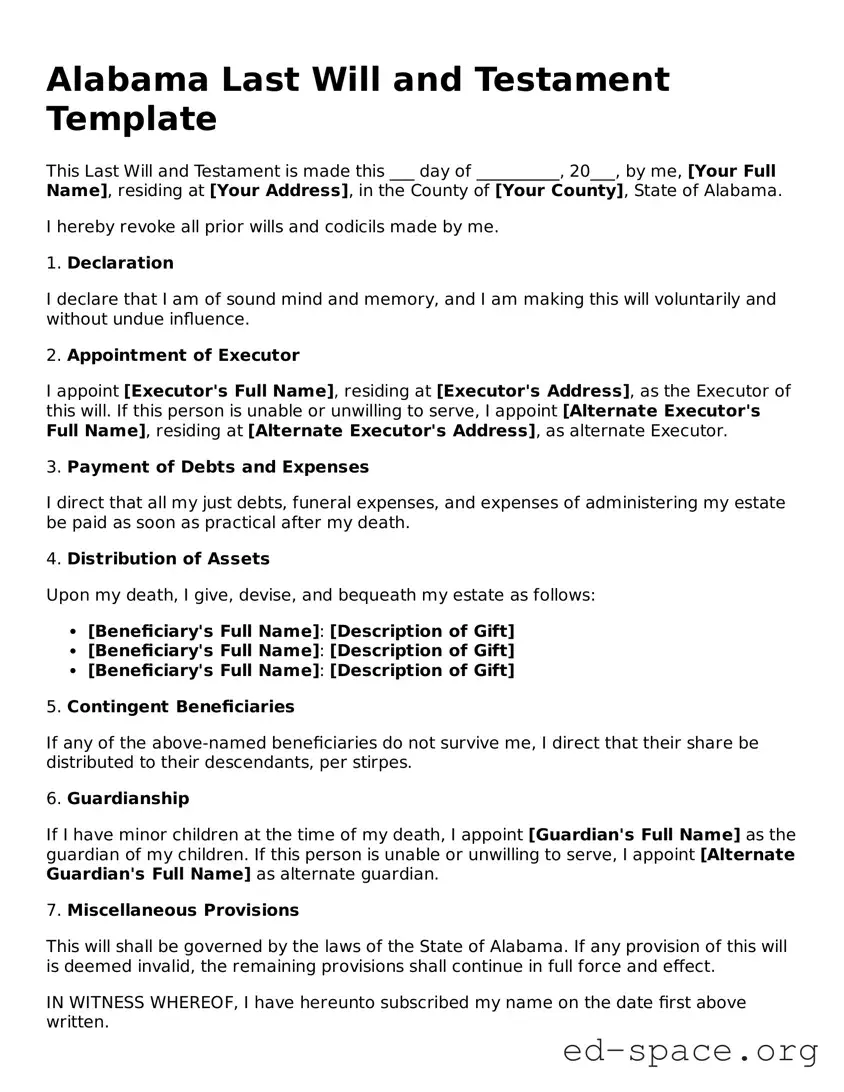
Creating a Last Will and Testament is a crucial step in ensuring that your wishes are honored after your passing. In Alabama, this legal document allows you to specify how your assets should be distributed, appoint guardians for minor children, and designate an executor to manage your estate. The form is straightforward and includes essential components such as the testator's information, a declaration of intent, and specific bequests. Additionally, it requires signatures from witnesses to validate the document, ensuring it meets state requirements. Understanding the key elements of the Alabama Last Will and Testament form can help you navigate the process of estate planning with confidence, ensuring that your loved ones are taken care of according to your wishes.
Alabama Last Will and Testament Template
This Last Will and Testament is made this ___ day of __________, 20___, by me, [Your Full Name], residing at [Your Address], in the County of [Your County], State of Alabama.
I hereby revoke all prior wills and codicils made by me.
1. Declaration
I declare that I am of sound mind and memory, and I am making this will voluntarily and without undue influence.
2. Appointment of Executor
I appoint [Executor's Full Name], residing at [Executor's Address], as the Executor of this will. If this person is unable or unwilling to serve, I appoint [Alternate Executor's Full Name], residing at [Alternate Executor's Address], as alternate Executor.
3. Payment of Debts and Expenses
I direct that all my just debts, funeral expenses, and expenses of administering my estate be paid as soon as practical after my death.
4. Distribution of Assets
Upon my death, I give, devise, and bequeath my estate as follows:
5. Contingent Beneficiaries
If any of the above-named beneficiaries do not survive me, I direct that their share be distributed to their descendants, per stirpes.
6. Guardianship
If I have minor children at the time of my death, I appoint [Guardian's Full Name] as the guardian of my children. If this person is unable or unwilling to serve, I appoint [Alternate Guardian's Full Name] as alternate guardian.
7. Miscellaneous Provisions
This will shall be governed by the laws of the State of Alabama. If any provision of this will is deemed invalid, the remaining provisions shall continue in full force and effect.
IN WITNESS WHEREOF, I have hereunto subscribed my name on the date first above written.
_____________________________
[Your Full Name], Testator
We, the undersigned witnesses, hereby declare that the above-named Testator signed this Last Will and Testament in our presence and that we, at the Testator's request, in their presence, and in the presence of each other, have subscribed our names as witnesses.
Witness 1:
_____________________________
[Witness 1 Full Name], residing at [Witness 1 Address]
Witness 2:
_____________________________
[Witness 2 Full Name], residing at [Witness 2 Address]
| Fact Name | Description |
|---|---|
| Legal Age Requirement | In Alabama, individuals must be at least 18 years old to create a valid will. |
| Written Document | A will must be in writing. This can be handwritten or typed. |
| Witness Requirement | At least two witnesses must sign the will for it to be valid. |
| Governing Laws | The laws governing wills in Alabama are found in the Alabama Code, Title 43, Chapter 8. |
| Revocation of Previous Wills | A new will automatically revokes any previous wills unless stated otherwise. |
| Self-Proving Wills | Alabama allows for self-proving wills, which can simplify the probate process. |
| Distribution of Property | The will can specify how property and assets are to be distributed among heirs. |
| Executor Appointment | The testator can appoint an executor to manage the estate and carry out the will's instructions. |
After gathering the necessary information, you’re ready to fill out the Alabama Last Will and Testament form. This document will help ensure your wishes are carried out regarding your estate and any dependents. Follow these steps carefully to complete the form accurately.
Once the form is completed, keep it in a safe place and inform your executor and loved ones where to find it. Regularly review and update your will as necessary to reflect any changes in your circumstances or wishes.
What is a Last Will and Testament in Alabama?
A Last Will and Testament is a legal document that outlines how a person's assets and affairs should be handled after their death. In Alabama, this document allows individuals to specify who will receive their property, name guardians for minor children, and appoint an executor to manage their estate. It ensures that a person's wishes are respected and followed, providing peace of mind for both the individual and their loved ones.
Who can create a Last Will and Testament in Alabama?
In Alabama, any person who is at least 18 years old and of sound mind can create a Last Will and Testament. This means the individual must understand the nature of the document and its implications. There are no special qualifications required, making it accessible for most adults. It is important that the will reflects the individual's true intentions and desires.
What are the requirements for a valid Last Will and Testament in Alabama?
For a Last Will and Testament to be valid in Alabama, it must be in writing and signed by the person creating the will, known as the testator. Additionally, it should be witnessed by at least two individuals who are present at the same time. These witnesses must also sign the document, affirming that they observed the testator sign the will. It is advisable to follow these requirements carefully to avoid any disputes later on.
Can I change my Last Will and Testament after it is created?
Yes, you can change your Last Will and Testament at any time while you are alive and of sound mind. This is done through a process called making a codicil, which is an amendment to the existing will, or by creating a new will that revokes the previous one. It is important to ensure that any changes are properly documented and witnessed to maintain their validity.
What happens if I die without a Last Will and Testament in Alabama?
If you die without a Last Will and Testament, your estate will be distributed according to Alabama's intestacy laws. This means that the state will determine how your assets are divided, which may not align with your wishes. Generally, your property will go to your closest relatives, such as a spouse, children, or parents. To avoid this situation, it is wise to create a will that clearly states your preferences.
How can I ensure my Last Will and Testament is properly executed?
To ensure your Last Will and Testament is properly executed, consider consulting with a legal professional who specializes in estate planning. They can guide you through the process and help you meet all legal requirements. Additionally, keep the original will in a safe place and inform your executor and loved ones where it can be found. Regularly reviewing and updating your will as your circumstances change will also help ensure that it remains valid and reflects your current wishes.
Not clearly identifying the testator. The will should clearly state the full name and address of the person creating the will. This helps avoid confusion about who the will belongs to.
Failing to properly sign the document. In Alabama, the testator must sign the will in the presence of at least two witnesses. If this step is overlooked, the will may not be valid.
Neglecting to date the will. A date provides a clear timeline and can help resolve disputes about which version of the will is the most current.
Omitting witness signatures. Witnesses must also sign the will. If they do not, the will could be challenged in court, leading to complications in executing the testator's wishes.
Using ambiguous language. Clear and specific language is essential to avoid misunderstandings. Vague terms can lead to disputes among heirs.
Not updating the will after major life changes. Events such as marriage, divorce, or the birth of a child should prompt a review and possible update of the will to reflect new circumstances.
When creating an estate plan in Alabama, a Last Will and Testament is a crucial document. However, it often works best in conjunction with other forms and documents that help clarify your wishes and streamline the probate process. Here are four important documents to consider alongside your will.
Considering these additional documents can enhance your estate planning. They provide a comprehensive approach to ensuring your wishes are respected and your loved ones are taken care of. Take the time to explore these options to create a well-rounded estate plan.
The Last Will and Testament is a crucial legal document that outlines an individual's wishes regarding the distribution of their assets after death. It shares similarities with several other important documents. Here are four such documents:
When filling out the Alabama Last Will and Testament form, it's important to follow certain guidelines to ensure your wishes are clearly expressed and legally valid. Below is a list of things you should and shouldn't do.
Understanding the Alabama Last Will and Testament form is essential for anyone looking to create a will. However, several misconceptions can lead to confusion. Here are nine common misunderstandings:
All wills must be notarized to be valid. While notarization can help prove the authenticity of a will, it is not a requirement in Alabama. A will can be valid without being notarized as long as it is signed by the testator and witnessed by two individuals.
Only wealthy individuals need a will. This is a common myth. Anyone with assets, regardless of their value, should consider having a will to ensure their wishes are honored after their passing.
A will can be created verbally. In Alabama, a verbal will is not recognized. A valid will must be in writing and signed by the testator.
Once a will is created, it cannot be changed. This is incorrect. A will can be amended or revoked at any time as long as the testator is of sound mind and follows the proper procedures.
Only an attorney can create a valid will. While it is advisable to consult an attorney for legal advice, individuals can create their own wills using the Alabama Last Will and Testament form, provided they follow the state’s guidelines.
All debts must be paid before distributing assets. This is partially true. While debts are typically settled from the estate before distribution, some debts may not need to be paid if there are insufficient assets in the estate.
Wills are only for distributing property. Wills can also appoint guardians for minor children and specify funeral arrangements, making them more versatile than many people realize.
Living trusts replace the need for a will. While living trusts can help avoid probate, they do not eliminate the need for a will. A will is still necessary to cover any assets not included in the trust.
Once filed, a will is public information. In Alabama, a will becomes public only after the testator passes away and the will is submitted for probate. Until then, it remains private.
By understanding these misconceptions, individuals can make informed decisions when creating their Last Will and Testament in Alabama.
When filling out and using the Alabama Last Will and Testament form, keep the following key takeaways in mind: