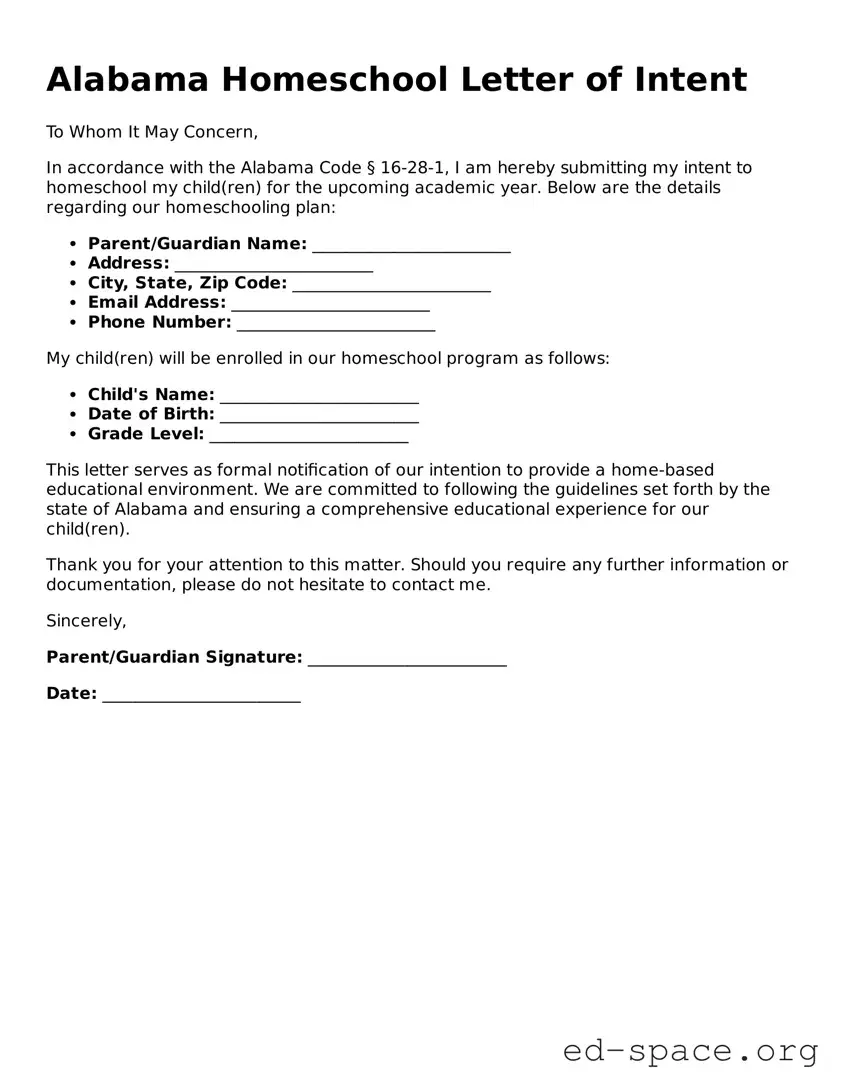
The Alabama Homeschool Letter of Intent form is a crucial document for families choosing to educate their children at home. This form serves as a formal notification to the local school board of your intent to homeschool. It requires basic information, such as the names and ages of the children being homeschooled, as well as the educational approach you plan to take. Parents must submit this letter within a specific timeframe to comply with state regulations. While the form itself is straightforward, it represents a significant commitment to your child's education and ensures that you are following Alabama's homeschooling laws. Understanding the nuances of this document can help streamline the process and foster a successful homeschooling experience for both parents and students.
Alabama Homeschool Letter of Intent
To Whom It May Concern,
In accordance with the Alabama Code § 16-28-1, I am hereby submitting my intent to homeschool my child(ren) for the upcoming academic year. Below are the details regarding our homeschooling plan:
My child(ren) will be enrolled in our homeschool program as follows:
This letter serves as formal notification of our intention to provide a home-based educational environment. We are committed to following the guidelines set forth by the state of Alabama and ensuring a comprehensive educational experience for our child(ren).
Thank you for your attention to this matter. Should you require any further information or documentation, please do not hesitate to contact me.
Sincerely,
Parent/Guardian Signature: ________________________
Date: ________________________
| Fact Name | Details |
|---|---|
| Governing Law | The Alabama Homeschool Letter of Intent is governed by the Alabama Code § 16-28-7. |
| Submission Deadline | Parents must submit the Letter of Intent within 30 days of beginning their homeschool program. |
| Content Requirements | The form must include the names and ages of the children being homeschooled and the address of the homeschool. |
| Annual Renewal | Once submitted, the Letter of Intent does not require annual renewal, but parents should keep records of their homeschooling activities. |
After obtaining the Alabama Homeschool Letter of Intent form, individuals can proceed with filling it out. This form is essential for notifying the local school district of the intention to homeschool. Follow the steps below to ensure the form is completed correctly.
What is the Alabama Homeschool Letter of Intent?
The Alabama Homeschool Letter of Intent is a formal notification submitted to the local school superintendent. This document indicates a parent's intention to homeschool their child. It serves as a way to comply with state regulations regarding homeschooling and ensures that the educational needs of the child are recognized and documented.
Who needs to submit the Letter of Intent?
Any parent or guardian who wishes to homeschool their child in Alabama must submit the Letter of Intent. This requirement applies to children of compulsory school age, typically between the ages of 6 and 17. Submitting the letter is essential to officially register the homeschooling status of the child.
When should the Letter of Intent be submitted?
The Letter of Intent should be submitted at the beginning of the school year or when a child is withdrawn from a public or private school to begin homeschooling. It is advisable to submit the letter as early as possible to avoid any potential complications regarding the child’s educational status.
What information is required in the Letter of Intent?
The Letter of Intent typically requires the name and address of the parent or guardian, the name and age of the child being homeschooled, and a statement of intent to provide a home education. Some parents may also include additional details about their educational plans, although this is not always necessary.
Is there a specific format for the Letter of Intent?
While there is no mandated format for the Letter of Intent, it should be clear, concise, and include all required information. Many parents choose to use a template to ensure they meet all necessary components. It is important to check with the local school district for any specific requirements they may have.
Where should the Letter of Intent be sent?
The completed Letter of Intent should be sent to the local school superintendent’s office. Each school district may have different procedures for submission, so it is wise to verify the correct address and method (mail, email, etc.) for submission with the local district.
What happens after submitting the Letter of Intent?
Once the Letter of Intent is submitted, the local school district will acknowledge receipt. Parents should keep a copy of the letter for their records. Following submission, it is the responsibility of the parent to ensure that they comply with Alabama’s homeschooling laws, including maintaining educational records and providing instruction.
What are the consequences of not submitting the Letter of Intent?
Failing to submit the Letter of Intent can lead to legal complications. The child may be considered truant, which can result in penalties for the parent or guardian. To avoid these issues, it is crucial to ensure that the Letter of Intent is submitted on time and in accordance with state regulations.
Incomplete Information: One common mistake is failing to provide all required details. Ensure that you include the names of all children being homeschooled, their birthdates, and the address of the homeschooling location.
Incorrect Format: Some individuals submit the form in an incorrect format. Always use the official template provided by the state to avoid any issues.
Missing Signatures: Neglecting to sign the form can lead to delays. Make sure that all necessary signatures are present before submission.
Late Submission: Submitting the letter after the deadline can cause complications. Be aware of the timeline and send your form on time to ensure compliance.
Not Keeping a Copy: Failing to keep a copy of the submitted form can be problematic. Always retain a copy for your records in case you need to reference it later.
Overlooking State Guidelines: Some people ignore specific state guidelines regarding homeschooling. Familiarize yourself with Alabama’s requirements to avoid potential issues.
When embarking on the journey of homeschooling in Alabama, the Letter of Intent is just the beginning. Several other forms and documents can help streamline the process and ensure compliance with state regulations. Here’s a list of essential documents that often accompany the Letter of Intent:
By preparing these documents alongside the Alabama Homeschool Letter of Intent, you can create a solid foundation for your homeschooling experience. Staying organized and informed will not only ease the process but also enhance your child’s educational journey.
Filling out the Alabama Homeschool Letter of Intent form can be a straightforward process, but there are some important dos and don'ts to keep in mind. Here’s a helpful list to guide you through it:
By following these tips, you can ensure a smoother experience as you embark on your homeschooling journey in Alabama.
Homeschooling in Alabama is a popular choice for many families, but there are some misconceptions about the Letter of Intent form that can lead to confusion. Here are five common misunderstandings:
Understanding these misconceptions can help families navigate the homeschooling process more smoothly. Clarity about the requirements can lead to a more successful homeschooling experience.
Filling out the Alabama Homeschool Letter of Intent form is an important step for parents choosing to educate their children at home. Here are some key takeaways to keep in mind:
By following these guidelines, you can navigate the process with confidence and clarity.