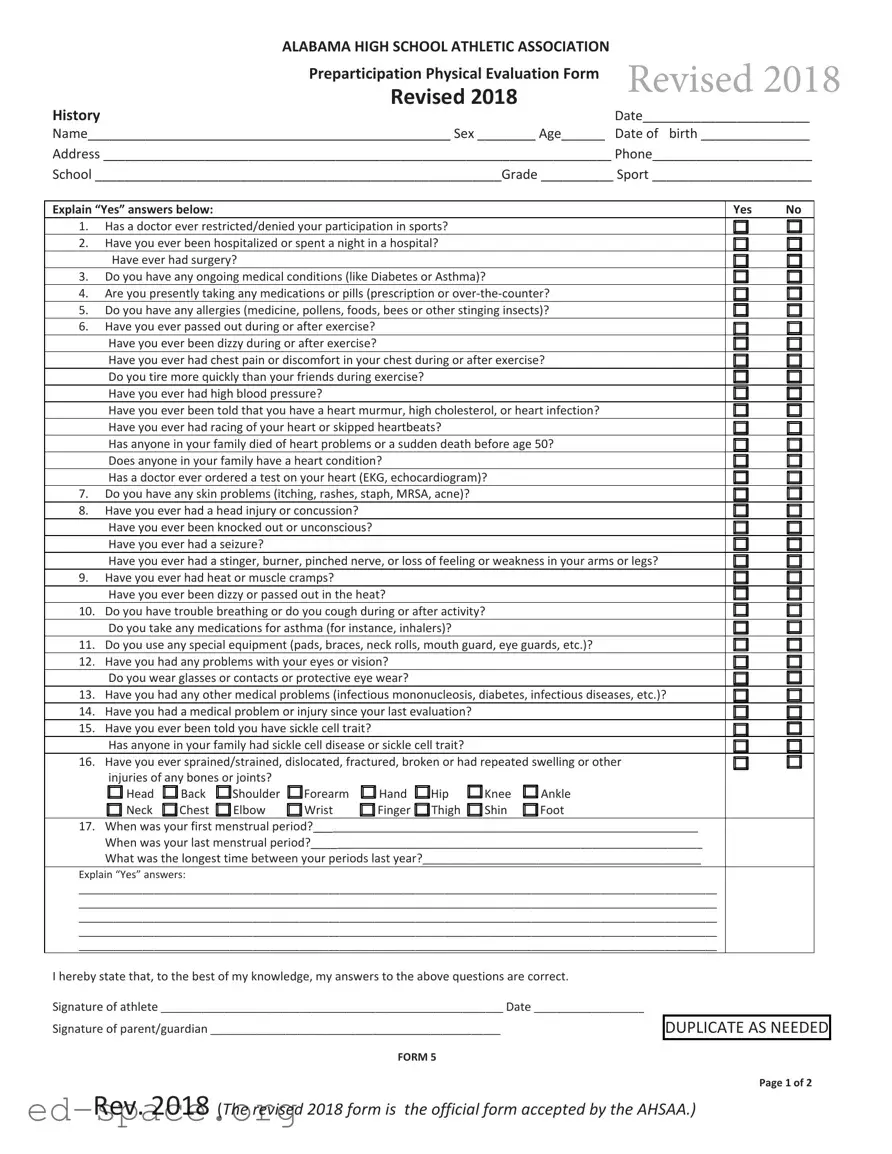
The Alabama High School Physical form is a crucial document for student-athletes participating in interscholastic sports. This form is designed to ensure that each athlete is physically fit and medically cleared to engage in various athletic activities. It begins with basic information, such as the athlete's name, age, address, and school details. The form then delves into the athlete's medical history, asking about past injuries, surgeries, and any ongoing health issues. Questions cover a range of topics, from respiratory problems and allergies to musculoskeletal injuries. A thorough physical examination follows, assessing vital signs and overall health, including cardiovascular and musculoskeletal evaluations. Importantly, the form requires a physician's signature to certify that the athlete is fit to compete. This certification must be updated annually to maintain eligibility for participation in sports. The emphasis on health and safety in this process underscores the importance of being proactive about physical well-being in the realm of high school athletics.

ALABAMA HIGH SCHOOL ATHLETIC ASSOCIATION |
Revised 2018 |
Revised 2018 |
|
Preparticipation Physical Evaluation Form |
|
History |
Date_______________________ |
Name__________________________________________________ Sex ________ Age______ Date of birth _______________
Address ______________________________________________________________________ Phone______________________
School ________________________________________________________Grade __________ Sport ______________________
Explain “Yes” answers below: |
|
|
|
|
|
Yes |
No |
||||
1. |
Has a doctor ever restricted/denied your participation in sports? |
|
|
|
|
|
|||||
2. |
Have you ever been hospitalized or spent a night in a hospital? |
|
|
|
|
|
|||||
|
Have ever had surgery? |
|
|
|
|
|
|
|
|
||
3. |
Do you have any ongoing medical conditions (like Diabetes or Asthma)? |
|
|
|
|
||||||
4. |
Are you presently taking any medications or pills (prescription or over‐the‐counter? |
|
|||||||||
5. |
Do you have any allergies (medicine, pollens, foods, bees or other stinging insects)? |
|
|||||||||
6. |
Have you ever passed out during or after exercise? |
|
|
|
|
|
|
|
|||
|
|
|
|
|
|
|
|||||
|
Have you ever been dizzy during or after exercise? |
|
|
|
|
|
|
|
|||
|
Have you ever had chest pain or discomfort in your chest during or after exercise? |
|
|||||||||
|
Do you tire more quickly than your friends during exercise? |
|
|
|
|
|
|
||||
|
Have you ever had high blood pressure? |
|
|
|
|
|
|
|
|||
|
Have you ever been told that you have a heart murmur, high cholesterol, or heart infection? |
|
|||||||||
|
Have you ever had racing of your heart or skipped heartbeats? |
|
|
|
|
|
|||||
|
Has anyone in your family died of heart problems or a sudden death before age 50? |
|
|||||||||
|
Does anyone in your family have a heart condition? |
|
|
|
|
|
|
||||
|
Has a doctor ever ordered a test on your heart (EKG, echocardiogram)? |
|
|
|
|
||||||
7. |
Do you have any skin problems (itching, rashes, staph, MRSA, acne)? |
|
|
|
|
|
|||||
8. |
Have you ever had a head injury or concussion? |
|
|
|
|
|
|
|
|||
|
Have you ever been knocked out or unconscious? |
|
|
|
|
|
|
|
|||
|
Have you ever had a seizure? |
|
|
|
|
|
|
|
|
||
|
Have you ever had a stinger, burner, pinched nerve, or loss of feeling or weakness in your arms or legs? |
|
|||||||||
9. |
Have you ever had heat or muscle cramps? |
|
|
|
|
|
|
|
|||
|
Have you ever been dizzy or passed out in the heat? |
|
|
|
|
|
|
||||
10. Do you have trouble breathing or do you cough during or after activity? |
|
|
|
|
|||||||
|
Do you take any medications for asthma (for instance, inhalers)? |
|
|
|
|
|
|||||
11. Do you use any special equipment (pads, braces, neck rolls, mouth guard, eye guards, etc.)? |
|
||||||||||
12. Have you had any problems with your eyes or vision? |
|
|
|
|
|
|
|||||
|
Do you wear glasses or contacts or protective eye wear? |
|
|
|
|
|
|
||||
13. Have you had any other medical problems (infectious mononucleosis, diabetes, infectious diseases, etc.)? |
|
||||||||||
14. Have you had a medical problem or injury since your last evaluation? |
|
|
|
|
|
||||||
15. Have you ever been told you have sickle cell trait? |
|
|
|
|
|
|
|
||||
|
Has anyone in your family had sickle cell disease or sickle cell trait? |
|
|
|
|
|
|||||
16. Have you ever sprained/strained, dislocated, fractured, broken or had repeated swelling or other |
|
||||||||||
|
injuries of any bones or joints? |
|
|
|
|
|
|
|
|
||
|
Head |
Back |
Shoulder |
Forearm |
Hand |
Hip |
Knee |
Ankle |
|
||
|
Neck |
Chest |
Elbow |
Wrist |
Finger |
Thigh |
Shin |
Foot |
|
||
17.When was your first menstrual period?__________________________________________________________________
When was your last menstrual period?___________________________________________________________________
What was the longest time between your periods last year?________________________________________________
Explain “Yes” answers:
______________________________________________________________________________________________________________
______________________________________________________________________________________________________________
______________________________________________________________________________________________________________
______________________________________________________________________________________________________________
______________________________________________________________________________________________________________
I hereby state that, to the best of my knowledge, my answers to the above questions are correct.
Signature of athlete ___________________________________________________________ Date ___________________
Signature of parent/guardian __________________________________________________
FORM 5
DUPLICATE AS NEEDED
Rev. 2018 (The revised 2018 form is the official form accepted by the AHSAA.)
Page 1 of 2

Preparticipation Physical Evaluation Rule 1, Sec. 14 — In order for a student to be eligible for interscholastic athletics, there must be
on file in the Superintendent’s or Principal’s office a current physician’s statement certifying that
__________________________________________ the student has passed a physical exam, and that in the opinion of the examining physician (M.D.
|
|
|
Student's name |
or D.O.) the student is fully able to participate in interscholastic athletics (Grade s 7‐12). The |
||||
|
|
|
AHSAA Physicians Certificate (Form 5 Rev. 2018) must be used. A physical exam will satisfy the |
|||||
|
|
|
|
|
||||
Physical Examination |
requirement for one calendar year through the end of the month from the date of the exam. For |
|||||||
example, a physical given on May 5, 2019, will satisfy the requirement through May 31, 2020. |
||||||||
|
|
|
|
|
|
|
||
|
|
|
Height ____________ Weight _____________ BP _____ / _____ Pulse ____________ |
|
||||
|
|
|
Vision R 20 / ____ L 20 / ____ Corrected: Y N |
Revised 2018 |
|
|||
|
|
|
|
|
||||
|
|
|
|
|
|
|
|
|
|
|
LIMITED |
|
Normal |
|
|
Abnormal Findings |
|
|
|
|
|
|
|
|
|
|
|
|
Cardiovascular |
|
|
|
|
|
|
|
|
|
|
|
|
|
|
|
|
|
|
|
|
|
|
|
|
|
|
|
Pulses |
|
|
|
|
|
|
|
|
|
|
|
|
|
|
|
|
|
Heart |
|
|
|
|
|
|
|
|
|
|
|
|
|
|
|
|
|
Lungs |
|
|
|
|
|
|
|
|
|
|
|
|
|
|
|
|
|
Skin |
|
|
|
|
|
|
|
|
|
|
|
|
|
|
|
|
|
E.N.T. |
|
|
|
|
|
|
|
|
|
|
|
|
|
|
|
COMPLETE |
|
Abdominal |
|
|
|
|
|
|
|
|
|
|
|
|
|
|
|
|
Genitalia (males) |
|
|
|
|
||
|
|
|
|
|
|
|
||
|
|
|
|
|
|
|
|
|
|
|
|
Musculoskeletal |
|
|
|
|
|
|
|
|
|
|
|
|
|
|
|
|
|
Neck |
|
|
|
|
|
|
|
|
|
|
|
|
|
|
|
|
|
Shoulder |
|
|
|
|
|
|
|
|
|
|
|
|
|
|
|
|
|
Elbow |
|
|
|
|
|
|
|
|
|
|
|
|
|
|
|
|
|
Wrist |
|
|
|
|
|
|
|
|
|
|
|
|
|
|
|
|
|
Hand |
|
|
|
|
|
|
|
|
|
|
|
|
|
|
|
|
|
Back |
|
|
|
|
|
|
|
|
|
|
|
|
|
|
|
|
|
Knee |
|
|
|
|
|
|
|
|
|
|
|
|
|
|
|
|
|
Ankle |
|
|
|
|
|
|
|
|
|
|
|
|
|
|
|
|
|
Foot |
|
|
|
|
|
|
|
|
|
|
|
|
|
|
|
|
|
Other |
|
|
|
|
|
|
|
|
|
|
|
|
|
|
Clearance:
A.Cleared
B.Cleared after completing evaluation/rehabilitation for: _______________________________________
C. Not cleared for: |
Collision |
|
|
|
Contact |
|
|
|
Noncontact ____ Strenuous |
____ Moderately strenuous |
____ Nonstrenuous |
Due to: ____________________________________________________________________________________________
Recommendation: _________________________________________________________________________________________
________________________________________________________________________________________________________
________________________________________________________________________________________________________
Name of physician ________________________________________________________________ Date ____________________
Address ________________________________________________________________________ Phone___________________
.
Signature of physician _____________________________________________________________, M.D. or D.O.
(Form must be signed and dated by the attending physician.)
Rev. 2018 (The revised 2018 form is the official form accepted by the AHSAA.)
| Fact Name | Details |
|---|---|
| Governing Body | The Alabama High School Athletic Association (AHSAA) oversees the physical evaluation form. |
| Eligibility Requirement | Students must have a current physician's statement on file to participate in interscholastic athletics. |
| Form Usage | The AHSAA Physicians Certificate (Form 5) is specifically required for physical evaluations. |
| Age Range | The form is applicable for students in grades 7 through 12. |
| Validity Period | A physical exam is valid for one calendar year from the date of the examination. |
| Physical Examination Components | The evaluation includes assessments of cardiovascular, musculoskeletal, and general health. |
| Signature Requirement | Both the athlete and a parent or guardian must sign the form to validate the information provided. |
| Medical History Questions | The form includes questions regarding past injuries, illnesses, and medical conditions. |
| Clearance Options | Physicians can clear students for participation, clear them with conditions, or deny clearance. |
| Compliance with State Law | The form is in compliance with Rule 1, Section 14 of the AHSAA regulations. |
Filling out the Alabama High School Physical form is an important step in ensuring that students are cleared for athletic participation. The process involves providing personal information, answering health-related questions, and obtaining a physician's evaluation. Below are the steps to complete the form accurately.
What is the Alabama High School Physical form?
The Alabama High School Physical form is a required document for students in grades 7 through 12 who wish to participate in interscholastic athletics. This form must be completed by a licensed physician and includes both a medical history and a physical examination. It certifies that the student is physically fit to engage in sports activities, ensuring their health and safety during participation.
How often do students need to complete the physical evaluation?
A physical evaluation must be completed annually. This means that a new form is required every year to confirm that the student remains healthy and fit for athletic participation. The physical exam is valid for one calendar year from the date of the examination, so it’s important to keep track of when the last evaluation was conducted.
What information is required on the form?
The form requires various details about the student, including their name, age, address, school, and grade. Additionally, it includes a medical history section where students must disclose any previous injuries, medical conditions, or ongoing health issues. This information helps the physician assess the student's readiness for sports and identify any potential risks.
Who can perform the physical examination?
The physical examination must be conducted by a licensed physician, either a Doctor of Medicine (M.D.) or a Doctor of Osteopathy (D.O.). It is crucial that the examining physician is familiar with the requirements of the Alabama High School Athletic Association (AHSAA) to ensure that the form is filled out correctly and meets all necessary standards.
What happens if a student is not cleared for participation?
If a student is not cleared for participation, the physician will indicate the reasons on the form. They may recommend further evaluation, rehabilitation, or specify restrictions regarding the type of sports the student can participate in. It is important for the student and their guardians to follow up on any recommendations made by the physician to ensure the student’s health and safety.
Incomplete Personal Information: Many individuals forget to fill in essential details such as name, age, and address. This information is crucial for identifying the student and ensuring proper documentation.
Missing Medical History: Failing to disclose previous medical conditions or injuries can lead to serious complications. It's vital to accurately report any past surgeries, allergies, or chronic conditions.
Not Seeking Clarification: Some people hesitate to ask questions if they don't understand a section of the form. It’s important to seek help to ensure all sections are completed correctly.
Ignoring Signatures: Neglecting to obtain the necessary signatures from both the athlete and a parent or guardian can render the form invalid. Ensure that all required signatures are present before submission.
Submitting Outdated Forms: Submitting a physical evaluation that is older than one calendar year will not meet the eligibility requirements. Keep track of the examination date to ensure compliance.
When preparing for participation in high school athletics in Alabama, several important documents accompany the Alabama High School Physical form. Each of these forms serves a distinct purpose, ensuring that student-athletes are healthy and cleared for sports activities. Below is a list of commonly used documents that parents and guardians should be aware of.
Understanding these documents is essential for ensuring a smooth and safe athletic experience for student-athletes. Parents and guardians should take the time to familiarize themselves with each form, as they play a crucial role in the health and safety of their children while participating in sports.
The Alabama High School Physical form serves as a crucial document for student-athletes, ensuring their health and readiness for sports participation. Several other documents share similarities with this form, particularly in their purpose of assessing physical fitness and medical history. Below is a list of nine documents that are comparable to the Alabama High School Physical form:
Each of these documents plays a vital role in safeguarding the health of student-athletes, ensuring they are fit to compete and ready to handle the physical demands of their sports.
When filling out the Alabama High School Physical form, it's essential to ensure that all information is accurate and complete. Here are some important dos and don'ts to consider:
By following these guidelines, you can help ensure that the process runs smoothly and that you are cleared for participation in sports activities.
Misconception 1: The physical form is only necessary for athletes.
In reality, the Alabama High School Physical form is required for all students participating in interscholastic athletics, regardless of the sport. This ensures that every student is medically evaluated before engaging in physical activities.
Misconception 2: A physical exam is valid indefinitely.
The form states that a physical exam is valid for one calendar year. After this period, a new evaluation is necessary to ensure continued health and safety for participation in sports.
Misconception 3: Only a doctor can complete the physical evaluation.
While a licensed physician (M.D. or D.O.) must sign the form, the evaluation can also be conducted by certain qualified healthcare professionals, depending on state regulations.
Misconception 4: The form only covers physical health.
The evaluation includes questions about medical history, allergies, and previous injuries. This comprehensive approach helps identify any potential health risks that could affect a student's ability to participate safely.
Misconception 5: Parents are not involved in the process.
Parental involvement is crucial. The form requires both the athlete's and the parent or guardian's signatures, indicating that parents should be aware of their child's health status and any medical concerns.
Misconception 6: The form can be submitted at any time.
There is a specific timeline for submitting the form, typically before the start of the sports season. Late submissions may affect a student's eligibility to participate.
Misconception 7: The physical evaluation is a one-time event.
Students may need to undergo multiple evaluations throughout their high school years, especially if they have ongoing health issues or if they change sports.
Here are some key takeaways about filling out and using the Alabama High School Physical form: