In Alabama, the General Power of Attorney form serves as a crucial legal tool, empowering individuals to designate someone they trust to make decisions on their behalf. This form is particularly significant for those looking to manage their financial affairs, healthcare decisions, or other personal matters when they are unable to do so themselves. By granting this authority, the principal— the person creating the power of attorney—can ensure that their wishes are respected even in times of incapacity. The designated agent gains the ability to handle tasks ranging from paying bills and managing investments to making medical decisions, depending on the scope outlined in the document. Importantly, the General Power of Attorney can be tailored to meet specific needs, whether it’s effective immediately or only when the principal becomes incapacitated. Understanding the nuances of this form is essential for anyone considering this powerful legal option, as it can significantly impact one’s financial and personal well-being.
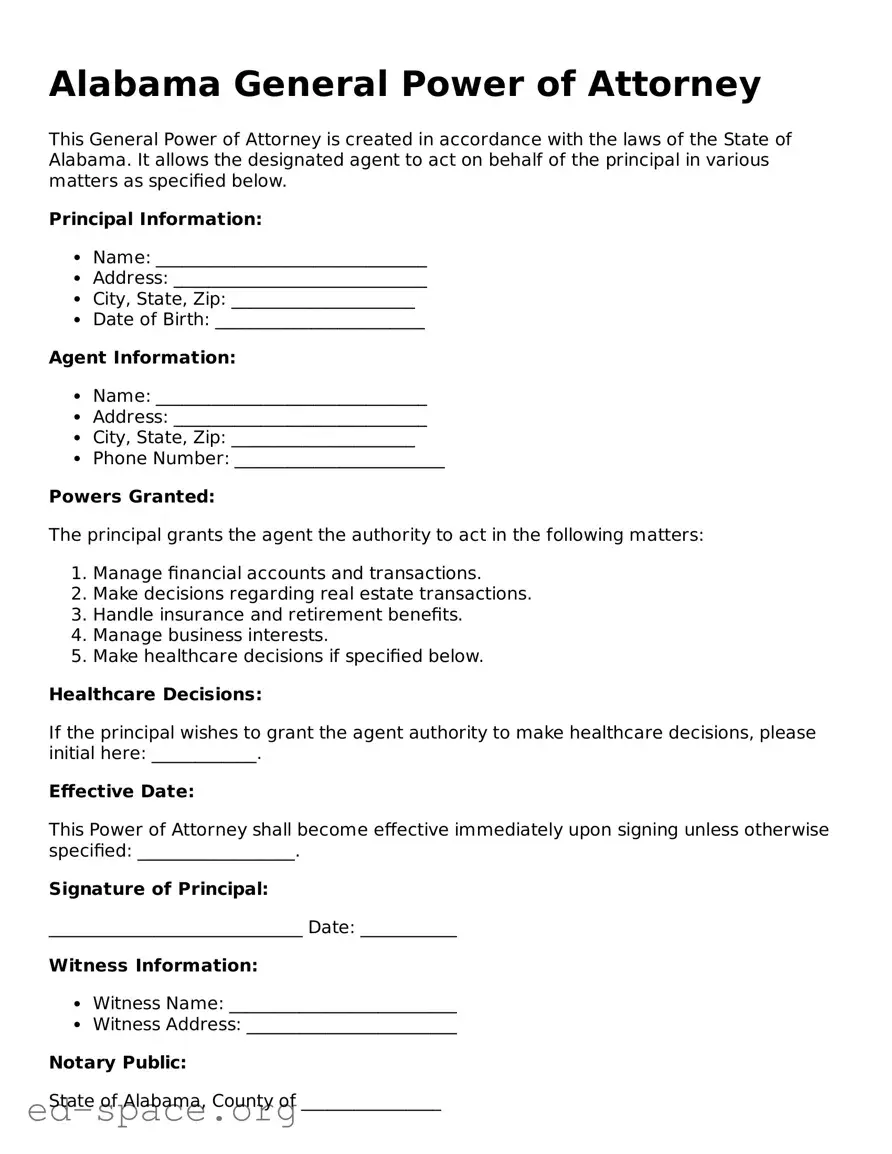
Alabama General Power of Attorney
This General Power of Attorney is created in accordance with the laws of the State of Alabama. It allows the designated agent to act on behalf of the principal in various matters as specified below.
Principal Information:
Agent Information:
Powers Granted:
The principal grants the agent the authority to act in the following matters:
Healthcare Decisions:
If the principal wishes to grant the agent authority to make healthcare decisions, please initial here: ____________.
Effective Date:
This Power of Attorney shall become effective immediately upon signing unless otherwise specified: __________________.
Signature of Principal:
_____________________________ Date: ___________
Witness Information:
Notary Public:
State of Alabama, County of ________________
Subscribed and sworn before me this ______ day of __________, 20__.
_____________________________ (Notary Signature)
My Commission Expires: _______________
| Fact Name | Description |
|---|---|
| Definition | The Alabama General Power of Attorney form allows an individual to grant authority to another person to act on their behalf in various matters. |
| Governing Law | This form is governed by the Alabama Uniform Power of Attorney Act, codified in Title 26, Chapter 1A of the Code of Alabama. |
| Principal | The individual granting the power is referred to as the "principal." They must be at least 18 years old and mentally competent. |
| Agent | The person receiving the authority is known as the "agent" or "attorney-in-fact." They should be trustworthy and capable of handling the responsibilities assigned. |
| Scope of Authority | The form can grant broad or limited powers, including financial decisions, real estate transactions, and legal matters. |
| Durability | A General Power of Attorney can be durable, meaning it remains effective even if the principal becomes incapacitated. |
| Revocation | The principal can revoke the power at any time, as long as they are mentally competent to do so. |
| Witness Requirements | The form must be signed in the presence of a notary public. Witnesses are not required but can add an extra layer of validity. |
| Limitations | Some actions, such as making a will or certain healthcare decisions, cannot be delegated through a General Power of Attorney. |
After obtaining the Alabama General Power of Attorney form, you will need to complete it accurately. This document allows one person to act on behalf of another in various matters. Follow these steps to fill out the form properly.
What is a General Power of Attorney in Alabama?
A General Power of Attorney in Alabama is a legal document that allows one person, known as the principal, to grant another person, known as the agent or attorney-in-fact, the authority to act on their behalf. This authority can cover a wide range of financial and legal matters, such as managing bank accounts, signing contracts, or making healthcare decisions, depending on the specific terms outlined in the document.
Who can create a General Power of Attorney in Alabama?
Any adult in Alabama who is mentally competent can create a General Power of Attorney. This means that the individual must understand the nature and consequences of the document they are signing. It is important for the principal to choose someone they trust, as the agent will have significant authority over their affairs.
Does a General Power of Attorney need to be notarized in Alabama?
Yes, in Alabama, a General Power of Attorney must be signed in the presence of a notary public to be considered valid. This notarization serves as a safeguard against fraud and ensures that the principal is signing the document voluntarily and with full understanding of its implications.
Can a General Power of Attorney be revoked?
Yes, a principal can revoke a General Power of Attorney at any time, as long as they are mentally competent. To do this, the principal should create a written revocation document and notify the agent as well as any institutions or parties that may have relied on the original power of attorney. This revocation should also be notarized to ensure its validity.
What happens if the principal becomes incapacitated?
If the principal becomes incapacitated, the General Power of Attorney remains effective unless it is a limited power that explicitly states it ends upon incapacitation. However, many individuals choose to create a durable power of attorney, which remains in effect even if the principal can no longer make decisions for themselves. This distinction is crucial for ensuring that the agent can continue to manage the principal's affairs during periods of incapacity.
Can an agent under a General Power of Attorney make healthcare decisions?
While a General Power of Attorney can grant broad authority, it does not automatically include the power to make healthcare decisions. For that, a separate document, often referred to as a Healthcare Power of Attorney or Advance Directive, is recommended. This ensures that the agent can make medical decisions aligned with the principal's wishes if they are unable to communicate those wishes themselves.
Is it necessary to use a specific form for a General Power of Attorney in Alabama?
While Alabama does not require a specific form for a General Power of Attorney, it is advisable to use a standardized form that complies with state laws to avoid any issues. Many legal resources and online platforms provide templates that can be tailored to fit the principal's needs while ensuring compliance with Alabama law.
What should be considered when choosing an agent for a General Power of Attorney?
Choosing an agent is a significant decision. The principal should consider the agent's reliability, trustworthiness, and ability to handle financial matters. Additionally, the principal should discuss their wishes and expectations with the agent to ensure alignment. It is also wise to select an alternate agent in case the primary agent is unable or unwilling to fulfill their duties.
Not specifying the powers granted: It's crucial to clearly outline the specific powers you wish to grant. Failing to do so can lead to misunderstandings about what your agent can or cannot do.
Inadequate agent information: Ensure that the agent's name, address, and contact information are complete and accurate. Missing or incorrect details can cause delays or complications in executing the document.
Not signing in the correct place: Sign the document where indicated. An unsigned form may be deemed invalid, rendering it ineffective in legal situations.
Ignoring witness and notarization requirements: Alabama requires certain documents to be witnessed and notarized. Neglecting these steps can invalidate the power of attorney.
Failing to date the document: Always include the date when you sign the form. Without a date, it may create confusion regarding when the powers take effect.
Not considering alternate agents: Designate an alternate agent in case your primary choice is unable or unwilling to act. This ensures continuity in managing your affairs.
Overlooking revocation of previous powers: If you have previously executed a power of attorney, make sure to revoke it explicitly in the new document to avoid conflicts.
Assuming the form is one-size-fits-all: Each situation is unique. Customize the form to fit your specific needs rather than relying on a generic template.
When creating a General Power of Attorney in Alabama, it is often beneficial to consider additional documents that may complement this form. These documents can help clarify intentions, provide additional authority, or ensure that all legal matters are addressed appropriately. Below is a list of commonly used forms that may accompany the General Power of Attorney.
Incorporating these additional documents can provide clarity and ensure that an individual's wishes are honored in various circumstances. It is advisable to consult with a legal professional to ensure that all forms are completed accurately and in accordance with state laws.
When filling out the Alabama General Power of Attorney form, it is essential to follow specific guidelines to ensure that the document is valid and effective. Below are ten things you should and shouldn't do:
The Alabama General Power of Attorney form is an important legal document that allows one person to act on behalf of another. However, there are several misconceptions surrounding its use and implications. Here are five common misunderstandings:
Many people believe that a General Power of Attorney is limited to financial transactions. In reality, this document can grant authority over various aspects of a person's life, including healthcare decisions, property management, and legal matters.
Some think that a General Power of Attorney automatically becomes void if the principal becomes incapacitated. However, if the document is set up as a durable power of attorney, it remains effective even if the principal can no longer make decisions.
While it is true that adults can be appointed, not just anyone is suitable for this role. The agent should be trustworthy and capable of managing the responsibilities that come with the authority granted.
Although notarization is recommended for added security, it is not strictly required for a General Power of Attorney in Alabama. Witnesses may also suffice, depending on the specific circumstances.
Some individuals assume that a General Power of Attorney lasts forever. In fact, it can be revoked at any time by the principal, as long as they are still competent to make that decision.
Understanding these misconceptions can help individuals make informed decisions about using a General Power of Attorney in Alabama.
Filling out and using the Alabama General Power of Attorney form is an important process that requires careful consideration. Here are some key takeaways to keep in mind:
Being informed and prepared will help you navigate this important legal document with confidence.