The Alabama Employee Handbook form serves as a crucial document for both employers and employees, outlining essential workplace policies and procedures. It typically includes sections on employee rights, workplace expectations, and company policies regarding attendance, dress code, and conduct. Additionally, the handbook often addresses critical topics such as anti-discrimination policies, harassment prevention, and safety protocols, ensuring that employees understand their rights and responsibilities. By providing clear guidelines, the handbook helps to foster a positive work environment and minimize misunderstandings. Furthermore, it often contains information about benefits, leave policies, and the process for addressing grievances, making it an invaluable resource for navigating workplace dynamics in Alabama. Overall, this form is a vital tool for promoting transparency and accountability within the workplace.
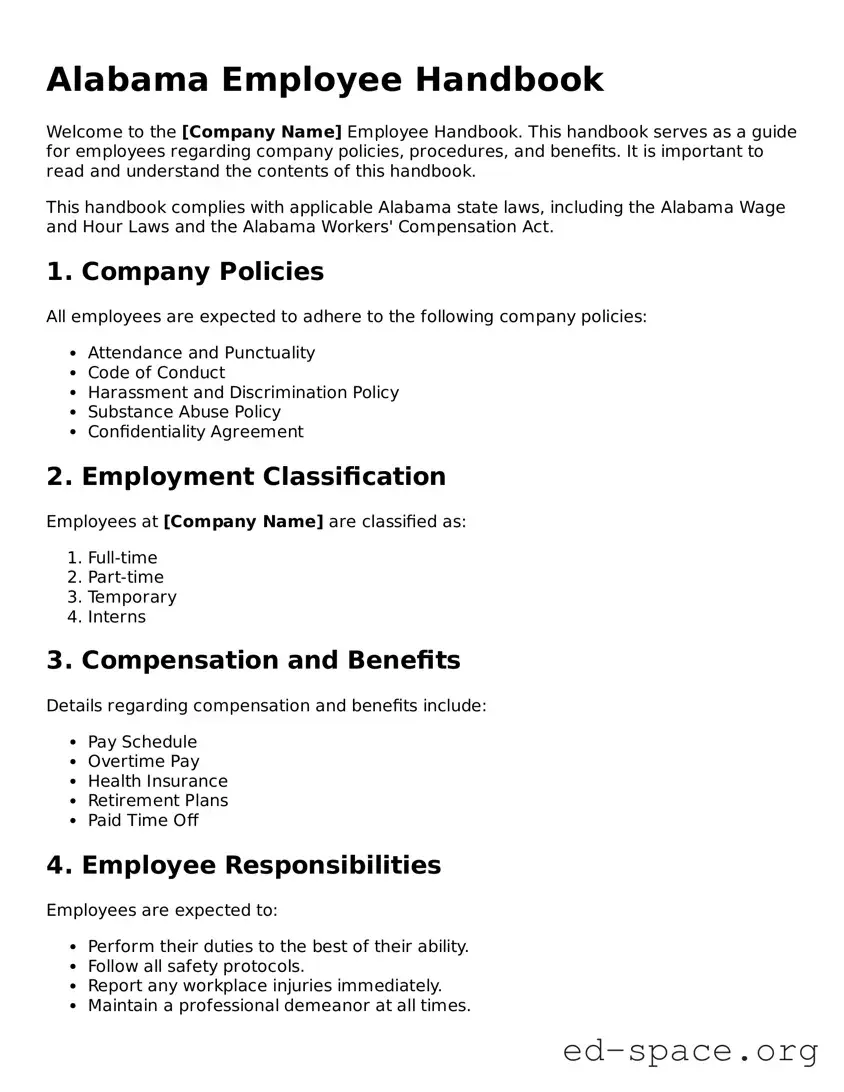
Alabama Employee Handbook
Welcome to the [Company Name] Employee Handbook. This handbook serves as a guide for employees regarding company policies, procedures, and benefits. It is important to read and understand the contents of this handbook.
This handbook complies with applicable Alabama state laws, including the Alabama Wage and Hour Laws and the Alabama Workers' Compensation Act.
1. Company Policies
All employees are expected to adhere to the following company policies:
2. Employment Classification
Employees at [Company Name] are classified as:
3. Compensation and Benefits
Details regarding compensation and benefits include:
4. Employee Responsibilities
Employees are expected to:
5. Acknowledgment of Receipt
All employees must sign an acknowledgment form indicating that they have received and understood this handbook. Please fill in the information below:
Employee Name: ________________________
Date: ________________________
6. Amendments
[Company Name] reserves the right to amend this handbook at any time. Employees will be notified of any changes.
Thank you for being a part of [Company Name]. We look forward to a successful working relationship.
| Fact Name | Description |
|---|---|
| Purpose | The Alabama Employee Handbook serves as a guide for employees regarding company policies, procedures, and expectations. |
| Legal Requirement | While not legally required, having an employee handbook is recommended for clarity and compliance. |
| Governing Laws | The handbook should comply with Alabama labor laws and federal regulations, including the Fair Labor Standards Act (FLSA). |
| Contents | Common sections include workplace policies, employee benefits, code of conduct, and disciplinary procedures. |
| Updates | Regular updates are necessary to reflect changes in laws and company policies. |
| Distribution | Employees should receive a copy of the handbook upon hiring and whenever significant changes occur. |
| Acknowledgment | Employees may be required to sign an acknowledgment form confirming they have read and understood the handbook. |
| Accessibility | The handbook should be easily accessible, either in print or electronically, for all employees. |
| Non-Disclosure | Confidential information within the handbook should be protected to maintain company integrity and employee privacy. |
Completing the Alabama Employee Handbook form is an important step in ensuring that both employees and employers are on the same page regarding workplace policies and expectations. This process requires careful attention to detail, as the information provided will help guide your understanding of the workplace environment.
What is the Alabama Employee Handbook form?
The Alabama Employee Handbook form is a document that outlines the policies, procedures, and expectations of an employer in Alabama. It serves as a guide for employees, helping them understand their rights and responsibilities within the workplace.
Why is an Employee Handbook important?
An Employee Handbook is crucial because it sets clear standards and expectations for behavior and performance. It helps prevent misunderstandings and disputes by providing a reference point for both employees and management. Additionally, it can protect the employer legally by demonstrating that they have communicated their policies effectively.
What should be included in the Alabama Employee Handbook?
Typically, an Employee Handbook should include sections on company policies, employee benefits, workplace conduct, disciplinary procedures, and safety guidelines. It may also cover topics such as anti-discrimination policies, leave policies, and procedures for reporting grievances.
Is it mandatory to have an Employee Handbook in Alabama?
While it is not legally required for employers in Alabama to have an Employee Handbook, it is highly recommended. Having one can help manage employee expectations and provide a framework for addressing workplace issues.
How often should the Employee Handbook be updated?
Employers should review and update the Employee Handbook regularly, ideally at least once a year or whenever there are significant changes in laws or company policies. This ensures that the information remains accurate and relevant for all employees.
Can employees be disciplined for violating handbook policies?
Yes, employees can be disciplined for violating the policies outlined in the Employee Handbook. It is essential that the disciplinary procedures are clearly stated in the handbook to ensure fairness and transparency in the enforcement of these policies.
What should employees do if they have questions about the handbook?
If employees have questions about the Employee Handbook, they should feel encouraged to speak with their supervisor or the human resources department. Open communication is vital for ensuring everyone understands the policies and expectations.
How can an Employee Handbook protect an employer?
An Employee Handbook can protect an employer by providing documented evidence that they have communicated policies and procedures to their employees. This can be vital in legal situations, as it demonstrates that the employer has acted in good faith and followed established protocols.
Are there any specific laws in Alabama that should be reflected in the Employee Handbook?
Yes, Alabama employers should ensure that their Employee Handbook complies with state and federal laws, such as those related to discrimination, wage and hour laws, and workplace safety. Consulting with a legal professional can help ensure compliance with all applicable regulations.
Can an Employee Handbook be used as a contract?
Generally, an Employee Handbook is not considered a contract unless it explicitly states that it is. However, some courts may view certain provisions as binding if they are clear and specific. To avoid confusion, it’s advisable to include a disclaimer stating that the handbook is for informational purposes only and does not create a contractual obligation.
Failing to read the entire handbook thoroughly. Many individuals skip sections, which can lead to misunderstandings about company policies.
Not providing accurate personal information. Errors in names, addresses, or contact details can create issues with communication and payroll.
Ignoring the acknowledgment section. This part confirms that the employee has read and understands the handbook, and neglecting it can cause problems later.
Overlooking updates or revisions. Employees should regularly check for any changes to the handbook and ensure they acknowledge them.
Not asking questions about unclear policies. If something is confusing, it’s important to seek clarification rather than making assumptions.
Submitting the form late. Timeliness is crucial, as delays can affect onboarding and compliance with company procedures.
When creating an Alabama Employee Handbook, it is essential to consider several other forms and documents that complement the handbook. These documents help establish clear expectations and guidelines for both employers and employees. Below is a list of important forms often used alongside the Employee Handbook.
Incorporating these documents alongside the Alabama Employee Handbook can create a comprehensive framework that promotes a positive workplace culture. Clear communication of policies and expectations fosters a better understanding between employers and employees, ultimately contributing to a more harmonious work environment.
The Employee Handbook serves as a key resource for employees, outlining company policies, procedures, and expectations. It shares similarities with various other documents that help guide workplace behavior and clarify rights and responsibilities. Here are ten documents that are similar to the Employee Handbook:
When filling out the Alabama Employee Handbook form, it’s important to approach the task with care. Here are some essential do's and don'ts to keep in mind:
Following these guidelines will help ensure that your submission is processed smoothly and efficiently.
When it comes to the Alabama Employee Handbook, several misconceptions can lead to confusion for both employers and employees. Understanding these misconceptions is crucial for creating a clear and effective handbook. Here are six common misunderstandings:
Many believe that having an employee handbook is not necessary. However, a well-crafted handbook can provide essential guidance on workplace policies and expectations.
Some think only large organizations need handbooks. In reality, even small businesses benefit from having a clear set of policies to ensure consistency and compliance.
There is a misconception that employee handbooks must be extensive. A concise handbook that covers key policies can be just as effective as a lengthy one.
Many assume that once an employee handbook is created, it cannot be changed. In fact, handbooks should be regularly reviewed and updated to reflect current laws and company practices.
Some employees believe that the handbook constitutes a legal contract. While it can outline policies, it typically does not create enforceable rights unless explicitly stated.
There is a belief that every possible policy must be included in the handbook. However, it is more important to focus on policies that are relevant to the specific workplace and its culture.
By addressing these misconceptions, both employers and employees can better navigate the expectations and benefits of an Alabama Employee Handbook.
When it comes to filling out and using the Alabama Employee Handbook form, there are several important points to keep in mind. Here are some key takeaways: