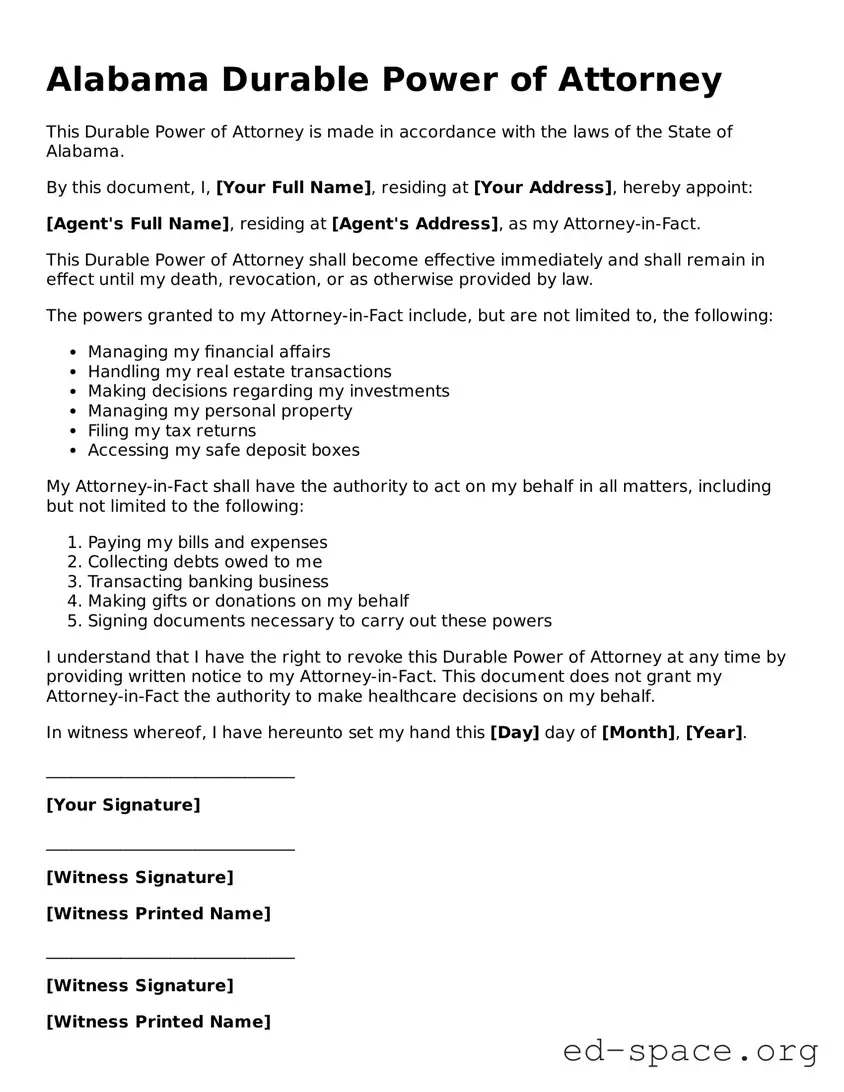
The Alabama Durable Power of Attorney form is an essential legal document that grants an individual the authority to make decisions on behalf of another person, particularly in matters related to financial and medical affairs. This form remains effective even if the principal becomes incapacitated, ensuring that their wishes are respected and their affairs are managed without interruption. Key aspects of the form include the designation of an agent, who is responsible for acting in the principal's best interest, and the specific powers granted, which can range from managing bank accounts to making healthcare decisions. Additionally, the form requires the principal's signature, as well as the signatures of witnesses or a notary, to ensure its validity. Understanding the importance and implications of this document is crucial for anyone looking to safeguard their interests or those of a loved one in times of need.
Alabama Durable Power of Attorney
This Durable Power of Attorney is made in accordance with the laws of the State of Alabama.
By this document, I, [Your Full Name], residing at [Your Address], hereby appoint:
[Agent's Full Name], residing at [Agent's Address], as my Attorney-in-Fact.
This Durable Power of Attorney shall become effective immediately and shall remain in effect until my death, revocation, or as otherwise provided by law.
The powers granted to my Attorney-in-Fact include, but are not limited to, the following:
My Attorney-in-Fact shall have the authority to act on my behalf in all matters, including but not limited to the following:
I understand that I have the right to revoke this Durable Power of Attorney at any time by providing written notice to my Attorney-in-Fact. This document does not grant my Attorney-in-Fact the authority to make healthcare decisions on my behalf.
In witness whereof, I have hereunto set my hand this [Day] day of [Month], [Year].
______________________________
[Your Signature]
______________________________
[Witness Signature]
[Witness Printed Name]
______________________________
[Witness Signature]
[Witness Printed Name]
Notarization:
State of Alabama
County of [County Name]
Subscribed and sworn to before me this [Day] day of [Month], [Year].
______________________________
[Notary Public Signature]
[Notary Public Printed Name]
My Commission Expires: [Expiration Date]
| Fact Name | Description |
|---|---|
| Definition | An Alabama Durable Power of Attorney allows a person to appoint someone else to make decisions on their behalf, even if they become incapacitated. |
| Governing Law | The form is governed by the Alabama Code, Title 26, Chapter 1. |
| Durability | This document remains effective even if the person who created it becomes unable to make decisions. |
| Agent Authority | The appointed agent can handle financial matters, property transactions, and other important decisions. |
| Signing Requirements | The form must be signed by the principal and witnessed by two individuals or notarized. |
| Revocation | The principal can revoke the Durable Power of Attorney at any time, as long as they are mentally competent. |
| Limitations | Some actions, like making a will or certain healthcare decisions, cannot be delegated through this form. |
Filling out the Alabama Durable Power of Attorney form is a straightforward process. After completing the form, you will need to sign it in the presence of a notary public to ensure its validity. This document will allow you to designate someone to make decisions on your behalf if you become unable to do so.
What is a Durable Power of Attorney in Alabama?
A Durable Power of Attorney (DPOA) in Alabama is a legal document that allows you to appoint someone you trust to make decisions on your behalf when you are unable to do so. This can include financial decisions, medical care, and other personal matters. The "durable" aspect means that the authority granted to your agent remains effective even if you become incapacitated.
Who can be appointed as an agent under a Durable Power of Attorney?
You can choose almost anyone to be your agent, as long as they are at least 19 years old and mentally competent. Common choices include family members, close friends, or trusted advisors. It’s essential to select someone who understands your values and can act in your best interest.
Does the Durable Power of Attorney need to be notarized?
Yes, in Alabama, the Durable Power of Attorney must be signed in the presence of a notary public. This step helps to ensure that the document is legally binding and that your intentions are clear. Additionally, having witnesses can add an extra layer of protection, although it’s not required.
Can I revoke a Durable Power of Attorney once it is created?
Absolutely. You have the right to revoke your Durable Power of Attorney at any time, as long as you are mentally competent. To do this, you should create a written revocation document and notify your agent and any institutions or individuals who may have relied on the original DPOA.
What happens if I do not have a Durable Power of Attorney?
If you become incapacitated without a Durable Power of Attorney in place, your loved ones may need to go through a court process to obtain guardianship or conservatorship. This can be time-consuming, costly, and may not reflect your wishes, making it crucial to have a DPOA established while you are still able to make decisions.
Can I limit the powers granted in a Durable Power of Attorney?
Yes, you can specify which powers you want to grant your agent. For example, you might allow them to handle financial matters but not medical decisions. Clearly outlining these limitations in the document helps ensure your agent acts according to your preferences.
Is a Durable Power of Attorney effective immediately?
In Alabama, a Durable Power of Attorney can be effective immediately upon signing, or it can be set to activate only under certain conditions, such as your incapacitation. This flexibility allows you to tailor the document to your specific needs and circumstances.
Failing to specify the powers granted. It is important to clearly outline the specific powers the agent will have. Without this, the document may not serve its intended purpose.
Not signing the document in the presence of a notary. Alabama law requires that the Durable Power of Attorney be notarized to be valid.
Leaving out the date. Omitting the date can create confusion about when the powers become effective.
Choosing an unsuitable agent. Selecting someone who may not act in your best interest can lead to complications.
Not considering alternate agents. It is wise to name a backup agent in case the primary agent is unable or unwilling to serve.
Using vague language. Ambiguous terms can lead to misunderstandings about the extent of the powers granted.
Failing to review the document periodically. Changes in circumstances may necessitate updates to the Power of Attorney.
Not discussing the document with the agent. Open communication ensures that the agent understands their responsibilities and your wishes.
When creating a Durable Power of Attorney in Alabama, individuals often consider additional forms and documents to ensure comprehensive legal planning. These documents can help clarify intentions and provide guidance in various circumstances, especially regarding healthcare and financial matters.
Each of these documents plays a vital role in effective estate planning and healthcare decision-making. By considering these forms alongside the Durable Power of Attorney, individuals can create a more robust framework for managing their affairs, ensuring their wishes are honored and their loved ones are supported during challenging times.
The Durable Power of Attorney (DPOA) form shares similarities with several other legal documents. Each serves a specific purpose in managing an individual's affairs. Below is a list of nine documents that are comparable to the DPOA:
When filling out the Alabama Durable Power of Attorney form, it’s essential to follow certain guidelines to ensure the document is valid and meets your needs. Here are seven important do's and don'ts to keep in mind:
Understanding the Alabama Durable Power of Attorney (DPOA) form is essential for anyone considering this legal document. However, several misconceptions can lead to confusion. Here are nine common misunderstandings:
This is not true. While many people associate DPOAs with older adults, anyone can benefit from having one, regardless of age. It is a proactive measure for anyone who wants to ensure their financial and medical decisions are managed by someone they trust.
While a DPOA allows someone to manage your financial affairs, it does not automatically grant them authority over medical decisions. For healthcare decisions, a separate document, such as a healthcare proxy or advance directive, is needed.
This is a misconception. You can revoke a DPOA at any time as long as you are mentally competent. It’s important to formally notify your agent and any institutions that may have relied on the document.
Different states have different requirements and forms. The Alabama DPOA has specific provisions that must be followed to ensure it is valid. Always use the form specific to your state.
While it is advisable to consult with an attorney, individuals can create a DPOA on their own using state-approved forms. However, legal advice can help ensure the document meets all necessary legal requirements.
This is misleading. A DPOA becomes effective immediately upon signing unless specified otherwise. However, it is essential to choose a trustworthy agent, as they will have significant control over your financial matters.
This is incorrect. While DPOAs primarily deal with financial decisions, they can also include provisions for health care decisions if properly structured. Always clarify what powers you want to grant in the document.
While agents have significant authority, they are still bound by fiduciary duties. They must act in your best interest and keep accurate records of their actions. If they fail to do so, they can be held accountable.
A will only takes effect after death, while a DPOA is effective during your lifetime. Having both documents is essential for comprehensive planning, ensuring that your wishes are honored both during your life and after your passing.
Understanding these misconceptions can help individuals make informed decisions about creating a Durable Power of Attorney in Alabama. Proper planning can provide peace of mind and protect your interests in the future.
Filling out and using the Alabama Durable Power of Attorney form is an important step in planning for future needs. Here are key takeaways to consider: