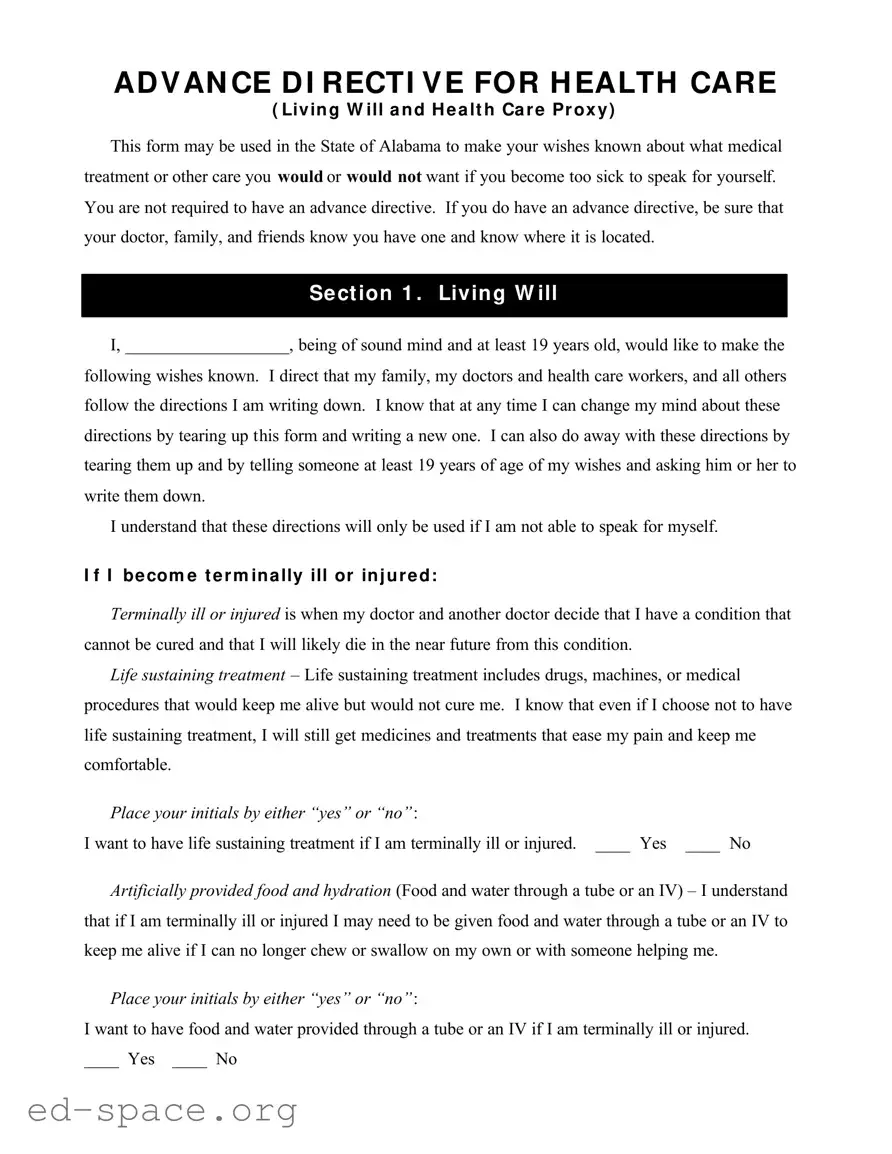
The Alabama Directive Health Care form serves as a vital tool for individuals wishing to express their medical treatment preferences in the event they become unable to communicate their wishes. This form encompasses several key components, including a Living Will, which outlines a person's decisions regarding life-sustaining treatments and artificially provided nutrition and hydration under specific medical conditions, such as terminal illness or permanent unconsciousness. It allows individuals to specify whether they want to receive such treatments, ensuring that their choices are respected when they cannot voice them. Additionally, the form enables individuals to appoint a health care proxy—someone trusted to make medical decisions on their behalf if they are incapacitated. While naming a proxy is optional, the directives outlined in the form remain binding regardless of this choice. Furthermore, the document includes sections for additional instructions and requires the signatures of witnesses to validate the individual's decisions. Overall, the Alabama Directive Health Care form empowers individuals to take control of their medical care and provides clarity for family members and healthcare providers during critical moments.

AD V AN CE D I RECTI V E FOR H EALTH CARE
( Liv in g W ill a n d H e a lt h Ca r e Pr ox y )
This form may be used in the State of Alabama to make your wishes known about what medical treatment or other care you would or would not want if you become too sick to speak for yourself. You are not required to have an advance directive. If you do have an advance directive, be sure that your doctor, family, and friends know you have one and know where it is located.
Se ct ion 1 . Livin g W ill
I, ___________________, being of sound mind and at least 19 years old, would like to make the
following wishes known. I direct that my family, my doctors and health care workers, and all others follow the directions I am writing down. I know that at any time I can change my mind about these directions by tearing up this form and writing a new one. I can also do away with these directions by tearing them up and by telling someone at least 19 years of age of my wishes and asking him or her to write them down.
I understand that these directions will only be used if I am not able to speak for myself.
I f I be com e t e r m in a lly ill or in j u r e d:
Terminally ill or injured is when my doctor and another doctor decide that I have a condition that cannot be cured and that I will likely die in the near future from this condition.
Life sustaining treatment – Life sustaining treatment includes drugs, machines, or medical procedures that would keep me alive but would not cure me. I know that even if I choose not to have life sustaining treatment, I will still get medicines and treatments that ease my pain and keep me comfortable.
Place your initials by either “yes” or “no”:
I want to have life sustaining treatment if I am terminally ill or injured. ____ Yes ____ No
Artificially provided food and hydration (Food and water through a tube or an IV) – I understand that if I am terminally ill or injured I may need to be given food and water through a tube or an IV to keep me alive if I can no longer chew or swallow on my own or with someone helping me.
Place your initials by either “yes” or “no”:
I want to have food and water provided through a tube or an IV if I am terminally ill or injured.
____ Yes ____ No
I f I Be com e Pe r m a n e n t ly U n con sciou s:
Permanent unconsciousness is when my doctor and another doctor agree that within a reasonable degree of medical certainty I can no longer think, feel anything, knowingly move, or be aware of being alive. They believe this condition will last indefinitely without hope for improvement and have watched me long enough to make that decision. I understand that at least one of these doctors must be qualified to make such a diagnosis.
Life sustaining treatment – Life sustaining treatment includes drugs, machines, or other medical procedures that would keep me alive but would not cure me. I know that even if I choose not to have life sustaining treatment, I will still get medicines and treatments that ease my pain and keep me comfortable.
Place your initials by either “yes” or “no”:
I want to have
Artificially provided food and hydration (Food and water through a tube or an IV) – I understand that if I become permanently unconscious, I may need to be given food and water through a tube or an IV to keep me alive if I can no longer chew or swallow on my own or with someone helping me.
Place your initials by either “yes” or “no”:
I want to have food and water provided through a tube or an IV if I am permanently unconscious.
____ Yes ____ No
O t h e r D ir e ct ion s: Please list any other things you want done or not done.
In addition to the directions I have listed on this form, I also want the following:
__________________________________________________________________________________
__________________________________________________________________________________
__________________________________________________________________________________
__________________________________________________________________________________
If you do not have other directions, place your initials here:
____ No, I do not have any other directions.

Se ct ion 2 . I f I ne e d som e one t o spe a k for m e .
This form can be used in the State of Alabama to name a person you would like to make medical or other decisions for you if you become too sick to speak for yourself. This person is called a health care proxy. You do not have to name a health care proxy. The directions in this form will be followed even if you do not name a health care proxy.
Place your initials by only one answer:
_____ I do not want to name a health care proxy. (If you check this answer, go to Section 3)
_____ I do want the person listed below to be my health care proxy. I have talked with this person
about my wishes.
First choice for proxy: ________________________________________
Relationship to me: __________________________________________
Address: ____________________________________________________
City: ____________________________ State _______ Zip ___________
If this person is not able, not willing, or not available to be my health care proxy, this is my next
choice:
Second choice for proxy: _______________________________________
Relationship to me: __________________________________________
Address: ____________________________________________________
City: ____________________________ State _______ Zip ___________
Instructions for Proxy
Place your initials by either “yes” or “no”:
I want my health care proxy to make decisions about whether to give me food and water through a tube or an IV. ____ Yes ____ No

Place your initials by only one of the following:
____ |
I want my health care proxy to follow only the directions as listed on this form. |
_____ |
I want my health care proxy to follow my directions as listed on this form and to make any |
|
decisions about things I have not covered in the form. |
_____ |
I want my health care proxy to make the final decision, even though it could mean doing |
|
something different from what I have listed on this form. |
Se ct ion 3 . Th e t h in gs list e d on t h is for m a r e w h a t I w a n t .
I understand the following:
§If my doctor or hospital does not want to follow the directions I have listed, they must see that I get to a doctor or hospital who will follow my directions.
§If I am pregnant, or if I become pregnant, the choices I have made on this form will not be followed until after the birth of the baby.
§If the time comes for me to stop receiving life sustaining treatment or food and water through a tube or an IV, I direct that my doctor talk about the good and bad points of doing this, along with my wishes, with my health care proxy, if I have one, and with the following people:
____________________________________________________________________
____________________________________________________________________
Se ct ion 4 . M y signa t ur e
Your name: _______________________________________________________
The month, day, and year of your birth: _________________________________
Your signature: ____________________________________________________
Date signed: _______________________________________________________

Se ct ion 5 . W it n e sse s ( n e e d t w o w it n e sse s t o sign )
I am witnessing this form because I believe this person to be of sound mind. I did not sign the person’s signature, and I am not the health care proxy. I am not related to the person by blood, adoption, or marriage and not entitled to any part of his or her estate. I am at least 19 years of age and am not directly responsible for paying for his or her medical care.
Name of first witness: ___________________________________
Signature: _____________________________________________
Date: _________________________________________________
Name of second witness: _________________________________
Signature: _____________________________________________
Date: _________________________________________________
Se ct ion 6 . Sign a t u r e of Pr ox y
I, ____________________________________________, am willing to serve as the health care proxy.
Signature: ________________________________________ |
Date: _________________________ |
Signature of Second Choice for Proxy:
I, __________________________, am willing to serve as the health care proxy if the first choice
cannot serve.
Signature: ________________________________________ |
Date: _________________________ |
| Fact Name | Description |
|---|---|
| Purpose | The Alabama Directive Health Care form allows individuals to express their medical treatment preferences if they become unable to communicate their wishes. |
| Voluntary Nature | Completing this form is not mandatory. Individuals can choose whether or not to create an advance directive. |
| Health Care Proxy | Users can designate a health care proxy to make decisions on their behalf if they are incapacitated. However, naming a proxy is not a requirement for the directive to be valid. |
| Governing Law | This form is governed by Alabama Code § 22-8A-1, which outlines the legal framework for advance directives in the state. |
| Witness Requirement | Two witnesses must sign the form to validate it. Witnesses cannot be related to the individual or entitled to any part of their estate. |
Filling out the Alabama Directive Health Care form is an important step in ensuring your medical wishes are honored. This document allows you to express your preferences regarding medical treatment and appoint a health care proxy to make decisions on your behalf if you become unable to communicate. Below are the steps to complete this form effectively.
Once the form is completed and signed, it is crucial to share it with your health care providers, family, and friends. Keeping copies in accessible locations ensures your wishes are respected when they matter most.
What is the Alabama Directive Health Care form?
The Alabama Directive Health Care form is a legal document that allows individuals to express their medical treatment preferences in case they become unable to communicate their wishes. This includes decisions about life-sustaining treatments and appointing a health care proxy to make decisions on their behalf if necessary. It's a way to ensure that your healthcare wishes are respected, even when you can't speak for yourself.
Do I have to have an advance directive?
No, having an advance directive is not a requirement in Alabama. However, if you choose to create one, it’s important to inform your family, friends, and healthcare providers about its existence and where it can be found. This helps ensure that your wishes are followed when the time comes.
What decisions can I make using this form?
How do I appoint a health care proxy?
If you wish to appoint a health care proxy, the form allows you to name someone who will make medical decisions on your behalf if you are unable to do so. You will need to provide their name, relationship to you, and contact information. It’s essential to discuss your wishes with this person before naming them, ensuring they understand your preferences.
What if I change my mind after completing the form?
You have the right to change your mind at any time. If you decide to alter your wishes, you can do so by tearing up the existing form and creating a new one. Additionally, you can communicate your updated wishes to someone who is at least 19 years old, and they can help document your new preferences.
Are there any restrictions on the decisions I can make?
Yes, there are some restrictions. For instance, if you are pregnant, the choices you make on this form will not take effect until after the baby is born. Also, if your doctor or hospital is unable to comply with your wishes, they must refer you to a healthcare provider who will follow your directives. It's important to understand these limitations as you fill out the form.
Not Providing Clear Instructions: It is essential to clearly state your wishes regarding life-sustaining treatment and hydration. Vague instructions can lead to confusion and may not reflect your true desires.
Failing to Initial Required Sections: Each section requires your initials to indicate your preferences. Neglecting to initial can result in those wishes being overlooked.
Not Discussing Wishes with Family: Failing to communicate your decisions with family members or your health care proxy can lead to misunderstandings during critical times.
Choosing an Unavailable Proxy: Selecting someone as a health care proxy who may not be available or willing to make decisions on your behalf can complicate matters when the time comes.
Overlooking Witness Signatures: The form requires two witnesses to sign. Not having the appropriate signatures can invalidate the document.
Not Updating the Directive: Life circumstances change. Failing to review and update your directive regularly can lead to outdated wishes being followed.
Ignoring the Importance of Clarity: Using ambiguous language or medical terms that may not be understood by others can lead to misinterpretation of your wishes.
Neglecting to Provide Contact Information: Not including up-to-date contact information for your health care proxy can hinder their ability to be reached when decisions need to be made.
The Alabama Directive Health Care form is a crucial document that allows individuals to express their medical treatment preferences in case they become unable to communicate. In addition to this form, several other documents often accompany it to ensure that a person's healthcare wishes are respected. Below is a list of these important documents.
These documents work together to provide a comprehensive view of your healthcare preferences. It is essential to discuss your wishes with your loved ones and ensure that they are aware of where these documents are stored. This proactive approach can help alleviate stress during difficult times and ensure that your choices are honored.
The Alabama Directive Health Care form shares similarities with several other important documents that help individuals express their medical care preferences. Below is a list of these documents and how they relate to the Alabama Directive Health Care form.
Each of these documents plays a crucial role in ensuring that individuals’ health care preferences are honored, particularly when they are unable to communicate their wishes. Understanding these similarities can help individuals make informed decisions about their health care planning.
When filling out the Alabama Directive Health Care form, it's essential to be thorough and clear. Here are some important do's and don'ts to keep in mind:
Understanding the Alabama Directive Health Care form can be challenging, and there are several misconceptions that people often have. Here’s a list of common misunderstandings along with clarifications:
Filling out the Alabama Directive Health Care form is an important step in ensuring that your medical wishes are respected. Here are some key takeaways to keep in mind: