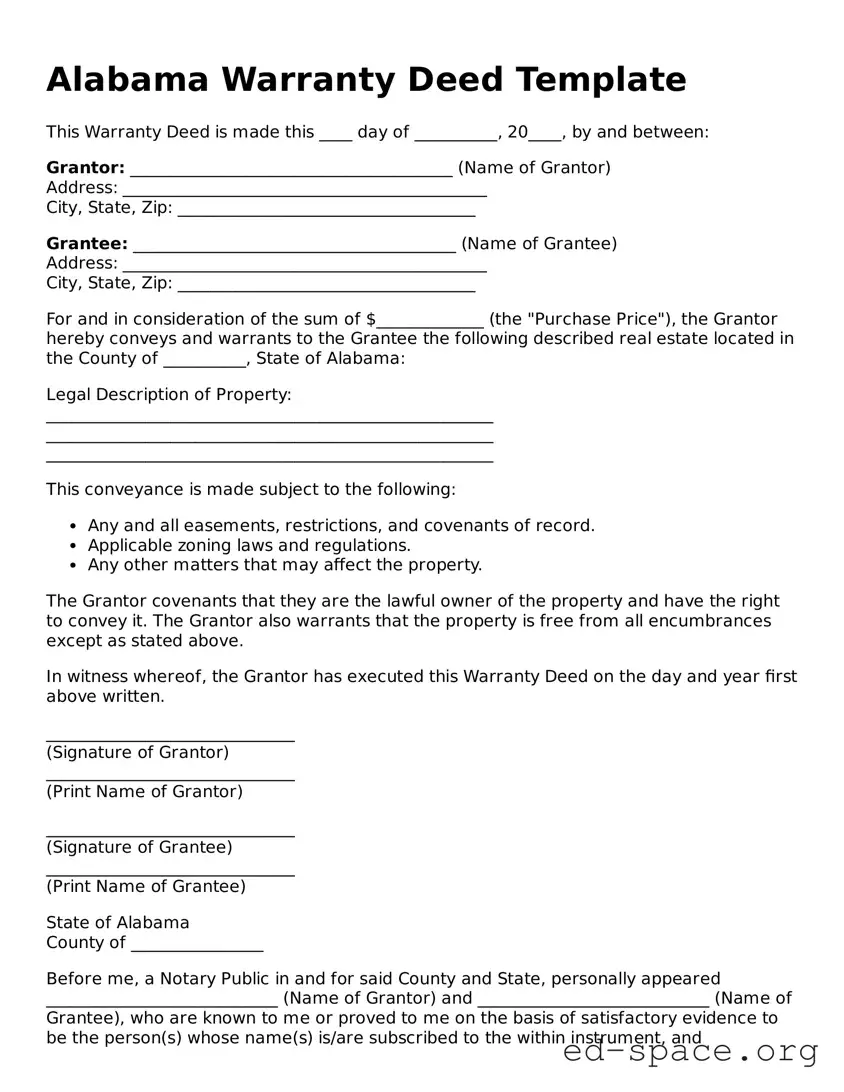
The Alabama Deed form serves as a crucial legal document in the transfer of property ownership in the state of Alabama. This form outlines essential details, including the names of the parties involved—typically the grantor (the seller) and the grantee (the buyer)—and provides a clear description of the property being transferred. It also specifies the consideration, or payment, involved in the transaction. The deed must be signed by the grantor, and in some cases, witnesses may be required to ensure the validity of the document. Importantly, the Alabama Deed form can take various forms, such as warranty deeds, quitclaim deeds, or special purpose deeds, each serving different purposes and offering varying levels of protection to the parties involved. Properly completing and recording this deed with the local county office is essential to finalize the property transfer and provide public notice of the new ownership. Understanding these key aspects is vital for anyone looking to buy or sell property in Alabama.
Alabama Warranty Deed Template
This Warranty Deed is made this ____ day of __________, 20____, by and between:
Grantor: _______________________________________ (Name of Grantor)
Address: ____________________________________________
City, State, Zip: ____________________________________
Grantee: _______________________________________ (Name of Grantee)
Address: ____________________________________________
City, State, Zip: ____________________________________
For and in consideration of the sum of $_____________ (the "Purchase Price"), the Grantor hereby conveys and warrants to the Grantee the following described real estate located in the County of __________, State of Alabama:
Legal Description of Property:
______________________________________________________
______________________________________________________
______________________________________________________
This conveyance is made subject to the following:
The Grantor covenants that they are the lawful owner of the property and have the right to convey it. The Grantor also warrants that the property is free from all encumbrances except as stated above.
In witness whereof, the Grantor has executed this Warranty Deed on the day and year first above written.
______________________________
(Signature of Grantor)
______________________________
(Print Name of Grantor)
______________________________
(Signature of Grantee)
______________________________
(Print Name of Grantee)
State of Alabama
County of ________________
Before me, a Notary Public in and for said County and State, personally appeared ____________________________ (Name of Grantor) and ____________________________ (Name of Grantee), who are known to me or proved to me on the basis of satisfactory evidence to be the person(s) whose name(s) is/are subscribed to the within instrument, and acknowledged to me that they executed the same in their capacity as Grantor and Grantee, respectively, for the purposes therein contained.
Given under my hand and official seal this ____ day of __________, 20____.
______________________________
Notary Public
My Commission Expires: ________________
| Fact Name | Description |
|---|---|
| Governing Law | The Alabama Deed form is governed by the Alabama Code Title 35, Chapter 4. |
| Types of Deeds | Alabama recognizes several types of deeds, including warranty deeds and quitclaim deeds. |
| Recording Requirements | All deeds must be recorded in the county where the property is located to provide public notice. |
| Signature Requirement | The deed must be signed by the grantor and notarized to be valid. |
Completing the Alabama Deed form is an important step in transferring property ownership. After filling out the form, it will need to be signed, notarized, and recorded with the appropriate county office. This ensures that the transfer is legally recognized and documented.
What is an Alabama Deed form?
An Alabama Deed form is a legal document used to transfer ownership of real property from one party to another within the state of Alabama. This form outlines the details of the transaction, including the names of the parties involved, a description of the property, and any conditions of the transfer. It serves as a public record of the change in ownership and is essential for ensuring that the new owner has clear title to the property.
What types of deeds are available in Alabama?
Alabama recognizes several types of deeds, each serving a different purpose. The most common types include Warranty Deeds, which guarantee that the seller holds clear title to the property and has the right to sell it; Quitclaim Deeds, which transfer whatever interest the seller has without any warranties; and Special Warranty Deeds, which provide limited warranties only for the time the seller owned the property. Understanding the differences can help in choosing the right deed for your needs.
How do I complete an Alabama Deed form?
Completing an Alabama Deed form involves several steps. First, gather the necessary information, such as the legal description of the property, the names and addresses of the grantor (seller) and grantee (buyer), and any relevant details about the transaction. Next, fill out the form accurately, ensuring all information is correct. Finally, both parties must sign the deed in the presence of a notary public. After signing, the deed should be filed with the county probate court to make the transfer official.
Are there any fees associated with filing an Alabama Deed form?
Yes, there are fees associated with filing an Alabama Deed form. The exact amount can vary by county, but generally, there is a recording fee that must be paid when submitting the deed to the probate court. Additionally, there may be transfer taxes based on the value of the property being transferred. It’s advisable to check with the local county office for the most accurate fee schedule and any additional requirements that may apply.
Incorrect Names: One common mistake is misspelling names or using incorrect legal names. Ensure that all parties are identified accurately to avoid future disputes.
Missing Signatures: All required parties must sign the deed. Failing to obtain a signature from one party can render the deed invalid.
Improper Notarization: The deed must be notarized correctly. If the notary does not sign or stamp the document, it may not be accepted.
Incorrect Property Description: A vague or incorrect description of the property can lead to confusion or legal issues. Use precise language and include any relevant details.
Failure to Record: After filling out the deed, it’s essential to record it with the appropriate county office. Not doing so can affect ownership rights.
Ignoring State Requirements: Each state has specific requirements for deeds. Familiarize yourself with Alabama’s regulations to ensure compliance.
When transferring property in Alabama, several documents often accompany the deed form. Each of these documents plays a crucial role in ensuring a smooth transaction and protecting the interests of all parties involved. Here’s a list of some commonly used forms and documents:
Each of these documents serves a specific purpose in the real estate transaction process. Ensuring that you have all the necessary forms can help avoid complications and ensure a successful transfer of property ownership.
The Deed form is a critical document in real estate transactions, but it shares similarities with several other legal documents. Here are six documents that are comparable to the Deed form, along with explanations of their similarities:
When filling out the Alabama Deed form, it is crucial to approach the task with care. Properly completing this document can prevent future legal complications. Below are essential guidelines to follow, along with common pitfalls to avoid.
Things You Should Do:
Things You Shouldn't Do:
By adhering to these guidelines, you can ensure that your Alabama Deed form is filled out correctly and legally binding. Take the time to review your work before submission, as errors can lead to significant delays or complications in the property transfer process.
When it comes to Alabama deed forms, there are several misconceptions that can lead to confusion. Understanding the facts can help ensure a smoother property transfer process. Here’s a look at some common misunderstandings:
By understanding these misconceptions, you can navigate the process of property transfer in Alabama with greater confidence. Always consider seeking professional advice if you're unsure about any aspect of the deed process.
When filling out and using the Alabama Deed form, there are several important points to keep in mind. Understanding these key takeaways can help ensure a smooth process and protect your interests.
Taking the time to understand these key aspects will help ensure that your Alabama Deed form is filled out correctly and used effectively. Protect your investment and your rights by following these guidelines closely.