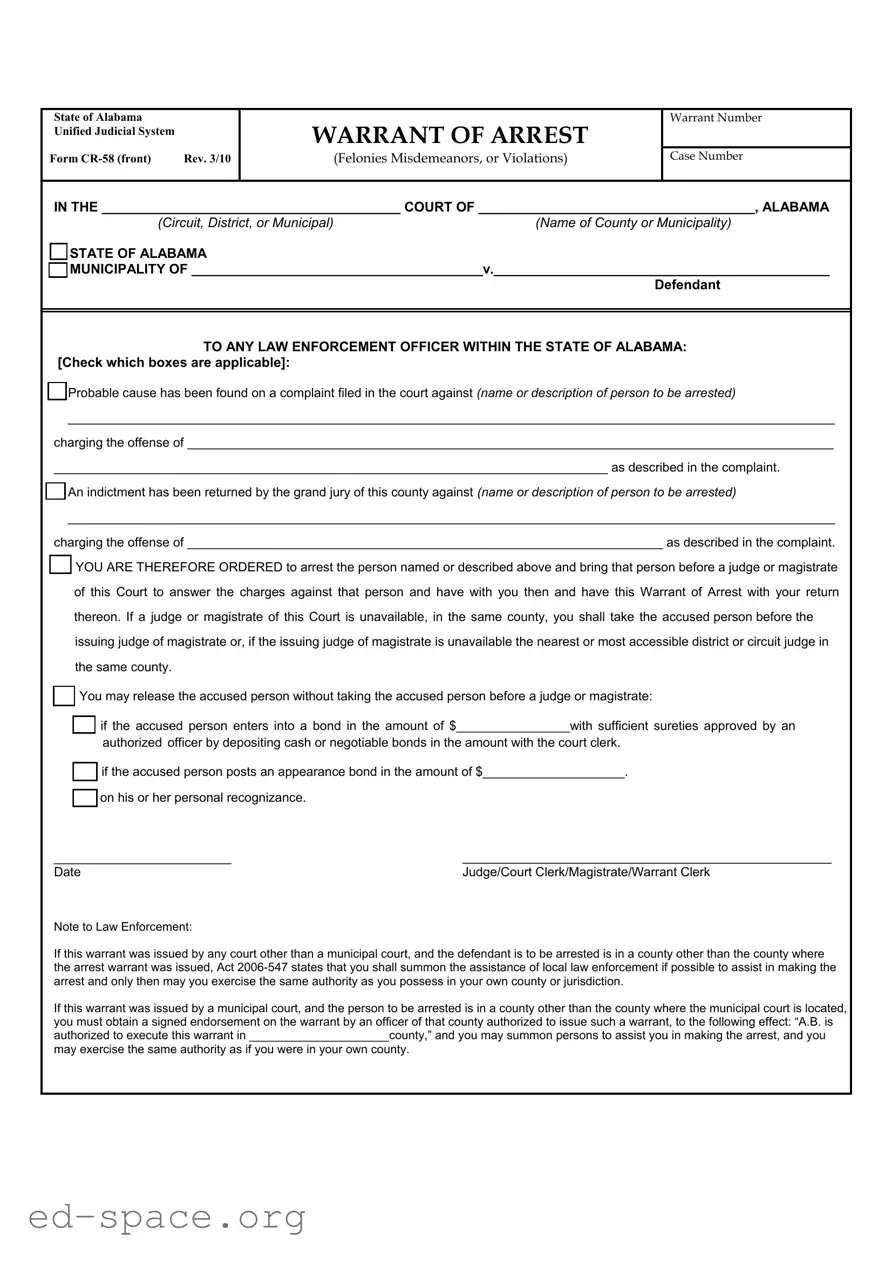
The Alabama CR-58 form is a critical document used in the state’s legal system to facilitate the issuance of arrest warrants. This form serves various purposes, including the authorization of law enforcement officers to apprehend individuals accused of felonies, misdemeanors, or violations. When a complaint is filed in court, the form allows a judge or magistrate to determine whether there is probable cause to issue a warrant. It includes essential details such as the name of the accused, the specific charges against them, and the court's jurisdiction. Additionally, the CR-58 form outlines procedures for the arrest, including instructions for law enforcement on how to proceed if the accused is located in a different county than where the warrant was issued. The form also provides options for the accused to be released under certain conditions, such as posting a bond or being released on personal recognizance. Furthermore, it includes a section for law enforcement to certify the execution of the warrant and gather pertinent information about the accused, including identification details and witness information. Overall, the Alabama CR-58 form plays a vital role in ensuring that the arrest process is conducted legally and efficiently, balancing the rights of the accused with the need for public safety.

State of Alabama |
|
|
WARRANT OF ARREST |
Warrant Number |
|
Unified Judicial System |
|
|
|||
|
|
|
|
||
|
|
|
|
|
|
Form |
|
Rev. 3/10 |
|
(Felonies Misdemeanors, or Violations) |
Case Number |
|
|
|
|||
IN THE ________________________________________ COURT OF _____________________________________, ALABAMA |
|||||
|
(Circuit, District, or Municipal) |
(Name of County or Municipality) |
|||
STATE OF ALABAMA
MUNICIPALITY OF _______________________________________v._____________________________________________
Defendant
TO ANY LAW ENFORCEMENT OFFICER WITHIN THE STATE OF ALABAMA:
[Check which boxes are applicable]:
Probable cause has been found on a complaint filed in the court against (name or description of person to be arrested)
____________________________________________________________________________________________________________
charging the offense of ___________________________________________________________________________________________
______________________________________________________________________________ as described in the complaint.
An indictment has been returned by the grand jury of this county against (name or description of person to be arrested)
____________________________________________________________________________________________________________
charging the offense of ___________________________________________________________________ as described in the complaint.
YOU ARE THEREFORE ORDERED to arrest the person named or described above and bring that person before a judge or magistrate of this Court to answer the charges against that person and have with you then and have this Warrant of Arrest with your return thereon. If a judge or magistrate of this Court is unavailable, in the same county, you shall take the accused person before the issuing judge of magistrate or, if the issuing judge of magistrate is unavailable the nearest or most accessible district or circuit judge in the same county.
You may release the accused person without taking the accused person before a judge or magistrate:
if the accused person enters into a bond in the amount of $________________with sufficient sureties approved by an
authorized officer by depositing cash or negotiable bonds in the amount with the court clerk. if the accused person posts an appearance bond in the amount of $____________________.
on his or her personal recognizance.
_________________________ |
____________________________________________________ |
Date |
Judge/Court Clerk/Magistrate/Warrant Clerk |
Note to Law Enforcement:
If this warrant was issued by any court other than a municipal court, and the defendant is to be arrested is in a county other than the county where the arrest warrant was issued, Act
If this warrant was issued by a municipal court, and the person to be arrested is in a county other than the county where the municipal court is located, you must obtain a signed endorsement on the warrant by an officer of that county authorized to issue such a warrant, to the following effect: “A.B. is authorized to execute this warrant in _____________________county,” and you may summon persons to assist you in making the arrest, and you
may exercise the same authority as if you were in your own county.

Form |
WARRANT OF ARREST |
|
|
|
(Felonies, Misdemeanors, or Violations) |
|
CERTIFICATE OF EXECUTION |
I, the undersigned law enforcement officer, certify that I executed the foregoing WARRANT OF ARREST by arresting the accused person
named (or described) therein at ________________o’ clock |
|
a.m. |
|
p.m. on the__________ day of _______________________, __________. |
|||||||||
in ____________________________________________________ COUNTY, ALABAMA. |
|
|
|
|
|
|
|||||||
After arrest, the accused person was: |
|
|
|
|
|
|
|
|
|
|
|
||
|
|
Released as authorized at _________________o’clock |
a.m. |
|
p.m. |
________________, __________. |
|||||||
|
|
Taken before ( Judge) ( Magistrate) at ___________________o’ clock |
|
a.m. |
|
|
p.m. |
||||||
|
|
|
|
|
|||||||||
_______________________ ________. |
|
|
|
|
|
|
|
|
|
|
|
||
____________________________________ |
___________________________________________ |
|
|||||||||||
Date |
Signature/Title/Agency |
|
|
|
|
|
|
||||||
IDENTIFICATION OF ACCUSED PERSON
|
Name of Accused (or Alias) |
|
|
|
|
|
|
|
|
|
|
|
|
|
|
Telephone Number |
|||||||
|
|
|
|
|
|
|
|
|
|
|
|
|
|
|
|
|
|
|
|
|
|
|
|
|
Social Security Number |
|
Date of Birth |
|
|
|
Age |
Race |
|
Sex |
|
|
Height |
||||||||||
|
|
|
|
|
|
|
|
|
|
|
|
|
|
|
|
|
|
|
|
|
|
|
|
|
Weight |
|
Hair |
|
Eyes |
|
|
Other |
|
|
|
|
|
|
|
|
|||||||
|
|
|
|
|
|
|
|
|
|
|
|
|
|
|
|
|
|
|
|
|
|||
|
Address |
|
|
|
|
|
|
|
|
|
|
City |
|
|
State |
|
|
Zip Code |
|||||
|
|
|
|
|
|
|
|
|
|
|
|
|
|
|
|
|
|
|
|||||
|
Name of Employer |
|
|
|
|
|
|
|
|
|
|
|
|
|
Employer’s Telephone Number |
||||||||
|
|
|
|
|
|
|
|
|
|
|
|
|
|
|
|
|
|
|
|
||||
|
Address of Employer |
|
|
|
|
|
|
|
|
|
|
City |
|
|
State |
|
|
Zip Code |
|||||
|
|
|
|
|
|
|
|
|
|
|
|
|
|
|
|
|
|
|
|
|
|
|
|
|
|
|
|
|
|
|
|
|
|
|
|
|
|
WITNESSES |
|
|
|
|
|
|
|
|
|
|
|
|
|
|
|
|
|
|
|
|
|
|
|
|
|
|
|
|
|
|
|||
|
|
|
|
Name |
|
|
|
|
|
|
|
|
Address |
|
|
|
|
|
|
Telephone Number |
|||
________________________________________ |
|
|
______________________________________________ |
|
|
_________________________ |
|||||||||||||||||
________________________________________ |
|
|
______________________________________________ |
|
|
_________________________ |
|||||||||||||||||
________________________________________ |
|
|
______________________________________________ |
|
|
_________________________ |
|||||||||||||||||
________________________________________ |
|
|
______________________________________________ |
|
|
_________________________ |
|||||||||||||||||
|
|
|
|
|
|
|
|
|
|
|
|
|
|
|
|||||||||
|
|
|
|
|
|
|
|
|
|
|
|
|
|
|
|
|
|
|
|
|
|
|
|
|
|
|
|
ACKNOWLEDGEMENT BY ACCUSED PERSON |
|
|
|
||||||||||||||||
|
|
I hereby acknowledge that at the time of my release from custody I was directed to appear in person before the court, as follows: |
|||||||||||||||||||||
|
|
||||||||||||||||||||||
|
|
Place: ____________________________________________________________________________________ |
|
|
|
|
|||||||||||||||||
|
|
Date: _______________________________, ___________. |
|
|
|
|
|
|
|
|
|||||||||||||
|
|
Time: __________________o’ clock |
|
|
|
a.m. |
|
|
p.m., and as thereafter needed until discharge. |
|
|
|
|
||||||||||
|
|
|
|
|
|
|
|
|
|
|
|||||||||||||
|
|
I promise to appear as directed before the court, as follows: |
|
|
|
|
|
|
|
|
|||||||||||||
|
|
|
|
|
|
|
|
|
|
||||||||||||||
|
|
Place: ____________________________________________________________________________________ |
|
|
|
|
|||||||||||||||||
|
|
Date: _______________________________, ___________. |
|
|
|
|
|
|
|
|
|||||||||||||
|
|
Time: __________________o’ clock |
|
|
|
a.m. |
|
|
p.m., and as thereafter needed until discharge. |
|
|
|
|
||||||||||
|
|
|
|
|
|
|
|
|
|
|
|||||||||||||
____________________________________________ |
_______________________________________________________________ |
||||||||||||||||||||||
|
Date |
|
|
|
|
|
|
|
|
|
|
Signature of Accused Person |
|
|
|
|
|||||||
| Fact Name | Details |
|---|---|
| Purpose | The Alabama CR-58 form is used to issue a warrant of arrest for felonies, misdemeanors, or violations within the state. |
| Governing Law | This form is governed by Alabama state law, specifically under the Unified Judicial System regulations. |
| Issuing Authority | Warrants can be issued by circuit, district, or municipal courts in Alabama, depending on the nature of the offense. |
| Execution of Warrant | The law enforcement officer executing the warrant must bring the accused before a judge or magistrate without unnecessary delay. |
| Release Conditions | The accused may be released without seeing a judge if they post a bond or are released on personal recognizance, as specified in the form. |
Filling out the Alabama CR-58 form requires attention to detail to ensure all necessary information is provided accurately. Once completed, this form will facilitate the legal process related to the warrant of arrest.
What is the Alabama CR 58 form used for?
The Alabama CR 58 form, also known as the Warrant of Arrest, is utilized to authorize law enforcement officers to arrest individuals based on probable cause or an indictment. This form is necessary for both felonies and misdemeanors, ensuring that the legal process is followed when apprehending a suspect. It serves as an official document that outlines the charges against the accused and provides instructions for their arrest and subsequent court appearance.
Who can issue the Alabama CR 58 form?
The Alabama CR 58 form can be issued by judges, magistrates, or court clerks within the state of Alabama. The form must be filled out accurately, detailing the charges and the individual to be arrested. It is crucial that the person issuing the warrant has the appropriate authority to do so, as this ensures that the arrest is legally valid.
What should law enforcement officers do upon executing the CR 58 form?
Upon executing the CR 58 form, law enforcement officers are required to arrest the individual named in the warrant and bring them before a judge or magistrate. If the issuing judge or magistrate is unavailable, officers should take the accused to the nearest accessible judge within the same county. Additionally, officers may release the accused under certain conditions, such as posting a bond or being released on personal recognizance.
What information is required on the CR 58 form?
The CR 58 form requires several key pieces of information. This includes the name and description of the accused, the specific charges being filed, and the issuing court's details. It also requires the signature of the judge or court clerk and provides sections for the identification of the accused, witnesses, and the acknowledgment of the accused person regarding their court appearance obligations.
What happens if the accused is in a different county?
If the accused is located in a different county than where the warrant was issued, specific procedures must be followed. For warrants issued by courts other than municipal courts, local law enforcement assistance should be sought. If the warrant originates from a municipal court, the warrant must be endorsed by an authorized officer in the county where the arrest is to take place. This ensures that the arrest is conducted legally and effectively across county lines.
Failing to include the correct court name and location. This information is crucial for the warrant to be valid.
Not specifying the offense clearly. The charges must be detailed to avoid confusion during the arrest.
Leaving the date and time fields blank. These details help establish the timeline of the arrest.
Incorrectly identifying the defendant. Providing an accurate name or description is essential for the warrant's effectiveness.
Using outdated or incorrect form versions. Always ensure you are using the most recent version of the CR-58 form.
Not signing the form. A signature from the issuing judge or magistrate is necessary for the warrant to be valid.
Forgetting to include witness information. This can be important for establishing the context of the arrest.
Failing to provide identification details for the accused. This includes their address, phone number, and other identifying information.
Not following up on acknowledgment by the accused. Ensure that the accused person signs the acknowledgment of their release conditions.
The Alabama Cr 58 form is a crucial document used in the process of issuing a warrant of arrest. It serves as a formal request for law enforcement to apprehend an individual based on probable cause or an indictment. Alongside this form, several other documents often play significant roles in the legal proceedings that follow. Below is a brief overview of these documents.
These documents collectively ensure that the legal process is thorough and transparent. Each plays a distinct role in maintaining the integrity of the justice system, from the initial complaint to the eventual court proceedings.
The Alabama Cr 58 form, which is a warrant of arrest, shares similarities with several other legal documents used in the criminal justice system. Here are five documents that are comparable to the Cr 58 form, along with explanations of their similarities:
When filling out the Alabama CR-58 form, it is important to follow specific guidelines to ensure accuracy and compliance. Here are seven things you should and shouldn't do:
Understanding the Alabama Cr 58 form is essential for anyone involved in the legal process. However, several misconceptions exist regarding this form. Here are four common misunderstandings:
By clarifying these misconceptions, individuals can better navigate the legal landscape in Alabama.
Filling out and using the Alabama Cr 58 form involves several key considerations. Understanding these points can help ensure proper adherence to legal requirements.