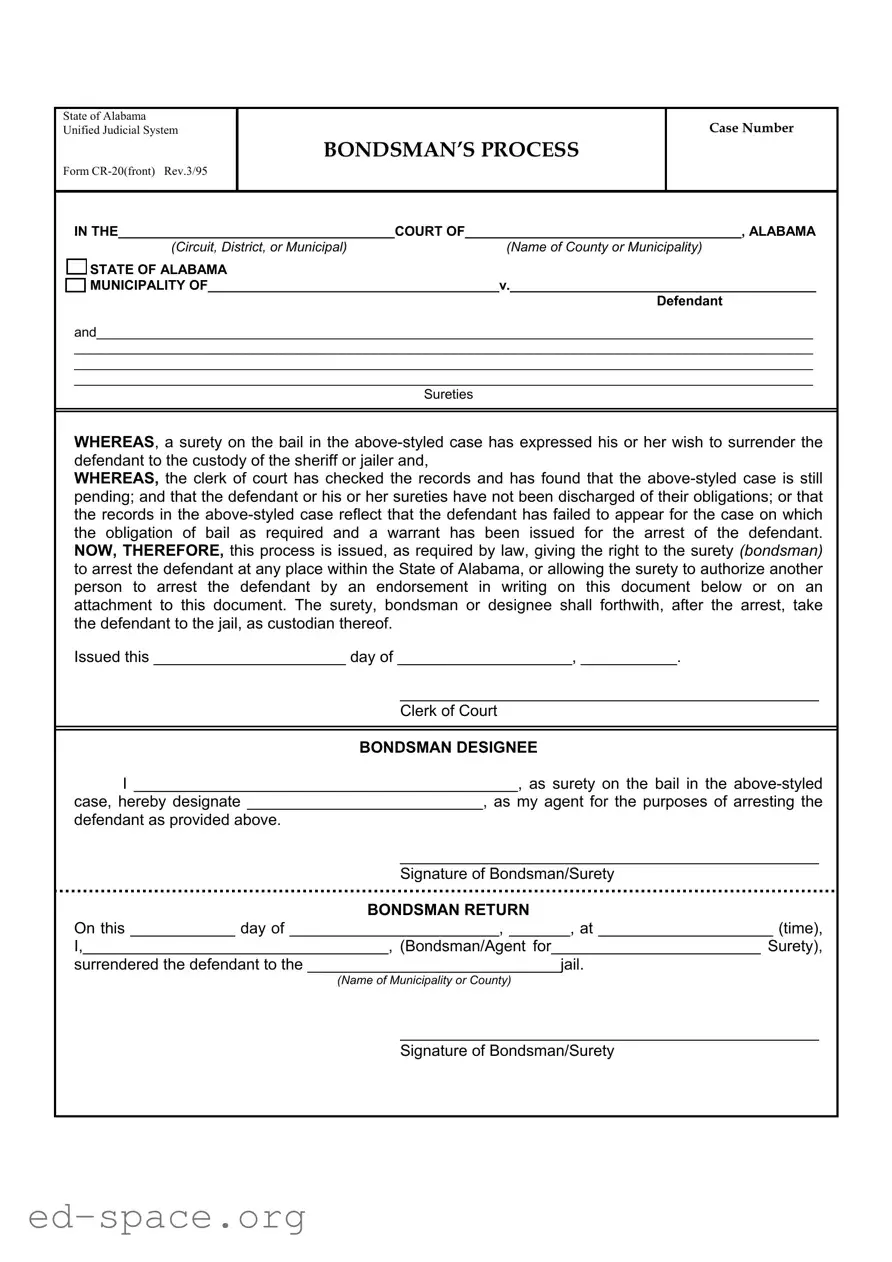
The Alabama Cr 20 form is an essential document in the state’s judicial system, particularly concerning the bail process. This form is utilized by sureties, often known as bondsmen, who are responsible for the release of defendants awaiting trial. When a surety wishes to surrender a defendant back to law enforcement, they must complete this form to initiate the process. The form outlines important details, such as the case number, court information, and the identities of both the defendant and the surety. It also grants the surety the legal authority to arrest the defendant and return them to custody. Additionally, the form includes provisions for designating an agent to carry out the arrest, ensuring that the surety can act even if they cannot be present. Furthermore, the Alabama Cr 20 form emphasizes the responsibilities of the bondsman and the jailer, including deadlines for returning the process to the court. Understanding the implications and requirements of this form is crucial for those involved in the bail process in Alabama.

State of Alabama Unified Judicial System
Form
BONDSMAN’S PROCESS
CASE NUMBER
IN THE_____________________________________COURT OF_____________________________________, ALABAMA
(Circuit, District, or Municipal)(Name of County or Municipality)
STATE OF ALABAMA
MUNICIPALITY OF_______________________________________v._________________________________________
Defendant
and________________________________________________________________________________________________
___________________________________________________________________________________________________
___________________________________________________________________________________________________
___________________________________________________________________________________________________
Sureties
WHEREAS, a surety on the bail in the
WHEREAS, the clerk of court has checked the records and has found that the
Issued this ______________________ day of ____________________, ___________.
________________________________________________
Clerk of Court
BONDSMAN DESIGNEE
I ____________________________________________, as surety on the bail in the
case, hereby designate ___________________________, as my agent for the purposes of arresting the
defendant as provided above.
________________________________________________
Signature of Bondsman/Surety
BONDSMAN RETURN
On this ____________ day of ________________________, _______, at ____________________ (time),
I,___________________________________, (Bondsman/Agent for________________________ Surety),
surrendered the defendant to the _____________________________jail.
(Name of Municipality or County)
________________________________________________
Signature of Bondsman/Surety

FORM
BONDSMAN’S PROCESS
NOTICE TO BONDSMAN OR BONDMAN’S DESIGNEE
(1)When notified by the clerk of court to return this process, you must return it within five (5) days of receiving the notice.
(2)Execution of this process after the defendant has been discharged is an illegal arrest.
NOTICE TO THE JAILER
Upon receipt of this Bondsman’s Process, you must return this Process to the clerk within five (5) days of receipt.
IDENTIFICATION OF ACCUSED PERSON
Name of Accused Person |
|
|
|
|
|
|
|
Telephone Number |
||||||
|
|
|
|
|
|
|
|
|
|
|
|
|
|
|
Social Security Number |
|
Date of Birth |
|
|
Age |
Race |
|
Sex |
|
Height |
||||
|
|
|
|
|
|
|
|
|
|
|
|
|
|
|
Weight |
|
Hair |
Eyes |
Other |
|
|
|
|
|
|
|
|
||
|
|
|
|
|
|
|
|
|
|
|
|
|
||
Address |
|
|
City |
|
|
|
|
State |
|
Zip Code |
||||
|
|
|
|
|
|
|
|
|
|
|
||||
Name of Employer |
|
|
|
|
|
|
|
Employer’s Telephone Number |
||||||
|
|
|
|
|
|
|
|
|
|
|
|
|
||
Address of Employer |
|
|
|
|
City |
|
|
|
|
State |
|
Zip Code |
||
|
|
|
|
|
|
|
|
|
|
|
|
|
|
|
| Fact Name | Description |
|---|---|
| Form Title | The official title of the form is "Bondsman’s Process," designated as CR-20 by the State of Alabama Unified Judicial System. |
| Governing Law | This form is governed by Alabama state law, specifically related to bail and surety processes. |
| Purpose | The form allows a surety or bondsman to surrender a defendant to the custody of law enforcement when the defendant has failed to appear in court. |
| Jurisdiction | The form is applicable in various courts across Alabama, including Circuit, District, and Municipal courts. |
| Timeframe for Return | Bondsmen must return the process to the clerk of court within five days of receiving notice to do so. |
| Illegal Arrest | Executing the process after the defendant has been discharged from bail obligations constitutes an illegal arrest. |
| Identification Requirements | The form requires detailed identification information about the accused, including personal details such as name, date of birth, and physical characteristics. |
Filling out the Alabama CR-20 form requires careful attention to detail. This form is essential for a bondsman or surety who needs to surrender a defendant to law enforcement. Once the form is completed, it will need to be submitted to the appropriate court or jail as specified. Here’s a straightforward guide to help you through the process.
What is the Alabama Cr 20 form used for?
The Alabama Cr 20 form is a legal document that allows a bondsman or surety to surrender a defendant to the custody of law enforcement. This process is necessary when a surety wishes to take action due to a defendant's failure to appear in court or other circumstances that warrant their return to custody. It provides the legal authority for the bondsman to arrest the defendant anywhere in the state of Alabama.
Who can use the Alabama Cr 20 form?
This form is intended for use by bondsmen or sureties who have posted bail for a defendant. If a bondsman believes that the defendant has violated the terms of their bail, they can utilize this form to formally surrender the defendant to law enforcement. Additionally, a bondsman may designate another person to assist in this process.
What information is required on the Alabama Cr 20 form?
The form requires several key pieces of information, including the case number, the names of the court and municipality, the defendant's details, and the bondsman's information. It also includes sections for the designation of an agent by the bondsman and for the bondsman's return of the defendant to jail.
What happens if the defendant has been discharged?
If the defendant has been discharged from their obligations, executing the Alabama Cr 20 form to arrest them would be considered an illegal act. This is a crucial point for bondsmen to understand, as it can lead to legal repercussions if not followed correctly.
How long does a bondsman have to return the process to the clerk of court?
Once notified by the clerk of court, a bondsman must return the process within five days. This timeframe is essential to ensure that all legal procedures are followed and that the case remains active in the court system.
What should a jailer do upon receiving the Alabama Cr 20 form?
Upon receiving the Bondsman’s Process, the jailer is required to return the document to the clerk of court within five days. This ensures that the court maintains accurate records regarding the status of the defendant and the actions taken by the bondsman.
Can a bondsman authorize someone else to arrest the defendant?
Yes, a bondsman can designate another person to arrest the defendant by providing written authorization on the form. This allows the bondsman to delegate the responsibility while still maintaining legal authority over the process.
What details about the accused person are needed on the form?
The form requires comprehensive information about the accused, including their name, contact information, Social Security number, date of birth, physical description, and employment details. This information helps to accurately identify the defendant and facilitate the arrest process.
What are the consequences of not following the instructions on the Alabama Cr 20 form?
Failing to adhere to the instructions outlined on the Alabama Cr 20 form can result in serious consequences. This includes potential legal action against the bondsman for illegal arrest or failure to comply with court orders. It is crucial for bondsmen to understand their responsibilities and follow the process as required by law.
Incomplete Information: Failing to provide all required details can lead to delays or rejections. Ensure that every section of the form is filled out completely, including the case number, names, and contact information.
Incorrect Signatures: Signatures must match the names listed on the form. A mismatch can raise questions about the validity of the document. Double-check that the bondsman and designee have signed where necessary.
Missing Dates: Dates are crucial for the processing of the form. Omitting the date of issuance or the date of surrender can cause confusion and may lead to processing delays. Always include accurate dates.
Failure to Notify the Clerk: After completing the process, it is important to notify the clerk of court. Not doing so within the required timeframe can result in legal complications. Follow up promptly to ensure compliance.
The Alabama Cr 20 form is a crucial document used in the process of surrendering a defendant by a bondsman. However, several other forms and documents often accompany it, each serving specific purposes within the judicial system. Understanding these documents can provide clarity on the legal processes involved in bail and surrender situations.
Each of these documents plays a vital role in the bail process and the judicial system's overall functioning. Familiarity with them can aid individuals navigating these legal waters, ensuring that all necessary steps are taken correctly and efficiently.
The Alabama CR 20 form serves a specific purpose in the legal process involving bail and the surrender of defendants. Several other documents share similarities with this form, particularly in their function and structure. Below is a list of documents that are comparable to the Alabama CR 20 form:
When filling out the Alabama CR-20 form, it is important to follow specific guidelines to ensure accuracy and compliance. Below is a list of actions to take and avoid.
Adhering to these guidelines will help ensure that the process runs smoothly and legally. Proper completion of the CR-20 form is essential for the effective management of bail and custody issues in Alabama.
This form can be used in various types of cases, including civil matters where a surety is involved. It is not limited to criminal proceedings.
While the bondsman is primarily responsible for completing the form, a designated agent can also fill it out on their behalf. This allows for flexibility in handling the process.
The form should be submitted after the arrest, but it is essential to adhere to the timelines specified in the instructions. For example, the bondsman must return the process within five days of notification from the clerk.
The bondsman has the right to arrest the defendant anywhere within the State of Alabama, but they must still comply with legal guidelines and procedures outlined in the form.
This is incorrect. If the defendant has been discharged, executing the process would result in an illegal arrest. The bondsman must verify the status of the defendant before proceeding.
All information requested on the Alabama Cr 20 form is necessary for proper processing. Incomplete forms may lead to delays or complications in the arrest process.
Filling out and using the Alabama CR-20 form involves several important steps and considerations. Below are key takeaways to keep in mind: