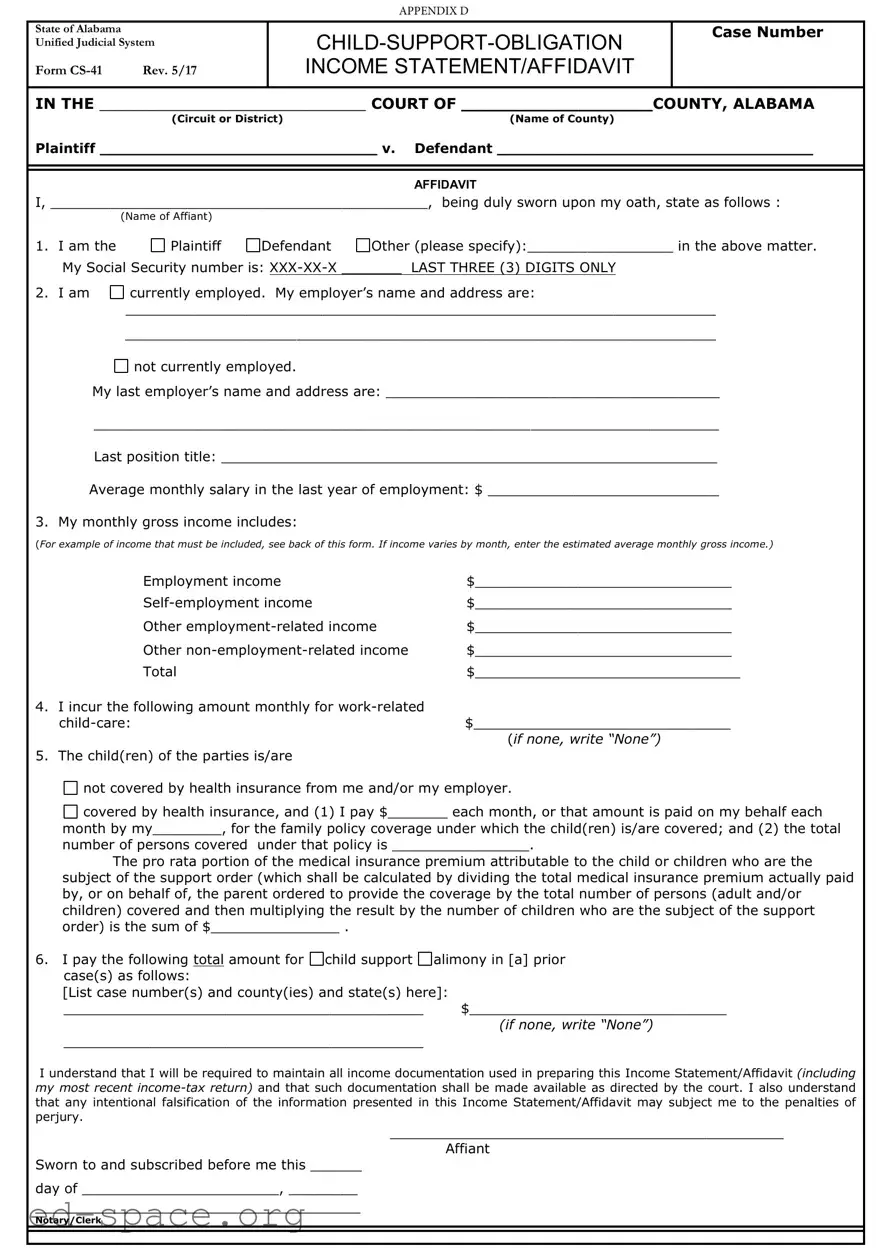
The Alabama Child Support Income form, officially known as the Income Statement/Affidavit, plays a critical role in determining child support obligations in the state. This form collects essential financial information from both parents involved in a child support case, ensuring that the court has a clear picture of each parent's income and expenses. It requires the affiant to disclose their employment status, including the name and address of their employer, or details about their last employer if currently unemployed. The form also asks for a breakdown of monthly gross income, which encompasses various sources such as employment income, self-employment income, and other related earnings. Additionally, it addresses work-related child-care costs and health insurance coverage for the child or children in question. The affiant must also report any existing child support or alimony obligations from prior cases. By gathering this information, the form helps the court establish fair and equitable child support arrangements that reflect the financial realities of both parents. Completing this form accurately is crucial, as any intentional misrepresentation can lead to serious legal consequences.

|
|
|
|
|
APPENDIX D |
|
|
State of Alabama |
|
|
|
Case Number |
|||
Unified Judicial System |
|
|
|
||||
Form |
Rev. 5/17 |
|
|
INCOME STATEMENT/AFFIDAVIT |
|
||
|
|
|
|||||
IN THE ____________________________ COURT OF __________________COUNTY, ALABAMA |
|||||||
|
(Circuit or District) |
|
|
(Name of County) |
|
||
Plaintiff _____________________________ v. |
Defendant _________________________________ |
||||||
|
|
|
|
|
|
|
|
|
|
|
|
|
|
|
|
|
|
|
|
|
|
AFFIDAVIT |
|
I, ____________________________________________, being duly sworn upon my oath, state as follows : |
|||||||
(Name of Affiant) |
|
|
|
|
|
|
|
1. I am the |
Plaintiff |
Defendant |
Other (please specify):_________________ in the above matter. |
||||
My Social Security number is: |
LAST THREE (3) DIGITS ONLY |
|
|||||
2. I am |
currently employed. My employer’s name and address are: |
|
|||||
|
_____________________________________________________________________ |
||||||
_____________________________________________________________________
not currently employed.
My last employer’s name and address are: _______________________________________
_________________________________________________________________________
Last position title: __________________________________________________________
Average monthly salary in the last year of employment: $ ___________________________
3. My monthly gross income includes:
(For example of income that must be included, see back of this form. If income varies by month, enter the estimated average monthly gross income.)
|
Employment income |
$______________________________ |
|
$______________________________ |
|
|
Other |
$______________________________ |
|
Other |
$______________________________ |
|
Total |
$_______________________________ |
4. |
I incur the following amount monthly for |
|
|
$______________________________ |
|
|
|
(if none, write “None”) |
5. |
The child(ren) of the parties is/are |
|
not covered by health insurance from me and/or my employer.
covered by health insurance, and (1) I pay $_______ each month, or that amount is paid on my behalf each
month by my________, for the family policy coverage under which the child(ren) is/are covered; and (2) the total
number of persons covered under that policy is ________________.
The pro rata portion of the medical insurance premium attributable to the child or children who are the subject of the support order (which shall be calculated by dividing the total medical insurance premium actually paid by, or on behalf of, the parent ordered to provide the coverage by the total number of persons (adult and/or children) covered and then multiplying the result by the number of children who are the subject of the support order) is the sum of $_______________ .
6.I pay the following total amount for child support alimony in [a] prior case(s) as follows:
[List case number(s) and county(ies) and state(s) here]:
__________________________________________ $______________________________
(if none, write “None”)
__________________________________________
I understand that I will be required to maintain all income documentation used in preparing this Income Statement/Affidavit (including my most recent
______________________________________________
Affiant
Sworn to and subscribed before me this ______
day of _______________________, ________
______________________________________
Notary/Clerk

Form
EXAMPLES OF INCOME THAT MUST BE INCLUDED IN YOUR GROSS MONTHLY INCOME
1.Employment Income – shall include, but not be limited to, salary, wages, bonuses, commissions, severance pay, worker’s compensation, pension income, unemployment insurance, disability insurance, and Social Security benefits.
2.
3.Other
4.Other
RULE 32, ALABAMA RULES OF JUDICIAL ADMINISTRATION, PROVIDES THE FOLLOWING DEFINITIONS:
Income. For purposes of the guidelines specified in this Rule, “income” means the actual gross income of a parent, if the parent is employed to full capacity, or if the parent is unemployed or underemployed, then it means the actual gross income the parent has the ability to earn.
Gross Income.
“Gross income” includes income from any source, and includes, but is not limited to, income from salaries,
wages, commissions, bonuses, dividends, severance pay, pensions, interest, trust income, annuities, capital gains, Social Security benefits, workers’ compensation benefits,
insurance benefits, gifts, prizes, and preexisting periodic alimony.
“Gross income” does not include child support received for other children or benefits received from means- tested
For income from
expenses required to produce such income, as allowed by the Internal Revenue Service, with the exceptions noted in Rule 32 (B)(3)(b).
Under those exceptions, “ordinary and necessary expenses” does not include amounts allowable by the Internal Revenue Service for the accelerated component of depreciation expenses, investment tax credits, or any other business expenses determined by the court to be inappropriate for determining gross income for purposes of calculating child support.
Other Income. Expense reimbursements or
| Fact Name | Description |
|---|---|
| Form Title | The official title of the form is "Alabama Child Support Income Statement/Affidavit." It is designated as Form CS-41. |
| Governing Law | The form is governed by Rule 32 of the Alabama Rules of Judicial Administration, which outlines income definitions for child support calculations. |
| Affidavit Requirement | The affiant must swear to the accuracy of the information provided in the form, affirming its truthfulness under penalty of perjury. |
| Income Documentation | Affiants are required to maintain all income documentation used to prepare the affidavit, including recent tax returns. |
| Monthly Income Categories | The form requires the reporting of various income types, including employment income, self-employment income, and other related income. |
| Child Care Expenses | Affiants must disclose any monthly work-related child care expenses incurred, or indicate if there are none. |
| Health Insurance Information | The form asks whether the child(ren) are covered by health insurance and requires details about premiums and coverage. |
Completing the Alabama Child Support Income form is an essential step in the child support process. This form requires accurate and detailed information about your income and related expenses. Gathering the necessary documentation beforehand will help streamline the process and ensure that all required fields are filled out correctly.
What is the purpose of the Alabama Child Support Income form?
The Alabama Child Support Income form is used to provide a clear picture of a parent's financial situation. It helps the court determine the appropriate amount of child support based on the income and expenses of the parent. By filling out this form, parents can ensure that their financial circumstances are accurately represented in court.
Who needs to fill out this form?
What information is required on the form?
What types of income should be reported?
What happens if my income changes after submitting the form?
Is there a penalty for providing false information on the form?
How long do I need to keep documentation related to my income?
Incomplete Information: Failing to provide all required details can lead to delays. Ensure that every section of the form is filled out completely, including your name, Social Security number, and employment details.
Incorrect Income Reporting: Misreporting income is a common mistake. Be sure to include all sources of income, such as wages, bonuses, and self-employment earnings. This will help avoid discrepancies later on.
Neglecting Childcare Expenses: Forgetting to include work-related childcare costs can impact your financial obligations. If you incur such expenses, list them accurately, or indicate "None" if applicable.
Health Insurance Details Omitted: Not providing information about health insurance coverage for the child(ren) can lead to complications. Clearly state whether the children are covered and include the relevant costs.
Ignoring Prior Child Support Obligations: Failing to disclose existing child support or alimony payments can result in issues with the court. List all prior obligations to ensure transparency.
Not Maintaining Documentation: Forgetting to keep necessary documentation can create problems later. Retain all income-related documents, such as tax returns, for verification when required by the court.
Failure to Review for Accuracy: Submitting the form without a thorough review can lead to errors. Take the time to double-check all entries for accuracy before submitting the form.
Not Understanding the Definitions: Misunderstanding terms like "gross income" can lead to incorrect reporting. Familiarize yourself with the definitions provided in the guidelines to ensure compliance.
When navigating child support matters in Alabama, several key forms and documents often accompany the Alabama Child Support Income form. Each of these documents serves a specific purpose in ensuring that all financial aspects are accurately represented and considered during the support process.
Understanding these documents can help streamline the child support process and ensure that all necessary information is available for the court's consideration. Being prepared with the right forms can make a significant difference in achieving a fair and just outcome for all parties involved.
The Alabama Child Support Income form serves a crucial purpose in determining a parent’s financial obligations regarding child support. Several other documents share similarities with this form, each playing a role in various legal and financial contexts. Below is a list of nine documents that are comparable to the Alabama Child Support Income form, along with explanations of their similarities.
Each of these documents serves to clarify financial situations, ensuring that obligations, especially regarding child support, are understood and met. Understanding these similarities can help individuals navigate the complexities of family law and financial responsibilities.
When filling out the Alabama Child Support Income form, it's important to be thorough and accurate. Here are seven essential dos and don'ts to keep in mind:
By following these guidelines, you can help ensure that your form is completed correctly and efficiently.
Many believe that only those with a job need to fill out the Alabama Child Support Income form. In reality, even if someone is unemployed or underemployed, they must still complete the form. This includes providing information about previous employment and potential income they could earn.
Some people think that only salary is considered when calculating child support. However, the form requires all types of income to be reported. This includes self-employment income, bonuses, commissions, and even gifts or prizes.
It’s a common belief that prior child support payments do not affect the current calculation. In fact, the form asks for details about any ongoing child support or alimony payments. This information is crucial for determining the new support obligation.
Some individuals think they don’t need to disclose health insurance costs. This is not true. The form specifically asks for information on health insurance premiums related to the child(ren), and this can impact the overall support calculation.
Many assume that submitting the form is a one-off task. In reality, parents must keep their income documentation updated and may need to submit the form again if their financial situation changes.
Some people believe they can exaggerate or downplay their income without repercussions. This is a serious mistake. Intentionally providing false information can lead to penalties, including charges of perjury.
It is a common misunderstanding that only the paying parent is responsible for completing the form. Both parents may need to provide their financial information to ensure a fair assessment of child support obligations.
Many individuals shy away from completing the form due to its perceived complexity. However, the instructions are designed to be straightforward. With careful attention, most people can accurately report their income and expenses.
Some mistakenly believe that benefits from programs like food stamps or Temporary Assistance for Needy Families count as income. The form clearly states that these benefits are not included in the gross income calculation for child support purposes.
When filling out the Alabama Child Support Income form, understanding the requirements and implications is crucial. Here are some key takeaways to keep in mind:
Completing this form accurately is vital for ensuring that child support obligations are fair and based on true financial circumstances. Take your time to review each section carefully.