Homepage Blank Alabama Boa A PDF Form
Article Guide

The Alabama Boa A form is an essential document for individuals seeking to claim damages for personal injury or property damage caused by the state or its agencies. This form requires claimants to provide comprehensive information about the incident, including the date and location of the accident, a detailed statement of facts, and any supporting documentation that substantiates the claim. Claimants must sign the form and have it notarized, affirming that the information provided is truthful. It is crucial to file the claim within one year from the date of the injury or damage. The form also includes sections for detailing damages to personal property, personal injuries, and any permanent disabilities resulting from the incident. Additionally, claimants must disclose any insurance coverage they may have and the amounts claimed from other sources. Clear instructions guide the submission process, emphasizing the importance of attaching all relevant documents to avoid delays or complications in processing the claim. The Alabama Boa A form serves as a formal request for compensation, placing the responsibility on the claimant to provide adequate proof of their claim.
Document Preview

Form Specifications

Fact Name Details
Form Purpose This form is used to claim damages for personal injury or property damage, or both.
Governing Law The claims are governed by the Alabama Code, Title 41, Chapter 9.
Filing Deadline A claim must be filed within one year from the date of the injury or damage.
Claimant Verification The claimant must verify the information provided under oath before a notary public.
Communication Method All communications regarding the claim will be via fax or email unless specified otherwise.
Documentation Requirement Complete information and supporting documents must be attached to substantiate the claim.
Claimant Representation If represented by an attorney, all correspondence will be directed to the attorney.

Alabama Boa A: Usage Guidelines

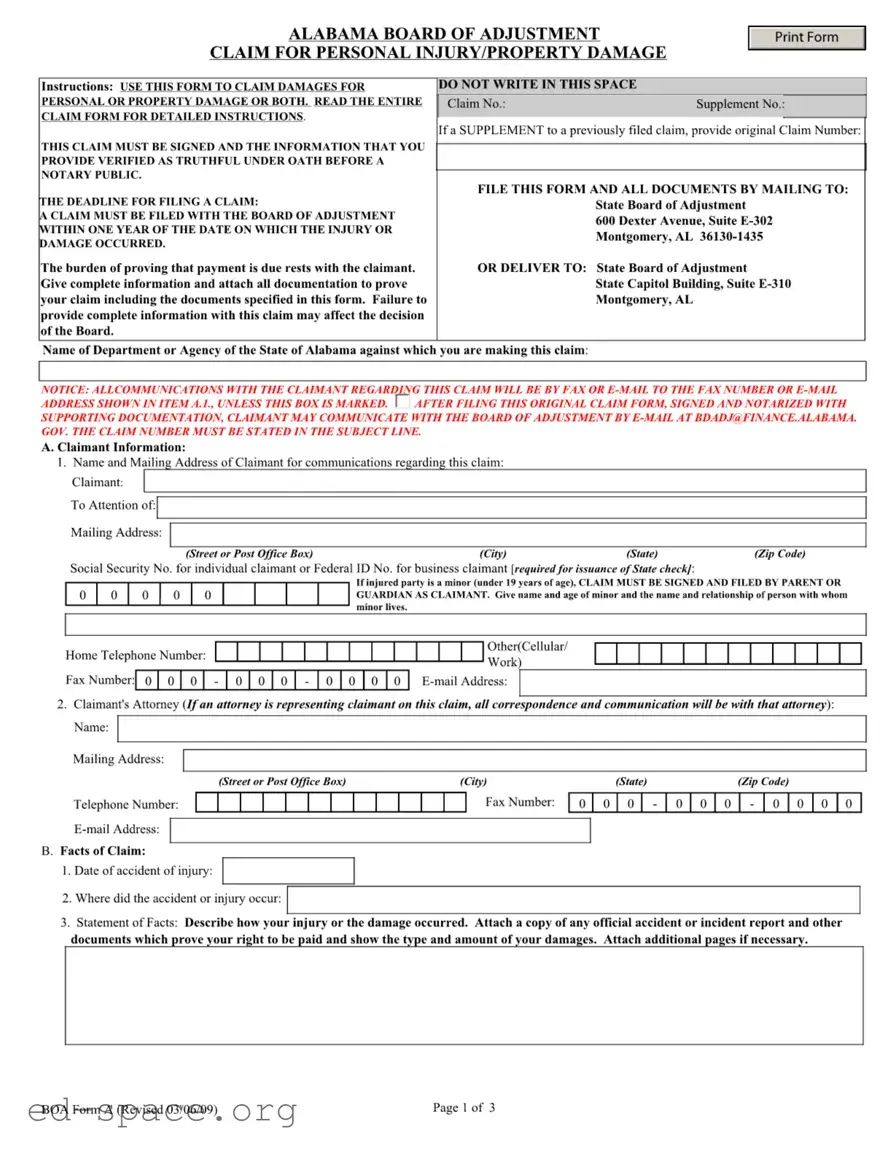
Filling out the Alabama Boa A form requires careful attention to detail. This form is essential for making a claim for personal injury or property damage. After completing the form, it must be signed and notarized before submission. Be sure to gather all necessary documentation to support your claim, as this will help ensure a smooth process.

  1. Print the form clearly and legibly.
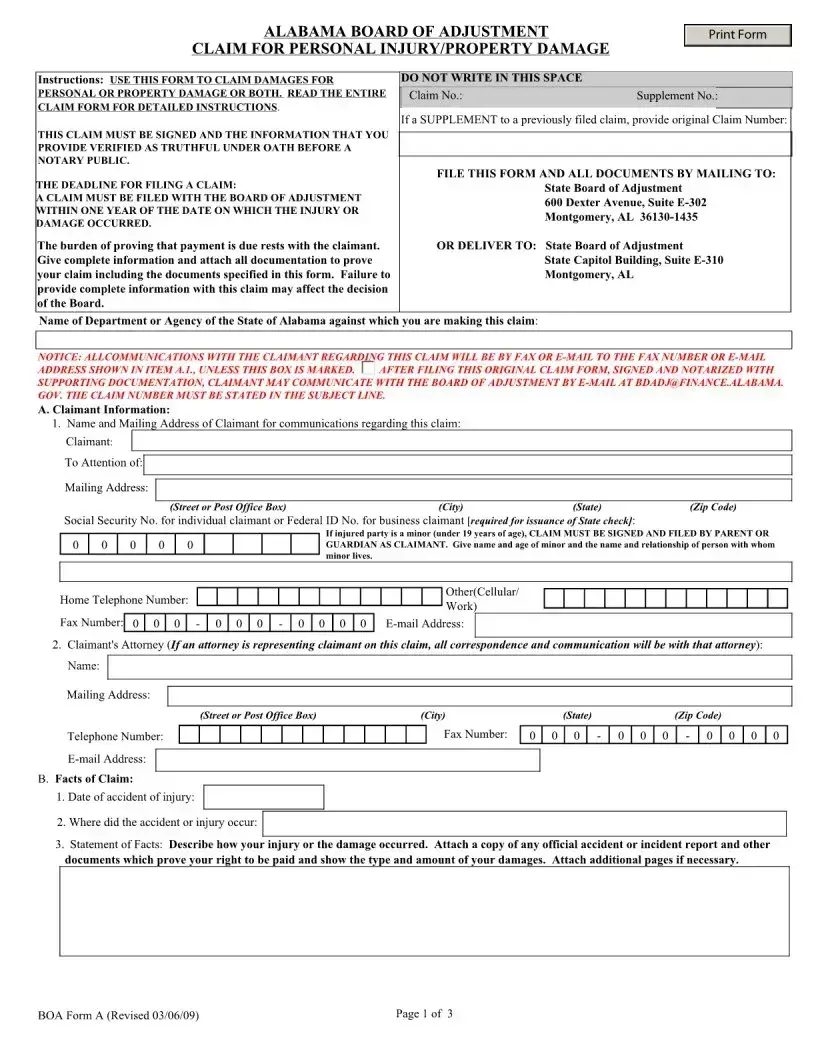
  2. In the top section, leave the "Claim No." and "Supplement No." fields blank.
  3. Identify the name of the department or agency of the State of Alabama against which you are making the claim.
  4. Fill in your personal information in section A. Include your Social Security Number or Federal ID Number, home telephone number, and email address.
  5. If applicable, provide information about the injured minor, including their name and age.
  6. If you have an attorney, fill in their details in section A. Include their name, mailing address, telephone number, and email address.
  7. In section B, provide the date of the accident or injury.
  8. Describe where the accident or injury occurred.
  9. Write a detailed statement of facts explaining how the injury or damage happened. Attach any official reports or documents that support your claim.
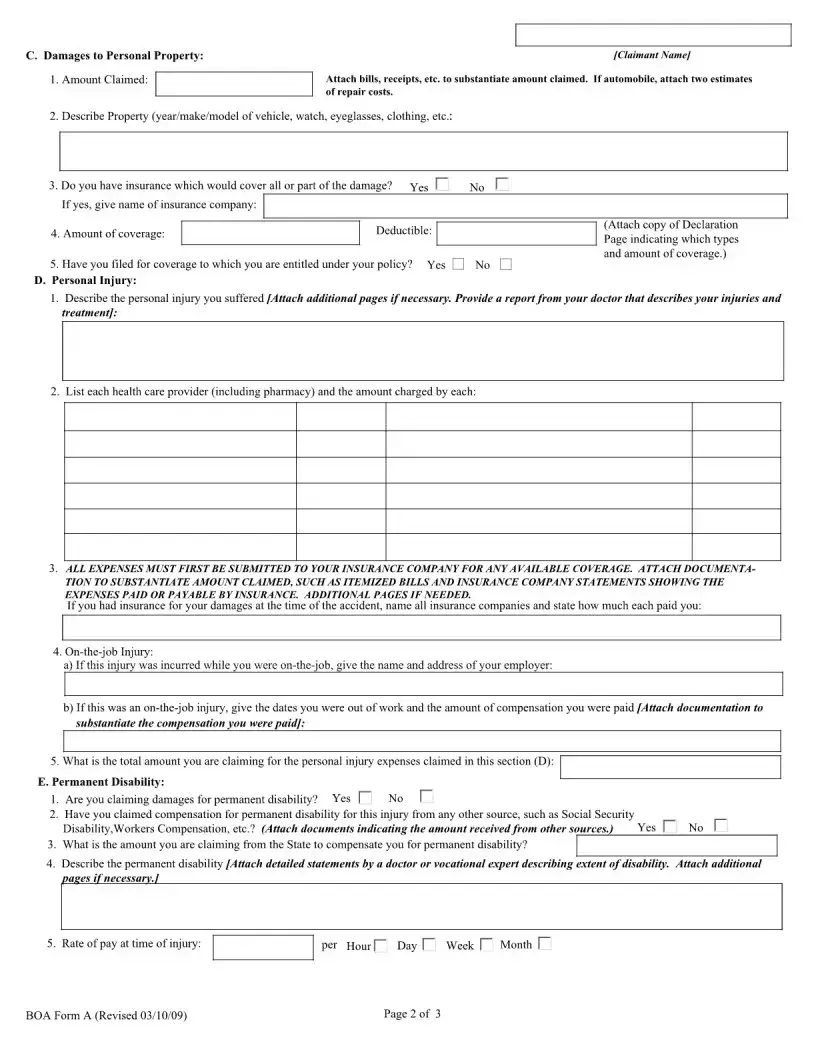
  10. In section C, list the amount claimed for personal property damage. Attach receipts or estimates to support this amount.
  11. Describe the property that was damaged, including details like year, make, and model.
  12. Indicate whether you have insurance that covers the damage. If yes, provide the name of the insurance company and the amount of coverage.
  13. In section D, describe the personal injury you suffered and attach any relevant medical reports.
  14. List each healthcare provider and the amount charged by each for your treatment.
  15. Submit all expenses to your insurance company first and attach documentation showing what was paid or payable by insurance.
  16. If applicable, provide details about your employer and any compensation received for on-the-job injuries.
  17. In section E, indicate if you are claiming damages for permanent disability and provide details about the disability.
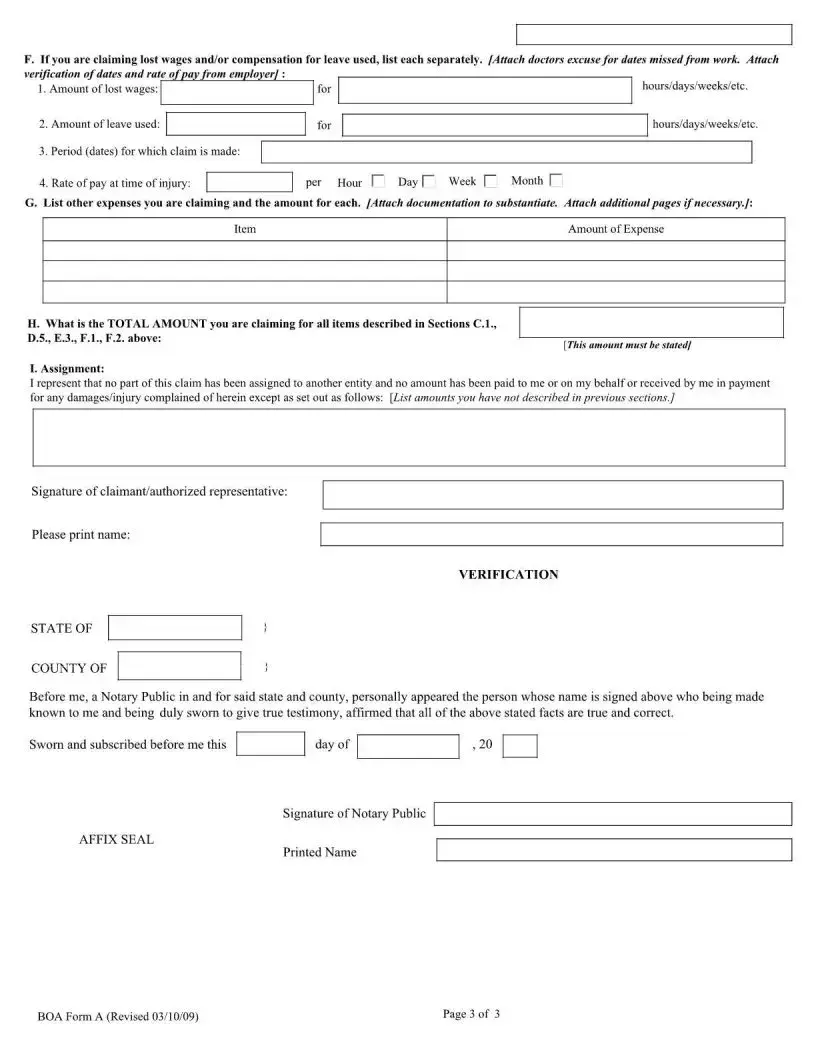
  18. In section F, list any lost wages or leave used, including the amount and period for which the claim is made.
  19. In section G, list any other expenses you are claiming and attach supporting documentation.
  20. Calculate and enter the total amount you are claiming in the designated field.
  21. Sign the form and print your name where indicated.
  22. Have the form notarized by a Notary Public.
  23. Mail the completed form and all supporting documents to the State Board of Adjustment at the address provided.

Your Questions, Answered

What is the Alabama Boa A form used for?

The Alabama Boa A form is specifically designed for individuals or businesses to claim damages for personal injury or property damage. This form allows claimants to formally request compensation from the State Board of Adjustment for losses they have suffered due to the actions or negligence of a state agency. It’s essential to provide thorough and accurate information to support your claim.

What is the deadline for filing a claim using the Alabama Boa A form?

Claims must be filed within one year from the date of the injury or damage. This time frame is crucial, as failing to submit your claim within this period may result in losing your right to seek compensation. It's advisable to gather all necessary documentation and complete the form promptly to meet this deadline.

What documentation is required when submitting the Alabama Boa A form?

When filing a claim, you must attach all relevant documentation to support your case. This includes accident reports, medical records, bills, receipts, and any other evidence that demonstrates the extent of your injury or property damage. Incomplete submissions may negatively impact the Board's decision, so be thorough in your documentation.

How should I submit the Alabama Boa A form and supporting documents?

You can submit the completed Alabama Boa A form and all supporting documents either by mailing them to the State Board of Adjustment at their Montgomery address or by delivering them in person to the State Capitol Building. Ensure that you keep copies of everything you send for your records.

What if the injured party is a minor?

If the injured party is under 19 years of age, the claim must be signed and filed by a parent or guardian. It’s important to provide the minor's name and age, as well as the name and relationship of the adult with whom the minor resides. This ensures that the claim is valid and properly processed.

What happens after I submit my claim?

After filing your claim, all communications regarding the claim will typically be conducted via fax or email. You will need to provide your contact information on the form to ensure that the Board can reach you. If you have an attorney representing you, they will handle communications on your behalf. Keep an eye on your email or fax for any updates or requests for additional information from the Board of Adjustment.

Common mistakes

  1. Incomplete Claimant Information: Failing to provide all necessary personal details, such as Social Security Number or Federal ID Number, can delay processing. Ensure that every field is filled out accurately.

  2. Missing Signature: The claim must be signed by the claimant. Omitting this step will result in immediate rejection of the form.

  3. Notarization Issues: The claim must be verified under oath before a notary public. Neglecting this requirement can invalidate the claim.

  4. Failure to Attach Supporting Documentation: It's essential to include all relevant documents, such as accident reports and medical bills. Missing these can weaken your claim.

  5. Ignoring the Filing Deadline: Claims must be submitted within one year of the incident. Late submissions will not be considered, so act promptly.

  6. Insufficient Description of the Incident: Providing vague or unclear details about how the injury or damage occurred can lead to misunderstandings. Be thorough in your explanation.

  7. Incorrect Amount Claimed: Ensure that the amount you are claiming is accurate and substantiated with proper documentation. Inaccuracies can lead to delays or denials.

Documents used along the form

The Alabama Board of Adjustment Claim for Personal Injury/Property Damage, commonly referred to as the Alabama Boa A form, is essential for individuals seeking compensation for damages. However, several other documents often accompany this claim to ensure that all necessary information is provided. Below is a list of these documents, each briefly described for clarity.

  • Accident Report: This official document details the circumstances of the incident, including the date, time, and location. It serves as crucial evidence to support the claim.
  • Medical Records: These documents include reports from healthcare providers that outline the injuries sustained and the treatment received. They are vital for substantiating claims related to personal injury.
  • Insurance Policy Declaration Page: This page provides an overview of the insurance coverage held by the claimant. It indicates the types of coverage and limits, which can affect the claim's outcome.
  • Repair Estimates: For claims involving property damage, two estimates from qualified repair services are often required. These estimates help establish the financial impact of the damage.
  • Wage Verification: Documentation from the employer that confirms the claimant's rate of pay and the dates missed due to injury is necessary for claims related to lost wages.
  • Verification of Other Compensation: If the claimant has received compensation from other sources, such as Workers' Compensation or Social Security Disability, documentation detailing these payments is required.
  • Notarized Affidavit: This document confirms the truthfulness of the claim and must be signed in the presence of a notary public. It adds an additional layer of credibility to the submission.

These documents collectively support the claim submitted through the Alabama Boa A form. Ensuring that all necessary documentation is included can significantly impact the efficiency and outcome of the claims process. If you have any questions about these documents, it is advisable to seek assistance to ensure a smooth experience.

Similar forms

  • Personal Injury Claim Form: Similar to the Alabama Boa A form, this document is used to claim damages for injuries sustained due to another party's negligence. It requires detailed information about the injury and supporting documentation.
  • Property Damage Claim Form: This form focuses specifically on damages to property, requiring claimants to provide evidence of the damage and its monetary value, much like the property section of the Boa A form.
  • Workers' Compensation Claim Form: This document is for employees who have been injured on the job. It shares similarities with the Boa A form in that it requires detailed information about the injury and related expenses.
  • Auto Accident Claim Form: Used to report damages from a vehicle accident, this form requires similar details about the incident and damages, including repair estimates and insurance information.
  • Medical Expense Claim Form: This document is utilized to claim reimbursement for medical expenses incurred due to an injury. It parallels the Boa A form by requiring detailed medical documentation and expense listings.
  • General Liability Claim Form: This form is used to claim damages from incidents covered under general liability insurance. It requires a statement of facts and evidence, similar to the Boa A form.
  • Homeowners Insurance Claim Form: Homeowners can use this form to report property damage or personal injury occurring on their property. It shares the need for documentation and a clear statement of damages.
  • Disability Claim Form: This form is for individuals seeking benefits due to a disability. It requires a detailed account of the disability and supporting medical documentation, akin to the permanent disability section of the Boa A form.
  • Life Insurance Claim Form: Beneficiaries use this form to claim benefits after the death of a policyholder. It requires proof of death and the relationship to the deceased, similar to the verification requirements in the Boa A form.
  • Insurance Subrogation Claim Form: This document is used when an insurance company seeks reimbursement for a claim it paid. It requires evidence of the original claim and damages, paralleling the Boa A form’s emphasis on supporting documentation.

Dos and Don'ts

When filling out the Alabama Board of Adjustment Claim Form, here are some important things to do and avoid:

  • Do read the entire claim form carefully before starting.
  • Do provide complete and accurate information to avoid delays.
  • Do attach all necessary documentation to support your claim.
  • Do ensure the form is signed and notarized before submission.
  • Don't miss the one-year deadline for filing your claim.
  • Don't leave any sections blank; fill in all required information.
  • Don't forget to include your claim number in all communications.
  • Don't submit the form without verifying your information is truthful.

Misconceptions

Misconceptions about the Alabama Boa A form can lead to confusion and mistakes. Here are nine common misconceptions explained:

  • Filing is optional. Many believe that submitting the claim form is optional. In reality, if you want to seek damages, you must file this claim within one year of the incident.
  • Notarization isn't necessary. Some think they can submit the form without notarization. However, the claim must be signed and verified under oath before a notary public.
  • Any documentation is sufficient. It’s a common belief that any documents will do. The form specifically requires complete information and relevant documentation to support your claim.
  • Claims can be filed at any time. Many people assume they can file their claims whenever they want. The truth is, there is a strict one-year deadline from the date of the injury or damage.
  • Insurance information is optional. Some claimants think they can skip providing insurance details. In fact, you must disclose any insurance coverage related to the damages claimed.
  • Lost wages don’t need documentation. It’s a misconception that you can simply state lost wages without proof. You must attach verification of the dates missed and the rate of pay from your employer.
  • Only physical injuries qualify. Many believe only physical injuries can be claimed. However, you can also claim for property damage and related expenses.
  • Once filed, no further communication is needed. Some think that after filing, they don’t need to follow up. In reality, communication with the Board may be necessary, especially regarding additional documentation or updates.
  • Claim amounts are set in stone. People often believe that the amount they claim is final. However, the Board may adjust the amount based on the evidence provided.

Understanding these misconceptions can help you navigate the claims process more effectively. Always read the instructions carefully and ensure that you provide all necessary information to support your claim.

Key takeaways

When dealing with the Alabama Boa A form, it's essential to understand the key aspects of filling it out and using it effectively. Here are some important takeaways:

  • Deadline for Filing: You must submit your claim within one year from the date of the injury or damage. Late submissions will not be accepted.
  • Complete Information Required: Provide all necessary details and documentation to support your claim. Incomplete submissions may lead to delays or denial of your claim.
  • Notarization is Mandatory: Your claim must be signed and verified under oath before a notary public. This step is crucial for the legitimacy of your submission.
  • Communication Preferences: Specify how you prefer to receive communications regarding your claim. If you do not mark the box, correspondence will be sent via fax or email.
  • Insurance Information: If you have insurance that covers any part of your damages, you must provide details about your policy, including coverage amounts and deductibles.
  • Document Everything: Attach all relevant documents, such as medical reports, accident reports, and receipts. This evidence is vital for substantiating your claim.

By keeping these points in mind, you can navigate the claims process more smoothly and increase your chances of a favorable outcome.