Homepage Free Bill of Sale Form for Alabama
Content Overview

When engaging in the sale or transfer of personal property in Alabama, having a Bill of Sale form is essential to ensure that both parties are protected and that the transaction is documented properly. This form serves as a written record of the sale, capturing critical details such as the names and addresses of both the buyer and seller, a description of the item being sold, and the agreed-upon purchase price. Additionally, it may include terms regarding warranties, conditions of the item, and any applicable disclosures. While it is commonly used for vehicles, the Bill of Sale can also apply to a variety of personal property, from furniture to electronics. Having this document not only helps to establish ownership but also provides legal proof of the transaction, which can be invaluable in case of disputes or future claims. Understanding the components and significance of the Alabama Bill of Sale form is vital for anyone looking to navigate the complexities of personal property transactions smoothly and securely.

Document Preview

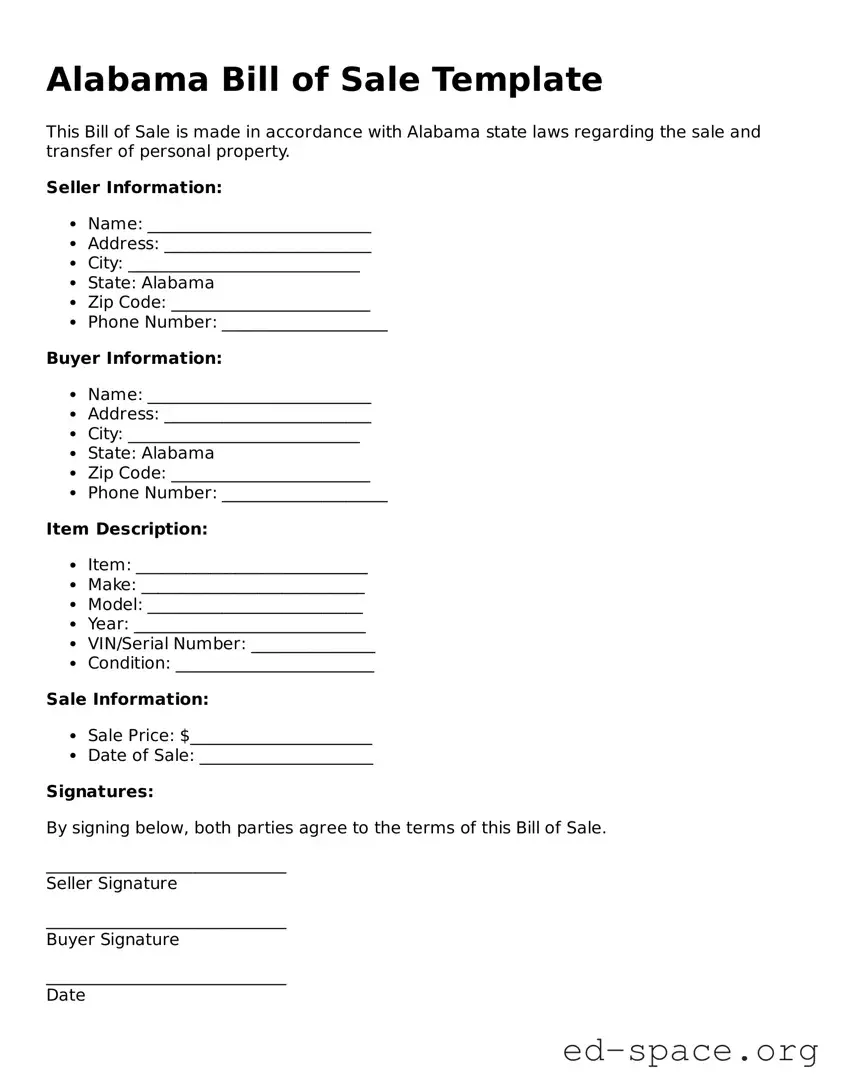
Alabama Bill of Sale Template

This Bill of Sale is made in accordance with Alabama state laws regarding the sale and transfer of personal property.

Seller Information:

  • Name: ___________________________
  • Address: _________________________
  • City: ____________________________
  • State: Alabama
  • Zip Code: ________________________
  • Phone Number: ____________________

Buyer Information:

  • Name: ___________________________
  • Address: _________________________
  • City: ____________________________
  • State: Alabama
  • Zip Code: ________________________
  • Phone Number: ____________________

Item Description:

  • Item: ____________________________
  • Make: ___________________________
  • Model: __________________________
  • Year: ____________________________
  • VIN/Serial Number: _______________
  • Condition: ________________________

Sale Information:

  • Sale Price: $______________________
  • Date of Sale: _____________________

Signatures:

By signing below, both parties agree to the terms of this Bill of Sale.

_____________________________
Seller Signature

_____________________________
Buyer Signature

_____________________________
Date

PDF Form Details

Fact Name Description
Definition The Alabama Bill of Sale is a legal document that records the transfer of ownership of personal property from one party to another.
Governing Law This form is governed by the Alabama Code, specifically Title 7, which deals with the transfer of personal property.
Types of Property The Bill of Sale can be used for various types of personal property, including vehicles, boats, and equipment.
Notarization While notarization is not required for all Bill of Sale forms in Alabama, it is recommended for added legal protection.
Importance A Bill of Sale serves as proof of purchase and can be crucial for resolving disputes regarding ownership or condition of the item.

Alabama Bill of Sale: Usage Guidelines

After obtaining the Alabama Bill of Sale form, you will need to fill it out with the required information. This document serves to record the sale of personal property and will need to be signed by both the buyer and seller. Follow the steps below to complete the form accurately.

  1. Begin by entering the date of the transaction at the top of the form.
  2. Next, provide the full name and address of the seller. Make sure to include the street address, city, state, and ZIP code.
  3. Then, fill in the full name and address of the buyer, following the same format as the seller's information.
  4. In the next section, describe the item being sold. Include details such as the make, model, year, and any identifying numbers (like VIN for vehicles).
  5. Specify the sale price of the item. Clearly state the amount in numbers and words to avoid confusion.
  6. Both the buyer and seller should sign the form. Include the date of each signature for clarity.
  7. If applicable, have a witness sign the form as well. Include their printed name and address.

Once you have completed these steps, review the document to ensure all information is accurate. Keep a copy for your records and provide a copy to the other party involved in the transaction.

Your Questions, Answered

What is a Bill of Sale in Alabama?

A Bill of Sale in Alabama is a legal document that records the transfer of ownership of personal property from one person to another. This form is often used for vehicles, boats, and other valuable items. It serves as proof of the transaction and includes important details such as the names of the buyer and seller, a description of the item, and the sale price. Having a Bill of Sale can protect both parties by providing a clear record of the sale.

Is a Bill of Sale required in Alabama?

While a Bill of Sale is not legally required for all transactions in Alabama, it is highly recommended, especially for significant purchases like vehicles. For vehicles, the Alabama Department of Revenue requires a Bill of Sale when transferring ownership. This document helps establish the chain of ownership and can be important for registration and title purposes. Without it, the buyer may face challenges when trying to register the vehicle.

What information should be included in a Bill of Sale?

A comprehensive Bill of Sale should include several key pieces of information. Start with the full names and addresses of both the buyer and seller. Next, provide a detailed description of the item being sold, including its make, model, year, and any identifying numbers, like a VIN for vehicles. Additionally, include the sale price and the date of the transaction. Both parties should sign the document to confirm the agreement. This information ensures clarity and can help prevent disputes in the future.

Can I create my own Bill of Sale in Alabama?

Yes, you can create your own Bill of Sale in Alabama. There are no specific forms mandated by the state, so you have the flexibility to draft a document that meets your needs. However, it’s essential to include all necessary information to make it legally binding. You can also find templates online that can serve as a guide. Just ensure that both parties review and sign the document to finalize the transaction.

Common mistakes

  1. Failing to provide accurate vehicle information. This includes the make, model, year, and VIN. Incorrect details can lead to future complications.

  2. Not including the purchase price. Leaving this blank can create issues for both the buyer and seller, especially regarding taxes.

  3. Omitting dates. Always include the date of the transaction. This is crucial for record-keeping and legal purposes.

  4. Neglecting to sign the document. Both parties must sign the Bill of Sale. Without signatures, the document is not legally binding.

  5. Using incorrect names. Ensure that the names of both the buyer and seller are spelled correctly and match official identification.

  6. Not providing contact information. Include phone numbers or email addresses for both parties to facilitate future communication.

  7. Forgetting to include any warranties or disclaimers. Clearly state if the sale is "as-is" or if any warranties are provided.

  8. Leaving out additional terms. If there are special conditions related to the sale, include them in the document.

  9. Not keeping a copy. Both parties should retain a copy of the Bill of Sale for their records. This can be important for future reference.

  10. Failing to verify local regulations. Different counties may have specific requirements for Bill of Sale forms. Always check local laws to ensure compliance.

Documents used along the form

The Alabama Bill of Sale is an essential document for transferring ownership of personal property. However, several other forms and documents are often used in conjunction with it to ensure a smooth transaction. Below are five important documents that you may encounter.

  • Title Transfer Document: This document is crucial for transferring the legal ownership of a vehicle. It provides proof that the seller has relinquished ownership and that the buyer has accepted it.
  • Odometer Disclosure Statement: Required for vehicle sales, this statement confirms the mileage on the vehicle at the time of sale. It helps prevent fraud related to odometer tampering.
  • Sales Agreement: This contract outlines the terms of the sale, including price, payment method, and any warranties. It serves as a reference for both parties in case of disputes.
  • Receipt: A simple yet important document, a receipt acknowledges that payment has been made. It provides proof of the transaction and can be useful for record-keeping.
  • Affidavit of Identity: This document verifies the identity of the seller and buyer. It can help prevent fraudulent transactions by confirming that both parties are who they claim to be.

Using these documents alongside the Alabama Bill of Sale can help ensure that all aspects of the transaction are legally sound and transparent. Proper documentation protects both the buyer and seller, providing clarity and security throughout the process.

Similar forms

  • Purchase Agreement: This document outlines the terms and conditions of a sale between a buyer and a seller. Like a Bill of Sale, it serves to confirm the transfer of ownership of an item, typically including details about the price and any warranties.
  • Title Transfer Document: Used primarily for vehicles, this document officially transfers ownership from one party to another. Similar to a Bill of Sale, it provides proof of ownership and is often required for registration purposes.
  • Lease Agreement: While primarily used for rental situations, a lease agreement can also serve as a record of transfer of possession. It details the terms under which one party can use another's property, akin to how a Bill of Sale documents the transfer of ownership.
  • Gift Deed: This document is used when property is given as a gift rather than sold. Like a Bill of Sale, it legally acknowledges the transfer of ownership, although it typically does not involve a monetary exchange.
  • Receipt: A receipt serves as proof of payment and can be similar to a Bill of Sale in that it indicates a transaction has occurred. It may not always include detailed terms but confirms the exchange of goods or services.
  • Inventory List: Often used in business transactions, an inventory list details items being sold or transferred. While it may not serve as a legal document like a Bill of Sale, it can accompany the sale to provide clarity on what is included in the transaction.

Dos and Don'ts

When filling out the Alabama Bill of Sale form, there are important steps to follow. Here are five things you should do and five things you should avoid.

Things You Should Do:

  • Provide accurate information about the buyer and seller.
  • Include a detailed description of the item being sold.
  • Clearly state the purchase price.
  • Sign and date the form to make it valid.
  • Keep a copy for your records after completing the form.

Things You Shouldn't Do:

  • Do not leave any sections blank unless specified.
  • Avoid using unclear or vague language in the description.
  • Do not forget to check for typos or errors before submitting.
  • Never sign the form without reviewing all the details.
  • Do not use a Bill of Sale form that is outdated or not recognized.

Misconceptions

When it comes to the Alabama Bill of Sale form, there are several misconceptions that often lead to confusion. Understanding the truth behind these misconceptions can help ensure that transactions are completed smoothly and legally. Here are ten common misconceptions:

  1. It's only necessary for vehicles. Many people believe that a Bill of Sale is only required for vehicles. In reality, this document can be used for a variety of transactions, including boats, trailers, and even personal property like furniture or electronics.
  2. A Bill of Sale is a legally binding contract. While a Bill of Sale serves as a record of the transaction, it is not a comprehensive contract. It does not replace other legal agreements that might be necessary for more complex transactions.
  3. You don't need a Bill of Sale if you have a title. Even if a title is present, a Bill of Sale is still recommended. It provides additional proof of the transaction and can help resolve disputes in the future.
  4. It's only important for the seller. Many believe that only the seller needs to worry about the Bill of Sale. However, the buyer also benefits from having this document as it protects their rights and confirms ownership.
  5. It doesn't need to be notarized. While notarization is not always required, having a Bill of Sale notarized can add an extra layer of security and authenticity, especially for high-value items.
  6. All Bills of Sale are the same. This is a common misconception. Bills of Sale can vary significantly based on the type of transaction and the items involved. It's important to use the correct form for your specific situation.
  7. You can write one up on a napkin. While technically possible, writing a Bill of Sale on a napkin may lead to issues later. It's best to use a formal template that includes all necessary information to avoid misunderstandings.
  8. Once signed, it can't be changed. Some people think that a Bill of Sale is set in stone once signed. In fact, both parties can agree to amend the document if changes are needed, as long as both parties consent.
  9. It's only needed for private sales. Many believe that only private sales require a Bill of Sale. However, businesses and dealers often use them as well to document transactions for tax and legal purposes.
  10. You can skip it if you trust the other party. Trust is important in any transaction, but relying solely on trust can be risky. A Bill of Sale provides legal protection and clarity, regardless of the relationship between the parties involved.

By dispelling these misconceptions, individuals can approach their transactions with greater confidence and understanding. Always remember that a Bill of Sale is a useful tool in safeguarding both buyers and sellers.

Key takeaways

When filling out and using the Alabama Bill of Sale form, several key points should be considered:

  • The Bill of Sale serves as a legal document that records the transfer of ownership of personal property.
  • Both the buyer and seller must provide their names, addresses, and signatures to validate the transaction.
  • It is important to include a detailed description of the item being sold, including make, model, year, and identification numbers if applicable.
  • The form should specify the sale price to establish the value of the transaction.
  • Both parties should keep a copy of the Bill of Sale for their records after it has been completed and signed.
  • In Alabama, a Bill of Sale may be required for certain transactions, such as vehicle sales, to register the vehicle with the Department of Revenue.