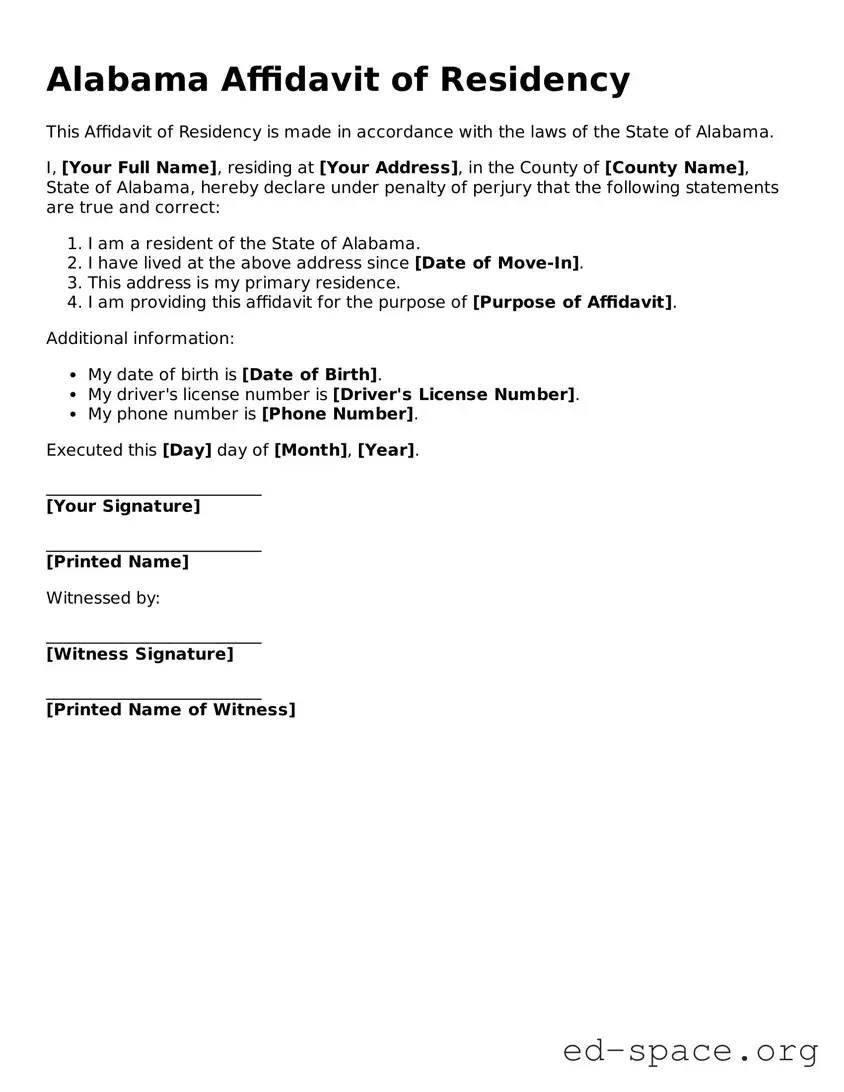
The Alabama Affidavit of Residency form serves as a crucial document for individuals seeking to establish their residency in the state of Alabama. This form is often required for various purposes, including enrolling in schools, obtaining a driver's license, or applying for certain government benefits. It typically requires the individual to provide personal information such as their name, address, and the length of time they have resided at that address. Additionally, the form may necessitate the signature of a witness or notary to verify the authenticity of the information provided. This verification process helps ensure that the claims made are legitimate and can be relied upon by institutions requiring proof of residency. Understanding the requirements and implications of this form is essential for residents, as it plays a significant role in accessing services and rights within the state.
Alabama Affidavit of Residency
This Affidavit of Residency is made in accordance with the laws of the State of Alabama.
I, [Your Full Name], residing at [Your Address], in the County of [County Name], State of Alabama, hereby declare under penalty of perjury that the following statements are true and correct:
Additional information:
Executed this [Day] day of [Month], [Year].
__________________________
[Your Signature]
__________________________
[Printed Name]
Witnessed by:
__________________________
[Witness Signature]
__________________________
[Printed Name of Witness]
| Fact Name | Details |
|---|---|
| Purpose | The Alabama Affidavit of Residency form is used to verify an individual's residency status in Alabama. |
| Governing Law | This form is governed by Alabama state law, specifically under the Code of Alabama Title 1, Chapter 1. |
| Eligibility | Any individual who resides in Alabama can complete this affidavit to affirm their residency. |
| Required Information | The form typically requires the individual's name, address, and a declaration of residency. |
| Signature Requirement | The affidavit must be signed by the individual affirming their residency, often in the presence of a notary public. |
| Usage | This affidavit is often used for various purposes, including voter registration and applying for state benefits. |
| Notarization | Notarization is generally required to ensure the authenticity of the affidavit. |
| Submission | The completed affidavit must be submitted to the appropriate state or local agency as required. |
| Validity | The affidavit remains valid as long as the individual's residency status does not change. |
After obtaining the Alabama Affidavit of Residency form, you will need to complete it accurately to ensure that it serves its intended purpose. Follow the steps below to fill out the form correctly.
After completing the form, review it for any errors. Make sure all information is accurate and legible before submitting it to the appropriate authority.
What is the Alabama Affidavit of Residency form?
The Alabama Affidavit of Residency form is a legal document used to verify an individual's residence in Alabama. This form is often required for various purposes, including enrolling in schools, obtaining a driver's license, or establishing residency for voting or legal matters.
Who needs to complete the Affidavit of Residency?
Anyone who needs to prove their residency in Alabama may need to complete this affidavit. This includes students enrolling in public schools, individuals applying for state benefits, or those who need to confirm their address for legal reasons.
What information is required on the form?
The form typically requires personal details such as the individual's name, current address, and the length of time they have lived at that address. Additionally, it may ask for the names of any individuals who can verify the residency, such as family members or neighbors.
How do I obtain the Alabama Affidavit of Residency form?
The form can usually be obtained online through the Alabama state government website or from local government offices. Some schools or institutions may also provide their own version of the form for specific purposes.
Is the Affidavit of Residency notarized?
Yes, the affidavit typically needs to be notarized to ensure its authenticity. A notary public will verify the identity of the individual signing the form and witness the signing process.
Where do I submit the completed Affidavit of Residency?
The submission process depends on the purpose of the affidavit. For school enrollment, it may need to be submitted to the school district. For legal matters, it might be filed with the court or other relevant agencies. Always check the specific requirements for your situation.
Are there any fees associated with the Affidavit of Residency?
Generally, there are no fees for completing the affidavit itself. However, there may be a fee for notarization, which varies depending on the notary public's rates.
What happens if I provide false information on the affidavit?
Providing false information on the Affidavit of Residency can lead to serious consequences, including legal penalties. It is important to ensure that all information is accurate and truthful before signing the document.
Can I use the Affidavit of Residency for multiple purposes?
Yes, the affidavit can often be used for multiple purposes, such as enrolling in school, applying for a driver's license, or verifying residency for government benefits. However, some institutions may have specific requirements, so it’s best to check with each entity.
How long is the Affidavit of Residency valid?
The validity of the affidavit can vary depending on the institution or purpose for which it is being used. Some may require a new affidavit every year, while others may accept it for a longer period. Always confirm the requirements with the relevant agency.
When filling out the Alabama Affidavit of Residency form, it's important to be thorough and accurate. Here are nine common mistakes people often make:
Incorrect Personal Information: Failing to provide your full name, address, or date of birth accurately can lead to complications.
Missing Signatures: Not signing the affidavit or forgetting to have it notarized can invalidate the document.
Using the Wrong Form: Submitting an outdated version of the form or a different affidavit can cause delays.
Incomplete Sections: Leaving any sections blank can raise red flags and result in rejection.
Providing False Information: Intentionally or unintentionally giving incorrect information can lead to legal issues.
Not Including Supporting Documents: Failing to attach required proof of residency can hinder the application process.
Neglecting to Check for Errors: Typos or mistakes in the details can create problems, so reviewing the form is essential.
Ignoring Notary Requirements: Not having the affidavit notarized when required can render it ineffective.
Submitting Late: Turning in the affidavit after the deadline can result in complications or denial of your request.
By being aware of these common mistakes, you can ensure that your Alabama Affidavit of Residency form is filled out correctly and submitted without issues.
The Alabama Affidavit of Residency form is often accompanied by several other documents that help establish residency or provide additional verification. Below is a list of commonly used forms and documents that may be required alongside the affidavit.
When preparing to submit the Alabama Affidavit of Residency, ensure that all accompanying documents are accurate and up-to-date. This will facilitate a smoother verification process and help avoid any potential delays.
The Affidavit of Residency form serves a specific purpose in confirming an individual's residence. However, several other documents share similarities in function or intent. Here are four such documents:
When completing the Alabama Affidavit of Residency form, attention to detail is crucial. Below is a list of things to do and avoid during this process.
Misconceptions about the Alabama Affidavit of Residency form can lead to confusion and misunderstandings. Here are eight common misconceptions, along with clarifications to help demystify the process.
This form is often associated with students, particularly for school enrollment purposes. However, it can also be used by adults needing to establish residency for various legal or administrative reasons.
Many people believe that an affidavit is merely a formality. In reality, it is a legal document that can carry significant weight in court or administrative proceedings.
While the affidavit itself is important, it typically requires accompanying documentation to verify the residency claim, such as utility bills or lease agreements.
Only individuals who meet specific criteria can complete the affidavit. This often includes those who have lived at the stated address for a certain period.
There are usually deadlines for submitting the affidavit, especially related to school enrollment or other time-sensitive matters. It is crucial to be aware of these timelines.
People often think that the affidavit is set in stone once filed. However, if circumstances change, it may be possible to amend or update the affidavit, depending on the specific situation.
This form is often required for establishing residency, but it can also be relevant for out-of-state residents who are seeking to enroll in Alabama schools or access certain services.
Completing the affidavit does not automatically confer residency status. Authorities will review the submitted documents and may require additional verification before granting residency.
Here are some key takeaways about filling out and using the Alabama Affidavit of Residency form: