Homepage Blank Alabama 9501 PDF Form
Article Guide

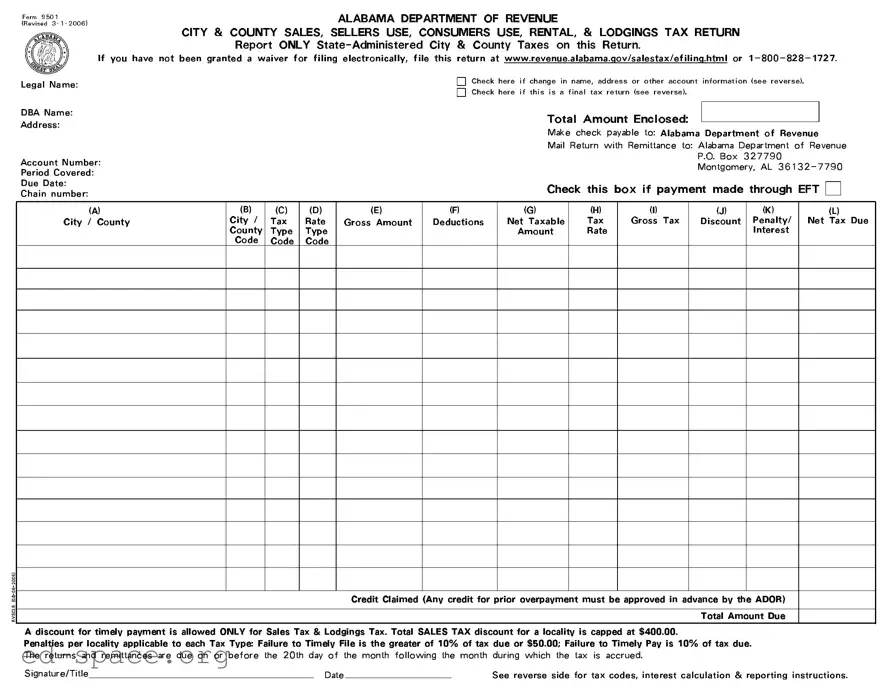
The Alabama 9501 form is an essential document for businesses operating within the state, specifically for reporting various city and county taxes. It serves as a tax return for state-administered sales, sellers use, consumers use, rental, and lodgings taxes. This form requires businesses to provide their legal name, address, and account number, along with details regarding the tax period covered and the total amount due. Important sections include the reporting of gross amounts, deductions, and the calculation of net taxable amounts. Additionally, the form outlines penalties for late filing and payment, as well as potential discounts for timely submissions. Businesses must also indicate any changes in account information, such as name or address, and specify if the return is final. Completing the Alabama 9501 accurately is crucial for compliance with state tax regulations and avoiding unnecessary penalties.
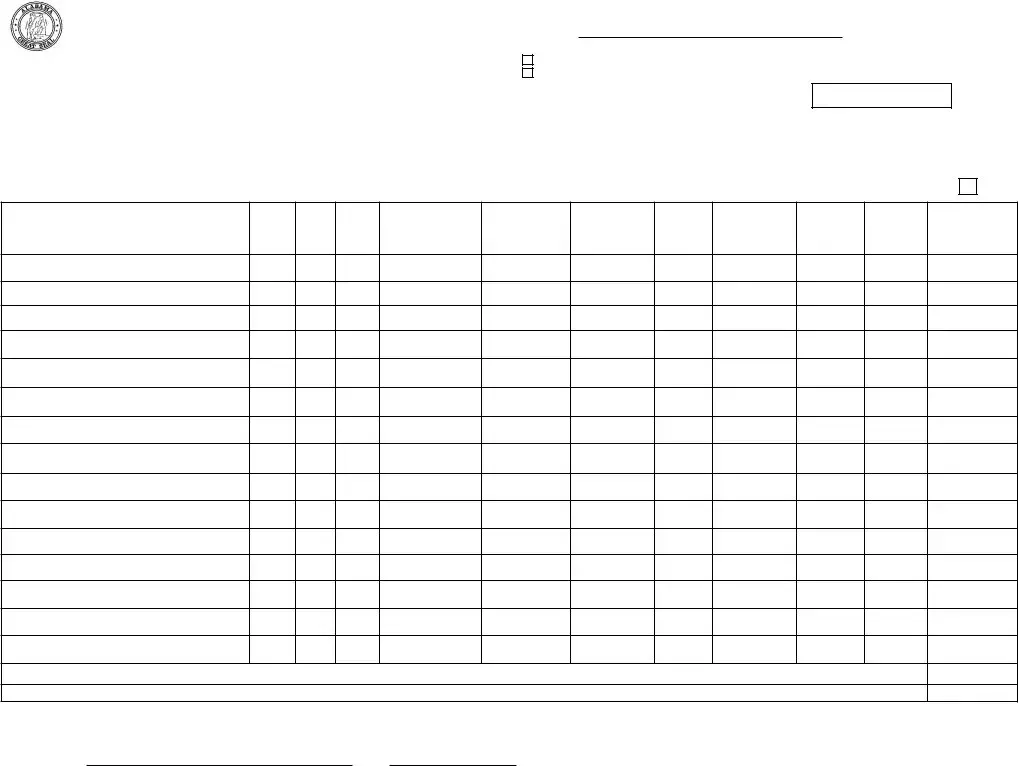
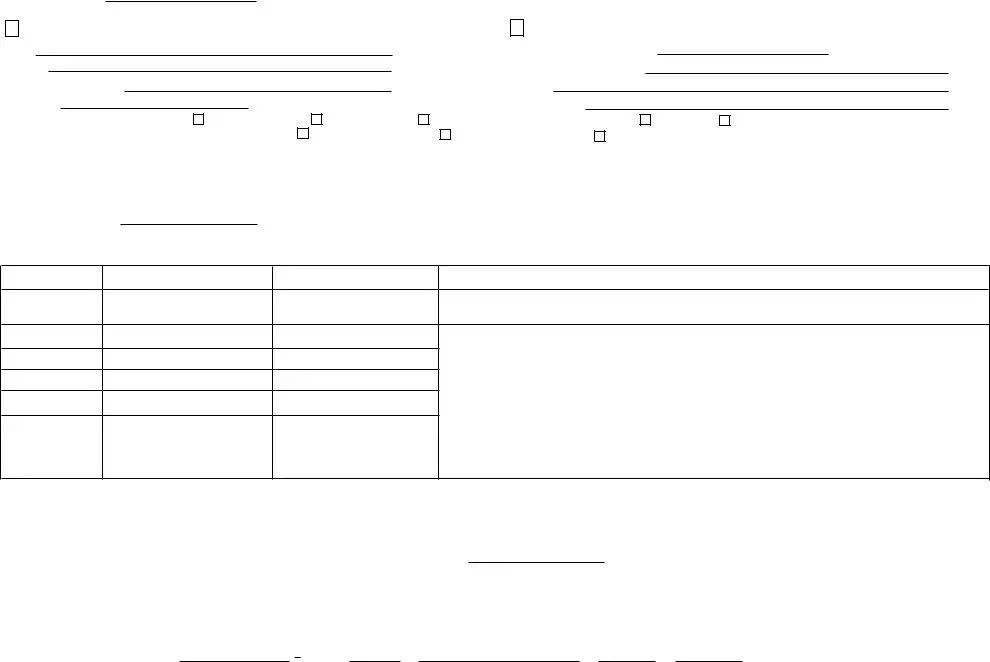
Document Preview

Form Specifications

Fact Name Details
Form Purpose The Alabama 9501 form is used to report state-administered city and county sales, sellers use, consumers use, rental, and lodgings taxes.
Filing Deadline Returns and remittances are due on or before the 20th day of the month following the month in which the tax is accrued.
Penalties Failure to file timely incurs a penalty of the greater of 10% of tax due or $50. Failure to pay timely results in a penalty of 10% of tax due.
Discounts A discount for timely payment is allowed only for sales tax and lodgings tax, capped at $400 per locality per month.
Governing Law This form is governed by the Alabama Code Title 40, Chapter 23, which outlines the taxation of sales and use.

Alabama 9501: Usage Guidelines

Completing the Alabama 9501 form is an essential step for reporting state-administered city and county taxes. This process requires careful attention to detail, ensuring that all information is accurate and complete. Once the form is filled out, it must be submitted along with the appropriate payment to the Alabama Department of Revenue.

  1. Legal Name: Enter the legal name of your business as registered.
  2. DBA Name: If applicable, provide the "Doing Business As" name.
  3. Address: Fill in your business address, including city, state, and zip code.
  4. Account Number: Input your unique account number assigned by the Alabama Department of Revenue.
  5. Period Covered: Specify the tax period for which you are reporting.
  6. Due Date: Enter the due date for this tax return.
  7. Chain Number: If applicable, include your chain number.
  8. City/County Total Amount Enclosed: Indicate the total amount you are sending with this form.
  9. Check the appropriate boxes: Mark the box if there is a change in name, address, or if this is a final tax return.
  10. Payment Method: If payment is made through EFT, check the corresponding box.
  11. Column (A): Enter the city or county name where the transaction occurred. If outside city limits but within police jurisdiction, write "PJ" after the city name.
  12. Column (B): Input the unique four-digit City/County Code assigned to your locality.
  13. Column (C): Enter the appropriate Tax Type Code based on the type of tax you are reporting.
  14. Column (D): Fill in the Rate Type Code corresponding to the tax type.
  15. Column (E): Report the gross sales, purchases, rental receipts, or lodgings receipts.
  16. Column (F): List any allowable deductions from the gross amount.
  17. Column (G): Calculate the Net Taxable Amount by subtracting deductions from the gross amount.
  18. Column (H): Enter the applicable tax rate for your locality.
  19. Column (I): Compute the Gross Tax by multiplying the tax rate by the Net Taxable Amount.
  20. Column (J): If applicable, enter the discount for timely payment of the gross tax due.
  21. Column (K): Include any penalties or interest if the return is filed or paid late.
  22. Column (L): Calculate the Net Tax Due, considering gross tax, discounts, penalties, and interest.
  23. Credit Claimed: If applicable, indicate any credit for prior overpayments, ensuring it has been approved by ADOR.
  24. Total Amount Due: Sum all amounts due in the Net Tax Due column, subtracting any claimed credit.
  25. Signature/Title: Sign and date the form to validate your submission.

Once completed, mail the form along with your payment to the Alabama Department of Revenue at the specified address. Ensure that all information is accurate to avoid delays or penalties.

Your Questions, Answered

What is the Alabama 9501 form used for?

The Alabama 9501 form is used to report state-administered city and county sales, sellers use, consumers use, rental, and lodgings taxes. Businesses must file this return to comply with Alabama tax regulations. It is essential to report only the relevant taxes on this form to ensure accurate processing by the Alabama Department of Revenue.

Who needs to file the Alabama 9501 form?

Any business operating in Alabama that collects sales, use, rental, or lodgings taxes must file the Alabama 9501 form. This includes retailers, service providers, and any entity involved in renting or providing lodging. Filing is required even if no taxes are due for a particular period.

When is the Alabama 9501 form due?

The form and any accompanying payments are due on or before the 20th day of the month following the month in which the tax was accrued. Timely filing is crucial to avoid penalties and interest charges.

What happens if I file the Alabama 9501 form late?

If the form is filed late, penalties will apply. The penalty for failure to file on time is the greater of 10% of the tax due or $50. Additionally, there is a 10% penalty for failure to pay the tax due by the deadline. Interest may also accrue on late payments.

Can I make changes to my Alabama 9501 form after submitting it?

What types of taxes are reported on the Alabama 9501 form?

The form is designed to report various tax types, including sales tax, consumers use tax, sellers use tax, rental tax, and lodgings tax. Each tax type has specific codes and rates that must be accurately reported to ensure compliance with state tax laws.

Is there a discount for timely payment on the Alabama 9501 form?

Yes, a discount for timely payment is available only for sales tax and lodgings tax. The discount is calculated as 5% of the first $100 of gross tax due, plus 2% on any amount over $100. However, the total discount for a locality is capped at $400 per month.

Common mistakes

  1. Incomplete Information: One common mistake is failing to provide all required details. Ensure that the legal name, DBA name, address, account number, and period covered are filled out completely. Missing any of these can delay processing.

  2. Incorrect Tax Type or Rate Codes: People often confuse tax type codes and rate type codes. It’s crucial to enter the correct codes as specified in the form instructions. Using the wrong code can lead to incorrect tax calculations and potential penalties.

  3. Neglecting to Check Required Boxes: The form includes important checkboxes for changes in name or address and for indicating a final return. Forgetting to check these boxes can result in processing errors or miscommunication with the Alabama Department of Revenue.

  4. Improper Payment Submission: Submitting payment incorrectly is another frequent error. Always make your check payable to the Alabama Department of Revenue and ensure that it matches the total amount due. Double-check that you are mailing it to the correct address to avoid delays.

Documents used along the form

When dealing with the Alabama 9501 form, there are several other documents and forms that may be necessary to ensure compliance with state tax regulations. Here’s a brief overview of some of these important forms:

  • Form ST-1: This is the application for a Sales Tax License. Businesses must file this form to obtain a license to collect sales tax in Alabama. It provides essential information about the business and its tax responsibilities.
  • Form ST-2: This is the exemption certificate for sales tax. It allows certain purchases to be made without paying sales tax, typically for non-profit organizations or specific types of goods. Proper completion of this form is crucial for claiming tax-exempt status.
  • Form ST-3: This form is used for claiming a refund of sales tax. If a business has overpaid sales tax or made a return, it can use this form to request a refund from the state.
  • Form ST-4: This is the annual sales tax return. Businesses must file this form to report their total sales and tax collected over the year. It summarizes the sales tax obligations and helps ensure accurate reporting.
  • Form ST-5: This is a resale certificate. Retailers use this form when purchasing goods for resale, allowing them to buy items without paying sales tax upfront. It’s important for maintaining proper tax records.
  • Form ST-6: This form is used to report the use tax. If a business purchases goods from out of state and does not pay sales tax, it must report and pay use tax using this form.
  • Form ST-7: This is the seller's use tax return. Similar to the use tax form, it is specifically for sellers who need to report tax on items they have purchased for their own use rather than for resale.

Each of these forms plays a vital role in managing tax obligations in Alabama. Understanding their purpose and how they relate to the Alabama 9501 form can help businesses stay compliant and avoid potential penalties. Always consider consulting with a tax professional for guidance tailored to your specific situation.

Similar forms

The Alabama 9501 form is a specific document used for reporting state-administered city and county taxes. There are several other forms that serve similar purposes in different contexts. Below is a list of documents that share similarities with the Alabama 9501 form:

  • IRS Form 1040: This is the standard individual income tax return form used in the United States. Like the Alabama 9501, it requires detailed financial information and is submitted annually to report taxes owed.
  • IRS Form 941: This form is used by employers to report income taxes, Social Security tax, and Medicare tax withheld from employee wages. Similar to the Alabama 9501, it involves calculations of tax amounts and is submitted quarterly.
  • State Sales Tax Return: Many states have their own sales tax return forms, which are similar to the Alabama 9501 in that they require reporting of sales tax collected and remitted to the state government.
  • Local Business License Application: This document is often required for businesses operating within a city or county. Like the Alabama 9501, it collects information about the business and its location, ensuring compliance with local regulations.
  • Form W-2: Employers use this form to report wages paid to employees and the taxes withheld. It shares similarities with the Alabama 9501 in that it provides a summary of tax-related information for reporting purposes.
  • IRS Form 1065: This form is used by partnerships to report income, deductions, gains, and losses. Like the Alabama 9501, it requires detailed financial reporting and is submitted annually.
  • State Employer Withholding Tax Return: This form is used to report state income tax withheld from employee wages. It is similar to the Alabama 9501 in that it involves tax calculations and periodic submissions.
  • Form 1099-MISC: This form is used to report payments made to independent contractors. It is similar to the Alabama 9501 in that it provides a summary of financial transactions for tax reporting.
  • Property Tax Return: This document is used to report property values and assess property taxes owed. Like the Alabama 9501, it requires accurate reporting of financial information related to taxes.

Each of these documents serves a specific purpose in tax reporting and compliance, similar to the Alabama 9501 form, which is focused on local tax obligations.

Dos and Don'ts

When filling out the Alabama 9501 form, attention to detail is crucial. Here are some important dos and don'ts to keep in mind.

  • Do ensure that all information is accurate, including your legal name and address.
  • Do check the appropriate boxes for any changes in your account information or if this is a final tax return.
  • Do calculate your total amount due carefully, including gross tax, deductions, and any penalties.
  • Do make your check payable to the Alabama Department of Revenue.
  • Do mail your completed form and remittance to the specified address: Alabama Department of Revenue, P.O. Box 327790, Montgomery, AL 36132-7790.
  • Don't forget to include your account number and the period covered in the appropriate sections of the form.
  • Don't submit the form late, as penalties for late filing and payment can significantly increase your tax liability.

By following these guidelines, you can help ensure that your submission is processed smoothly and efficiently. Always double-check your entries before mailing the form to avoid any complications.

Misconceptions

Understanding the Alabama 9501 form is crucial for businesses operating in the state. However, several misconceptions can lead to confusion. Here are nine common misunderstandings about this form, along with clarifications:

  • It’s only for large businesses. The Alabama 9501 form is required for all businesses that collect state-administered city and county taxes, regardless of size.
  • Filing is optional. Filing this form is mandatory for businesses that meet the criteria. Failing to file can result in penalties.
  • Only sales tax needs to be reported. The form is used to report various taxes, including sellers use tax, lodgings tax, and rental tax, not just sales tax.
  • Penalties are the same for all tax types. Each tax type has its own penalty structure. For example, the penalty for failing to file is 10% of the tax due or $50, whichever is greater.
  • Discounts apply to all tax types. Discounts for timely payment are only available for sales tax and lodgings tax, capped at $400 per locality.
  • Changes in business information can be ignored. It’s essential to report any changes in name, address, or ownership on the form to avoid issues with your tax account.
  • Late payments don’t incur interest. Late payments do accrue interest, and it’s calculated based on the number of days the payment is late.
  • All deductions are automatically accepted. Deductions must be reported accurately, and only allowable deductions will be accepted. Misreporting can lead to penalties.
  • Credits for overpayments can be claimed without approval. Any credit for prior overpayments must be pre-approved by the Alabama Department of Revenue before it can be claimed on the form.

By understanding these misconceptions, businesses can navigate the Alabama 9501 form more effectively and ensure compliance with state tax regulations.

Key takeaways

Filling out the Alabama 9501 form may seem daunting at first, but understanding its key components can simplify the process significantly. Here are some essential takeaways to keep in mind:

  • Accurate Information is Crucial: Ensure that the legal name, DBA name, address, and account number are entered correctly. Any errors can lead to processing delays.
  • Know Your Codes: Familiarize yourself with the City/County Codes and Tax Type Codes. Each locality has a unique code, and using the wrong one can affect your tax calculations.
  • Timely Filing is Essential: Returns and payments are due by the 20th day of the month following the tax period. Late submissions may incur penalties.
  • Understand Deductions: Enter allowable deductions accurately. This includes any nontaxable amounts reported in your gross sales. Deductions can significantly reduce your taxable amount.
  • Discounts for Timely Payment: A discount is available for timely payments on sales and lodgings tax. Be aware that this discount has a cap of $400 per locality.
  • Penalties for Late Filing: If you file or pay late, be prepared to face penalties. The greater of 10% of the gross tax due or $50 will apply for failure to file on time.
  • Interest on Late Payments: If payments are made after the due date, interest will accrue. Understanding how to calculate this interest can help you avoid surprises.
  • Final Returns: If this is your final tax return, mark the appropriate box. This informs the Alabama Department of Revenue that you are closing your account.

By keeping these points in mind, you can navigate the Alabama 9501 form with greater confidence and ease. Always refer to the instructions provided on the form and the Alabama Department of Revenue’s website for the most accurate and up-to-date information.