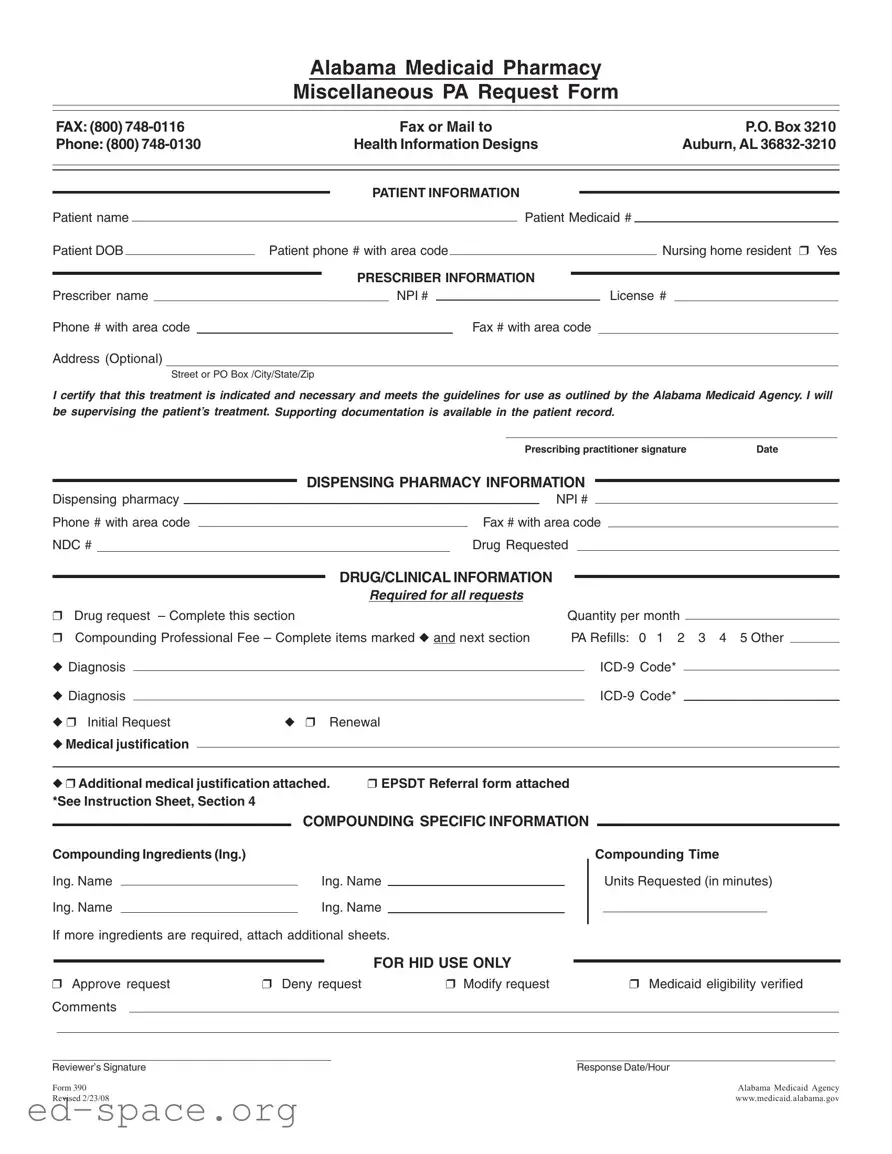
The Alabama 390 form is a crucial document for individuals seeking prior authorization for certain pharmacy services under the Alabama Medicaid program. This form is specifically designed for pharmacy providers to request approval for medications and treatments that may not be readily covered by Medicaid. It requires detailed patient information, including the patient's name, Medicaid number, and date of birth, as well as the prescriber's information, ensuring that all necessary parties are identified. The form also includes sections for the dispensing pharmacy and specific drug or clinical information. This is where providers must specify the drug requested, the quantity, and any relevant medical justification. For compounded medications, additional details about the ingredients and compounding time are required. The form emphasizes the importance of supporting documentation, which must be available in the patient's record. By completing this form accurately, healthcare providers can help ensure that patients receive the necessary medications in a timely manner, while also adhering to the guidelines set forth by the Alabama Medicaid Agency.

Alabama Medicaid Pharmacy
Miscellaneous PA Request Form
FAX: (800) |
|
|
|
Fax or Mail to |
|
|
|
|
P.O. Box 3210 |
|||||||||||
Phone: (800) |
|
|
Health Information Designs |
|
|
|
|
Auburn, AL |
||||||||||||
|
|
|
|
|
|
|
|
|
|
|
|
|
|
|
|
|
|
|
|
|
|
|
|
|
|
|
|
|
|
|
|
|
|
|
|
|
|
|
|
|
|
|
|
|
|
|
|
|
|
|
|
|
|
|
|
|
|
|
|
|
|
|
|
|
|
|
|
|
|
|
PATIENT INFORMATION |
|
|
|
|
|
|
||||||
|
|
|
|
|
|
|
|
|
|
|
|
|
|
|||||||
Patient name |
|
|
|
|
|
|
|
|
Patient Medicaid # |
|
|
|
||||||||
Patient DOB |
|
Patient phone # with area code |
|
|
|
|
|
|
Nursing home resident ❒ Yes |
|||||||||||
|
|
|
|
|
|
|
|
|
|
|
|
|
|
|
|
|
|
|
|
|
|
|
|
|
|
|
|
|
PRESCRIBER INFORMATION |
|
|
|
|
|
|
|
|||||
|
|
|
|
|
|
|
|
|
|
|
|
|
|
|||||||
Prescriber name |
|
|
|
|
|
|
NPI # |
|
|
License # |
|
|||||||||
Phone # with area code |
|
|
|
|
|
|
|
Fax # with area code |
|
|
|
|
|
|||||||
Address (Optional) |
|
|
|
|
|
|
|
|
|
|
|
|
|
|
|
|
||||
Street or PO Box /City/State/Zip
I certify that this treatment is indicated and necessary and meets the guidelines for use as outlined by the Alabama Medicaid Agency. I will be supervising the patient’s treatment. Supporting documentation is available in the patient record.
Prescribing practitioner signature |
Date |
DISPENSING PHARMACY INFORMATION
Dispensing pharmacy Phone # with area code NDC #
NPI #
Fax # with area code Drug Requested
DRUG/CLINICAL INFORMATION
Required for all requests
❒ |
Drug request – Complete this section |
|
Quantity per month |
|
|
|||||
|
|
|
||||||||
❒ |
Compounding Professional Fee – Complete items marked ◆ and next section |
PA Refills: |
0 1 2 3 4 5 Other |
|
||||||
◆ Diagnosis |
|
|
|
|
Code* |
|
||||
|
|
|
|
|
||||||
◆ Diagnosis |
|
|
|
|
Code* |
|
||||
◆ ❒ Initial Request |
◆ |
❒ Renewal |
|
|
|
|
|
|
||
◆Medical justification
◆ ❒ Additional medical justification attached. |
❒ EPSDT Referral form attached |
*See Instruction Sheet, Section 4 |
|
COMPOUNDING SPECIFIC INFORMATION
Compounding Ingredients (Ing.) |
|
|
Ing. Name |
|
Ing. Name |
|
||
Ing. Name |
|
Ing. Name |
If more ingredients are required, attach additional sheets.
Compounding Time
Units Requested (in minutes)
FOR HID USE ONLY
❒ Approve request |
❒ Deny request |
❒ Modify request |
❒ Medicaid eligibility verified |
||||
Comments |
|
|
|
|
|
|
|
|
|
|
|
|
|
|
|
|
|
|
|
|
|
||
Reviewer’s Signature |
|
|
|
Response Date/Hour |
|||
FORM 390 |
|
|
|
Alabama Medicaid Agency |
|||
Revised 2/23/08 |
|
|
|
www.medicaid.alabama.gov |
|||
| Fact Name | Details |
|---|---|
| Form Purpose | The Alabama 390 form is used to request prior authorization for pharmacy services under the Alabama Medicaid program. |
| Governing Law | This form is governed by the Alabama Medicaid Agency regulations and policies. |
| Patient Information | Essential patient details include name, Medicaid number, date of birth, and phone number. |
| Prescriber Information | Prescribers must provide their name, NPI number, license number, and contact information. |
| Dispensing Pharmacy | Information about the pharmacy includes the pharmacy name, phone number, NDC, and NPI number. |
| Drug Information | Requests must specify the drug, quantity per month, and any compounding requirements. |
| Diagnosis Codes | ICD-9 codes for the diagnosis must be included to support the medical necessity of the request. |
| Supporting Documentation | Prescribers must certify that treatment is necessary and that supporting documentation is available. |
| Submission Methods | The form can be submitted via fax or mail to the designated address provided on the form. |
| Review Process | After submission, the form will be reviewed, and the request may be approved, denied, or modified. |
Filling out the Alabama 390 form requires careful attention to detail. This form is essential for submitting a request for prior authorization related to pharmacy services. Follow these steps to ensure that all necessary information is accurately provided.
What is the Alabama 390 form?
The Alabama 390 form is a request form used for obtaining prior authorization for pharmacy services through Alabama Medicaid. It helps ensure that prescribed medications meet the necessary guidelines set by the Alabama Medicaid Agency.
Who needs to fill out the Alabama 390 form?
The form must be filled out by the prescribing practitioner, who is responsible for supervising the patient's treatment. Additionally, the patient's information, including their Medicaid number and date of birth, is required.
What information is required on the Alabama 390 form?
Essential information includes the patient's name, Medicaid number, date of birth, and contact number. The prescriber must provide their name, NPI number, license number, and contact details. The form also requires details about the requested drug, including the NDC number and any relevant diagnoses.
How do I submit the Alabama 390 form?
You can submit the Alabama 390 form either by faxing it to (800) 748-0116 or by mailing it to P.O. Box 3210, Auburn, AL 36832-3210. Ensure that all required information is complete to avoid delays in processing.
What is the purpose of the medical justification section?
The medical justification section is crucial for explaining why the requested medication is necessary for the patient. This helps the Alabama Medicaid Agency assess the request and determine if it meets their guidelines.
What should I do if I need to attach additional documentation?
If you need to provide additional documentation, such as medical justification or an EPSDT referral form, simply check the appropriate boxes on the form and include the extra sheets with your submission.
How long does it take to get a response after submitting the Alabama 390 form?
The response time can vary, but it is generally processed promptly. You can check the status of your request by contacting the provided phone number, (800) 748-0130.
What happens if my request is denied?
If your request is denied, you will receive a notification explaining the reason for the denial. You may have the option to modify your request or appeal the decision, depending on the circumstances.
Where can I find more information about the Alabama 390 form?
For more details, you can visit the Alabama Medicaid Agency's official website at www.medicaid.alabama.gov. They provide additional resources and guidance related to the form and its submission process.
Failing to provide complete patient information. Missing details like the patient's Medicaid number or date of birth can delay processing.
Not including the prescriber’s NPI number. This number is crucial for identifying the prescribing practitioner.
Leaving out the prescriber’s signature. The form requires a signature to certify the necessity of the treatment.
Neglecting to specify the drug requested. Without this information, the request cannot be processed.
Omitting the ICD-9 codes for diagnoses. These codes are essential for justifying the medical necessity of the request.
Not indicating the quantity per month. This detail is necessary for proper medication dispensing.
Forgetting to check the appropriate boxes for initial requests or renewals. This can lead to confusion about the nature of the request.
Failing to attach supporting documentation. If additional medical justification is required, it must be included.
Not providing the dispensing pharmacy's information. Missing this can cause delays in filling the prescription.
Submitting the form without verifying Medicaid eligibility. This step is critical to ensure that the request will be honored.
The Alabama 390 form is essential for requesting prior authorization for medications under the Alabama Medicaid program. Alongside this form, several other documents are commonly utilized to ensure a smooth application process. Below is a list of these forms and documents, along with brief descriptions of each.
Utilizing these forms in conjunction with the Alabama 390 form can streamline the process of obtaining necessary medications and services for patients under the Alabama Medicaid program. Proper documentation is vital for compliance and ensuring that patients receive the care they need.
The Alabama 390 form is a request form used for obtaining prior authorization for pharmacy services under Medicaid. There are several other documents that serve similar purposes in different contexts. Here’s a list of nine documents that share similarities with the Alabama 390 form:
Each of these documents serves to ensure that necessary treatments and medications are authorized before they are provided, promoting patient safety and appropriate use of healthcare resources.
When filling out the Alabama 390 form, attention to detail is crucial. Here are eight important dos and don'ts to ensure your submission is complete and accurate.
Following these guidelines will help streamline the process and reduce the likelihood of delays or denials in treatment requests.
Here are five common misconceptions about the Alabama 390 form:
When filling out and using the Alabama 390 form, there are several important points to keep in mind. These key takeaways will help ensure that the process is smooth and efficient.
By following these takeaways, the Alabama 390 form can be filled out correctly, facilitating a smoother approval process for necessary treatments.