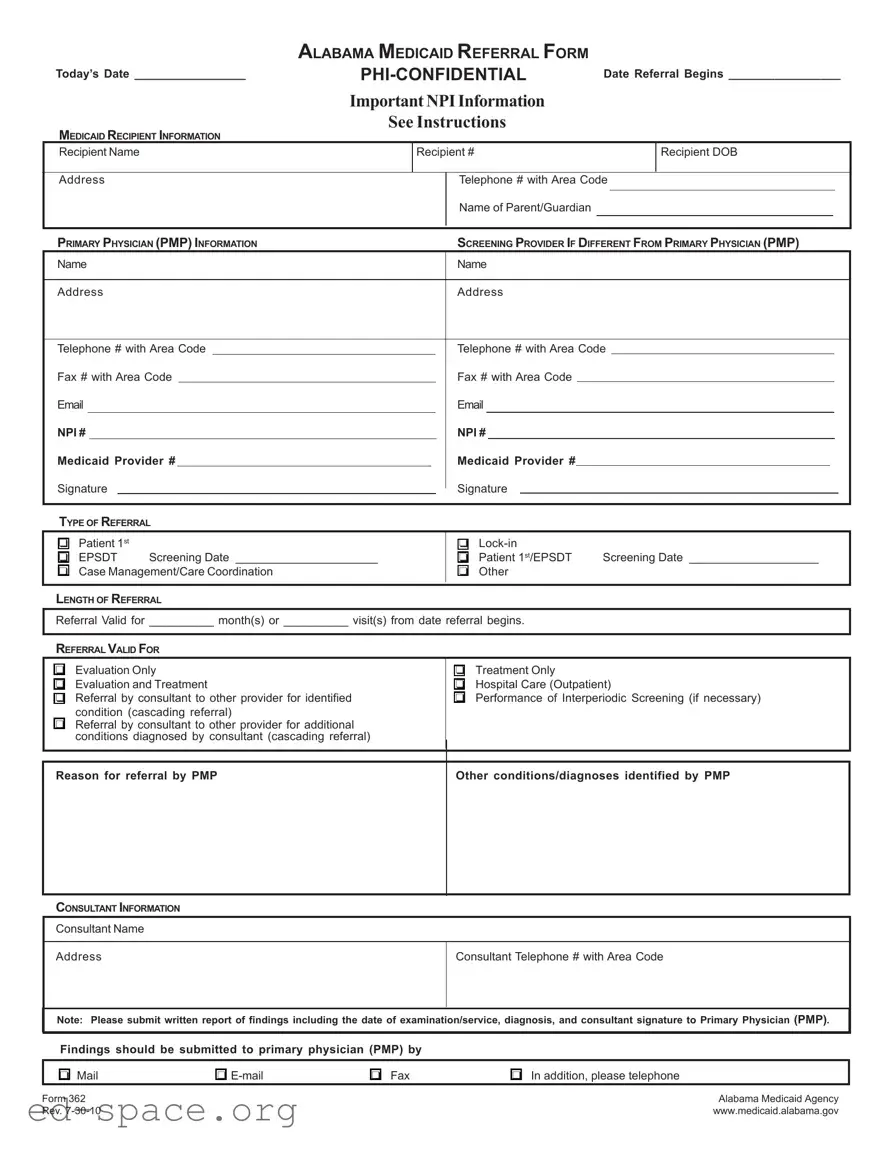
The Alabama 362 form is an essential document used in the Medicaid referral process within the state of Alabama. It serves as a structured way for healthcare providers to communicate necessary information regarding a Medicaid recipient's care. This form captures vital details such as the recipient's name, date of birth, and contact information, along with specifics about their primary physician and any screening providers involved in their care. It also outlines the type of referral being made, whether it is for evaluation, treatment, or case management. The form allows for a clear record of the referral's validity, indicating how long it will remain active, and includes space for the consultant's information if the referral involves additional specialists. By ensuring that all relevant details are documented, the Alabama 362 form helps streamline the coordination of care for Medicaid recipients, facilitating better health outcomes and efficient use of resources.
ALABAMA MEDICAID REFERRAL FORM
Today’s Date _________________
ImportantNPIInformation
See Instructions
Date Referral Begins _________________
MEDICAID RECIPIENT INFORMATION
Recipient Name
Recipient #
Recipient DOB
Address
Telephone # with Area Code
|
|
|
|
|
|
|
|
|
Name of Parent/Guardian |
|
|
|
|
|
|
|||||
|
|
|
|
|
|
|
|
|
|
|
|
|
|
|
|
|
|
|
|
|
PRIMARY PHYSICIAN (PMP) INFORMATION |
SCREENING PROVIDER IF DIFFERENT FROM PRIMARY PHYSICIAN (PMP) |
|||||||||||||||||||
Name |
|
|
|
|
|
Name |
|
|
|
|
|
|
||||||||
|
|
|
|
|
|
|
|
|
|
|
|
|
|
|
|
|
|
|
||
Address |
|
|
|
|
|
Address |
|
|
|
|
|
|
||||||||
|
|
|
|
|
|
|
|
|
|
|
|
|
|
|
|
|
||||
Telephone # with Area Code |
|
|
Telephone # with Area Code |
|
|
|||||||||||||||
Fax # with Area Code |
|
|
Fax # with Area Code |
|
|
|
|
|
|
|
||||||||||
|
|
|
|
|
|
|
|
|
|
|
|
|
||||||||
NPI # |
|
|
|
|
|
|
NPI # |
|
|
|
|
|
|
|
||||||
Medicaid Provider # |
Medicaid Provider # |
|
|
|
|
|
|
|||||||||||||
Signature |
|
|
|
|
|
|
Signature |
|
|
|
|
|
|
|
|
|||||
|
|
|
|
|
|
|
|
|
|
|
||||||||||
|
|
|
|
|
|
|
|
|
|
|
|
|
|
|
|
|
|
|
|
|
TYPE OF REFERRAL |
|
|
|
|
|
|
|
|
|
|
|
|
||||||||
❑ |
Patient 1st |
|
|
|
|
|
❑ |
|
|
|
|
|
|
|||||||
❑ |
EPSDT |
Screening Date ______________________ |
❑ |
Patient 1st/EPSDT |
Screening Date ____________________ |
|||||||||||||||
❑ |
Case Management/Care Coordination |
❑ |
Other |
|
|
|
|
|
|
|||||||||||
|
|
|
|
|
|
|
|
|
|
|
|
|
|
|
|
|
|
|
|
|
LENGTH OF REFERRAL
Referral Valid for __________ month(s) or __________ visit(s) from date referral begins.
REFERRAL VALID FOR
❑Evaluation Only
❑Evaluation and Treatment
❑Referral by consultant to other provider for identified condition (cascading referral)
❑Referral by consultant to other provider for additional conditions diagnosed by consultant (cascading referral)
❑Treatment Only
❑Hospital Care (Outpatient)
❑Performance of Interperiodic Screening (if necessary)
Reason for referral by PMP
Other conditions/diagnoses identified by PMP
CONSULTANT INFORMATION
Consultant Name
Address
Consultant Telephone # with Area Code
Note: Please submit written report of findings including the date of examination/service, diagnosis, and consultant signature to Primary Physician (PMP).
Findings should be submitted to primary physician (PMP) by
❑
❑Fax
❑In addition, please telephone
Form 362 |
Alabama Medicaid Agency |
Rev. |
www.medicaid.alabama.gov |
| Fact Name | Description |
|---|---|
| Purpose | The Alabama 362 form is used for Medicaid referrals, facilitating communication between healthcare providers regarding patient care. |
| Recipient Information | This form requires specific details about the Medicaid recipient, including name, date of birth, and contact information. |
| Referral Types | Multiple referral types are available, including Patient 1st, EPSDT Screening, and Case Management, allowing flexibility based on patient needs. |
| Governing Law | The Alabama Medicaid Referral Form is governed by the Alabama Medicaid Agency regulations and policies. |
Filling out the Alabama 362 form requires careful attention to detail. This form is essential for facilitating referrals within the Medicaid system. Once completed, it will help ensure that the necessary medical services are provided efficiently. Follow these steps to fill out the form accurately.
After completing the form, make sure to double-check all entries for accuracy. This will help prevent any delays in processing the referral. Once verified, the form can be submitted to the appropriate parties for further action.
What is the Alabama 362 form used for?
The Alabama 362 form, also known as the Alabama Medicaid Referral Form, is utilized to refer Medicaid recipients to healthcare providers. This form facilitates communication between primary care physicians and specialists, ensuring that patients receive appropriate evaluations and treatments. It captures essential information about the recipient, the referring physician, and the nature of the referral.
Who needs to fill out the Alabama 362 form?
The form must be completed by the primary physician or the healthcare provider initiating the referral. This includes providing details about the Medicaid recipient, the referring physician, and the consultant. It is crucial for ensuring that all necessary information is conveyed to the receiving provider, thereby streamlining the referral process.
What information is required on the Alabama 362 form?
Key information required on the form includes the recipient's name, Medicaid number, date of birth, address, and contact information. Additionally, the primary physician's details, the type of referral, and the duration of the referral must be specified. The form also requires the consultant's information if a specialist is involved. This comprehensive data collection is essential for proper patient management.
How long is a referral valid when using the Alabama 362 form?
The validity of a referral indicated on the Alabama 362 form can be specified in terms of either months or the number of visits. The referring physician must clearly state this duration at the time of referral initiation. This ensures that both the patient and the consulting provider understand the timeframe for which the referral is applicable.
What should be done after the referral is made?
After the referral is made, the consultant is responsible for providing a written report of their findings to the primary physician. This report should include the date of examination, the diagnosis, and the consultant's signature. The findings can be sent via mail, email, or fax, as indicated on the form. This step is vital for maintaining continuity of care and ensuring that the primary physician is updated on the patient's condition.
Missing Recipient Information: Failing to provide complete details about the Medicaid recipient can lead to processing delays. Ensure that the recipient's name, number, date of birth, address, and phone number are all filled out accurately.
Incorrect NPI Numbers: Entering the wrong National Provider Identifier (NPI) numbers for both the primary physician and consultant can cause issues. Double-check these numbers to ensure they are correct.
Not Specifying the Type of Referral: It’s important to clearly indicate the type of referral being made. Omitting this information can lead to confusion about the intended purpose of the referral.
Length of Referral Errors: Be careful when indicating the duration of the referral. Whether it's for a certain number of months or visits, any inaccuracies can affect the validity of the referral.
Omitting Consultant Information: If a consultant is involved, their information must be provided. Missing details like the consultant's name, address, and phone number can hinder communication and follow-up.
Signature Requirements: Both the primary physician and the consultant must sign the form. Neglecting to obtain these signatures can result in the form being rejected or delayed.
When navigating the healthcare system, especially in relation to Medicaid, various forms and documents may be necessary to ensure a smooth process. The Alabama 362 form is one such document, primarily used for referrals within the Medicaid system. Below is a list of other forms and documents that are often used in conjunction with the Alabama 362 form, each serving a specific purpose.
Each of these documents plays a vital role in the Medicaid process, helping to streamline communication and care among providers and patients. Understanding their purposes can empower individuals to navigate their healthcare needs more effectively.
The Alabama 362 form is a vital document used in the Medicaid system. It serves specific purposes related to referrals and patient information. Several other documents share similarities with the Alabama 362 form. Below is a list of ten such documents, each highlighting how they relate to the Alabama 362 form.
When filling out the Alabama 362 form, it is crucial to ensure accuracy and completeness. Below is a list of things you should and shouldn't do.
Understanding the Alabama 362 form is crucial for anyone involved in the Medicaid process. However, several misconceptions can lead to confusion. Here’s a breakdown of seven common misunderstandings.
This form is not limited to new recipients. It can be used for existing recipients who require referrals for various services.
While primary care physicians often complete the form, other healthcare providers can also initiate referrals as needed.
The Alabama 362 form is used for various types of referrals, including outpatient services and evaluations, not just for hospital care.
Referrals are valid for a specific duration, either by time or number of visits, as indicated on the form.
A signature from the primary physician is essential to validate the referral and ensure it is processed correctly.
The form allows for various types of referrals, including evaluations and consultations, depending on the patient's needs.
The Alabama 362 form contains protected health information (PHI) and must be handled with confidentiality in mind.
By clearing up these misconceptions, individuals can navigate the Medicaid referral process more effectively. Understanding the true purpose and requirements of the Alabama 362 form is key to ensuring proper care and compliance.
Here are key takeaways regarding the Alabama 362 form: