Homepage Blank Ahnentafel PDF Form
Article Guide

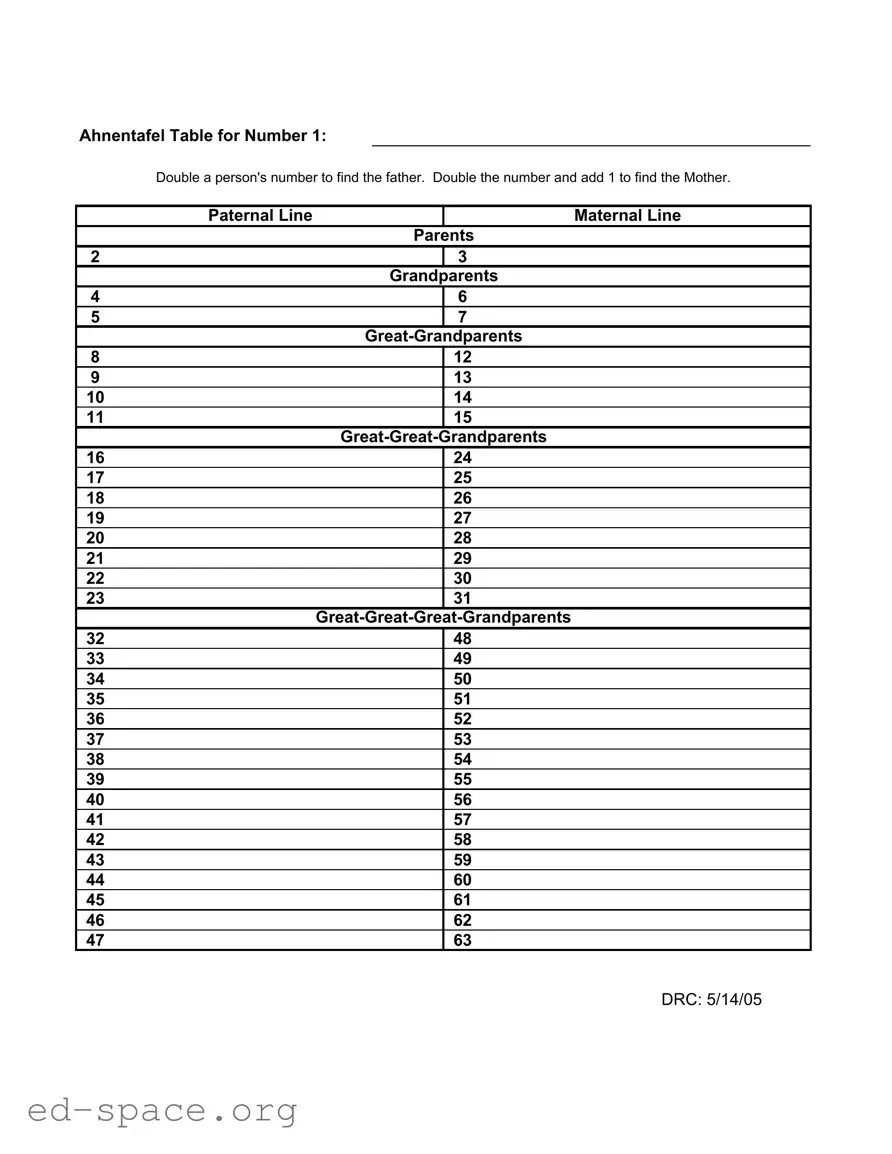
Exploring your family history can be an exciting journey, and one tool that can help you navigate this path is the Ahnentafel form. This structured genealogical chart allows you to trace your ancestry in a clear and organized manner. At its core, the Ahnentafel form assigns a unique number to each ancestor, making it easier to identify relationships across generations. For instance, by simply doubling a person's number, you can find their father, while adding one to that number reveals their mother. This straightforward method continues down the family tree, providing a systematic approach to documenting your lineage. As you delve deeper, the Ahnentafel expands to include grandparents, great-grandparents, and even great-great-grandparents, each generation neatly laid out for easy reference. Whether you're a seasoned genealogist or just starting to explore your roots, understanding the Ahnentafel form can enhance your research and bring clarity to your family history.

Document Preview

Ahnentafel Table for Number 1:

Double a person's number to find the father. Double the number and add 1 to find the Mother.

Paternal Line


Maternal Line


Parents

2


3


Grandparents

4


6

5


7


Great-Grandparents

8


12

9


13

10


14

11


15


Great-Great-Grandparents

16


24

17


25

18


26

19


27

20


28

21


29

22


30

23


31


Great-Great-Great-Grandparents

32


48

33


49

34


50

35


51

36


52

37


53

38


54

39


55

40


56

41


57

42


58

43


59

44


60

45


61

46


62

47


63

DRC: 5/14/05

Ahnentafel Table for Number 1:

(Continued)

Paternal Line

Maternal Line

Great-Great-Great-Great-Grandparents

64

96

65

97

66

98

67

99

68

100

69

101

70

102

71

103

72

104

73

105

74

106

75

107

76

108

77

109

78

110

79

111

80

112

81

113

82

114

83

115

84

116

85

117

86

118

87

119

88

120

89

121

90

122

91

123

92

124

93

125

94

126

95

127

DRC: 5/14/05

Form Specifications

Fact Name Description
Definition The Ahnentafel form is a genealogical chart that organizes a person's ancestors in a structured format.
Numbering System Each individual is assigned a unique number, starting with the person of interest as number 1.
Father's Number To find a person's father, double their number. For example, the father of number 1 is number 2.
Mother's Number To find a person's mother, double their number and add 1. For example, the mother of number 1 is number 3.
Generational Structure The chart expands with each generation, including parents, grandparents, and so on.
Depth of Ancestry The Ahnentafel can trace ancestors up to 128 generations back, depending on the individual's lineage.
Use in Genealogy This form is commonly used by genealogists to document family history and lineage.
State-Specific Forms Some states may have specific laws governing the use of genealogical records; check local regulations.
Historical Importance The Ahnentafel has been utilized for centuries, providing a clear lineage for legal and inheritance purposes.

Ahnentafel: Usage Guidelines

Completing the Ahnentafel form can be a rewarding process as it helps to trace your ancestry through generations. By following these steps, you can accurately fill out the form and create a comprehensive family tree.

  1. Start with yourself. Write your name at the top of the form as Number 1.
  2. To find your father's number, double your number (1) to get 2. Write your father's name next to this number.
  3. To find your mother's number, double your number (1) and add 1 to get 3. Write your mother's name next to this number.
  4. For your paternal grandparents, double your father's number (2) to get 4 for your paternal grandfather and 5 for your paternal grandmother (2 + 1). Write their names next to these numbers.
  5. For your maternal grandparents, double your mother's number (3) to get 6 for your maternal grandfather and 7 for your maternal grandmother (3 + 1). Write their names next to these numbers.
  6. Continue this process for your great-grandparents. For your paternal great-grandparents, double your paternal grandfather's number (4) to get 8 and your paternal grandmother's number (5) to get 10. For your maternal great-grandparents, double your maternal grandfather's number (6) to get 12 and your maternal grandmother's number (7) to get 14. Write their names accordingly.
  7. Repeat the doubling and adding process for each subsequent generation: great-great-grandparents and great-great-great-grandparents, using the same method as above.
  8. Ensure that you fill in all names accurately and check for any missing information as you progress through each generation.

After completing the Ahnentafel form, you will have a detailed outline of your ancestry. This structured approach can serve as a foundation for further genealogical research, allowing you to delve deeper into your family history.

Your Questions, Answered

What is an Ahnentafel form?

An Ahnentafel form is a genealogical tool used to organize and display an individual's ancestry in a structured way. It lists ancestors in a specific format, starting with the individual at number one, followed by their parents, grandparents, and so on. This form helps in tracing family lineage and understanding familial relationships over generations.

How do I use the Ahnentafel numbering system?

The Ahnentafel numbering system is straightforward. Begin with yourself as number one. To find your father, double your number. To find your mother, double your number and add one. For example, if you are number 1, your father is number 2, and your mother is number 3. This pattern continues for grandparents and great-grandparents, allowing you to build a comprehensive family tree.

What information should I include in my Ahnentafel form?

Include names, birth dates, and any other relevant details for each ancestor listed. You can also add marriage dates, death dates, and places of birth. The more information you provide, the richer your family history will become. It’s a great way to preserve your family's legacy.

Can I add more generations to the Ahnentafel form?

Yes, you can definitely add more generations. The Ahnentafel system allows for extensive family trees, reaching back many generations. Simply continue the numbering pattern, doubling for fathers and doubling plus one for mothers, as you go further back in your ancestry.

Is the Ahnentafel form suitable for all family types?

Absolutely! The Ahnentafel form is versatile and can be used for any family structure. Whether you have a traditional family setup or a more complex one, this format can accommodate all kinds of relationships. It’s a valuable resource for anyone interested in exploring their family history.

Common mistakes

  1. Failing to start with the correct number. The Ahnentafel table begins with number 1, representing the individual. If this number is incorrect, all subsequent calculations will be wrong.

  2. Confusing paternal and maternal lines. The form requires a clear distinction between paternal and maternal ancestors. Mixing these lines can lead to inaccurate family trees.

  3. Incorrectly calculating the numbers for parents. To find the father, double the person's number. For the mother, double the number and add 1. Mistakes in these calculations can affect the entire lineage.

  4. Neglecting to include all generations. Some may forget to extend the table beyond grandparents or great-grandparents. Each generation is crucial for a complete family history.

  5. Omitting essential details. It's important to include names, birth dates, and other relevant information for each ancestor. Missing details can hinder future research.

  6. Not reviewing the completed form. Failing to double-check the entries can lead to overlooked errors. A careful review helps ensure accuracy before finalizing the document.

Documents used along the form

The Ahnentafel form is a valuable tool for tracking family lineage. However, several other documents can complement this form and provide a more comprehensive view of one's ancestry. Here’s a list of related documents that can enhance genealogical research.

  • Pedigree Chart: This visual representation shows a person's direct ancestors in a tree format. It typically includes names, birth and death dates, and places of residence.
  • Family Group Sheet: This document organizes information about a family unit, including parents and their children. It helps clarify relationships and can be useful for gathering details on a specific family.
  • Birth Certificates: These official documents provide vital information about an individual's birth, including date, place, and parentage. They are often essential for verifying family connections.
  • Marriage Certificates: These records detail the union of two individuals. They typically include names, dates, and locations, serving as a critical link in tracing family lines.
  • Death Certificates: This document records the death of an individual, providing information such as date, cause of death, and family details. It can help establish timelines and connections.
  • Census Records: These government documents are conducted every ten years and provide a snapshot of households. They include names, ages, occupations, and relationships, making them invaluable for genealogical research.
  • Military Records: These documents can reveal a person's service history, including enlistment and discharge dates. They often provide insights into family history and can help locate ancestors who served in the military.
  • Obituaries: Published notices of a person's death often contain biographical details, family names, and sometimes even anecdotes. They can be a rich source of information about family history.
  • Land Deeds: These legal documents record property ownership and transfers. They can provide insights into family wealth and migration patterns over generations.

Using these documents alongside the Ahnentafel form can significantly enrich your understanding of your family history. Each piece contributes to a fuller picture of your ancestry, helping to connect the dots across generations.

Similar forms

The Ahnentafel form is a unique way to display a person's ancestry. However, it shares similarities with several other documents used in genealogy and family history research. Here are nine such documents:

  • Pedigree Chart: Like the Ahnentafel, a pedigree chart shows a person's lineage. It typically displays direct ancestors in a tree format, making it easy to visualize family connections.
  • Family Group Sheet: This document summarizes a family unit. It includes parents and their children, similar to how the Ahnentafel organizes information by generations.
  • Genealogical Research Report: This report details findings about a family line. It often includes Ahnentafel-style numbering to clarify relationships and lineage.
  • Descendant Chart: A descendant chart shows all the descendants of an ancestor. It’s a different focus but still shares the generational aspect found in the Ahnentafel.
  • Chronological Family History: This document presents family events in chronological order. While it differs in format, it aims to provide a comprehensive view of family history, similar to the Ahnentafel.
  • DNA Test Results: Many DNA testing services provide ancestry breakdowns. These results can show lineage connections, which complements the Ahnentafel's purpose of mapping ancestry.
  • Obituary: An obituary often includes family relationships. It can provide insights into a person's ancestry, much like the Ahnentafel does.
  • Marriage Certificate: This document records marriages and can establish connections between families, paralleling the lineage focus of the Ahnentafel.
  • Birth Certificate: A birth certificate lists a person's parents, serving as a foundational document in genealogy, similar to the Ahnentafel's emphasis on parental lines.

Dos and Don'ts

When filling out the Ahnentafel form, it's important to approach the task with care. This form helps organize family lineage, so accuracy is key. Here are some tips on what to do and what to avoid.

  • Do double-check your information before submitting the form.
  • Do use clear handwriting or type your entries to ensure readability.
  • Do start with yourself as number 1, then follow the numbering system for your parents and ancestors.
  • Do include both paternal and maternal lines for a complete family tree.
  • Do note the dates of birth and death when possible to provide context.
  • Don't leave any sections blank; incomplete information can lead to confusion.
  • Don't use abbreviations that may not be understood by others reviewing the form.
  • Don't forget to verify the relationships, ensuring accuracy in lineage connections.
  • Don't rush through the process; take your time to gather the correct details.
  • Don't submit the form without reviewing it for any errors or omissions.

Following these guidelines can help you create a thorough and accurate Ahnentafel form. This careful attention to detail will benefit anyone who looks into your family history in the future.

Misconceptions

Understanding the Ahnentafel form can be challenging, and several misconceptions often arise. Here are four common misunderstandings:

  • The Ahnentafel is only for genealogy enthusiasts. Many believe that this form is only useful for those deeply involved in genealogy. In reality, it can be beneficial for anyone interested in understanding their family history, regardless of their expertise level.
  • You need to know every ancestor to start an Ahnentafel. Some think that you must have a complete family tree before using the Ahnentafel form. However, you can begin with just your immediate family and gradually fill in more details as you learn about your ancestors.
  • The numbers in the Ahnentafel are arbitrary. It is a common misconception that the numbering system has no significance. Each number corresponds to a specific ancestor, with even numbers representing males and odd numbers representing females, creating a structured way to trace lineage.
  • The Ahnentafel only represents direct ancestors. Many assume that the Ahnentafel does not include collateral relatives. While it primarily focuses on direct ancestors, understanding your direct lineage can provide insights into the broader family context.

Key takeaways

Using the Ahnentafel form can be an exciting journey into your family history. Here are some key takeaways to help you navigate this genealogical tool effectively:

  • Understand the Basics: The Ahnentafel form is a structured way to display your ancestry. Each person is assigned a unique number.
  • Numbering System: Start with yourself as number 1. Your father will be number 2, and your mother will be number 3.
  • Doubling for Parents: To find your father’s number, simply double your own. For your mother, double your number and add 1.
  • Generational Clarity: Each generation expands exponentially. For example, you have two parents, four grandparents, and eight great-grandparents.
  • Keep It Organized: Maintain a clear structure. This will help you track each ancestor's lineage without confusion.
  • Use Both Lines: Remember to document both paternal and maternal lines. This provides a complete picture of your ancestry.
  • Expand Beyond Great-Grandparents: The Ahnentafel can be extended to great-great-grandparents and beyond, giving you a broader view of your family tree.
  • Record Details: As you fill out the form, include important details like birth dates, places, and any relevant notes about each ancestor.
  • Review Regularly: Family trees can change as new information comes to light. Regularly review and update your Ahnentafel to reflect the most accurate data.

By following these guidelines, you can make the most of your Ahnentafel form and deepen your understanding of your family’s history.
