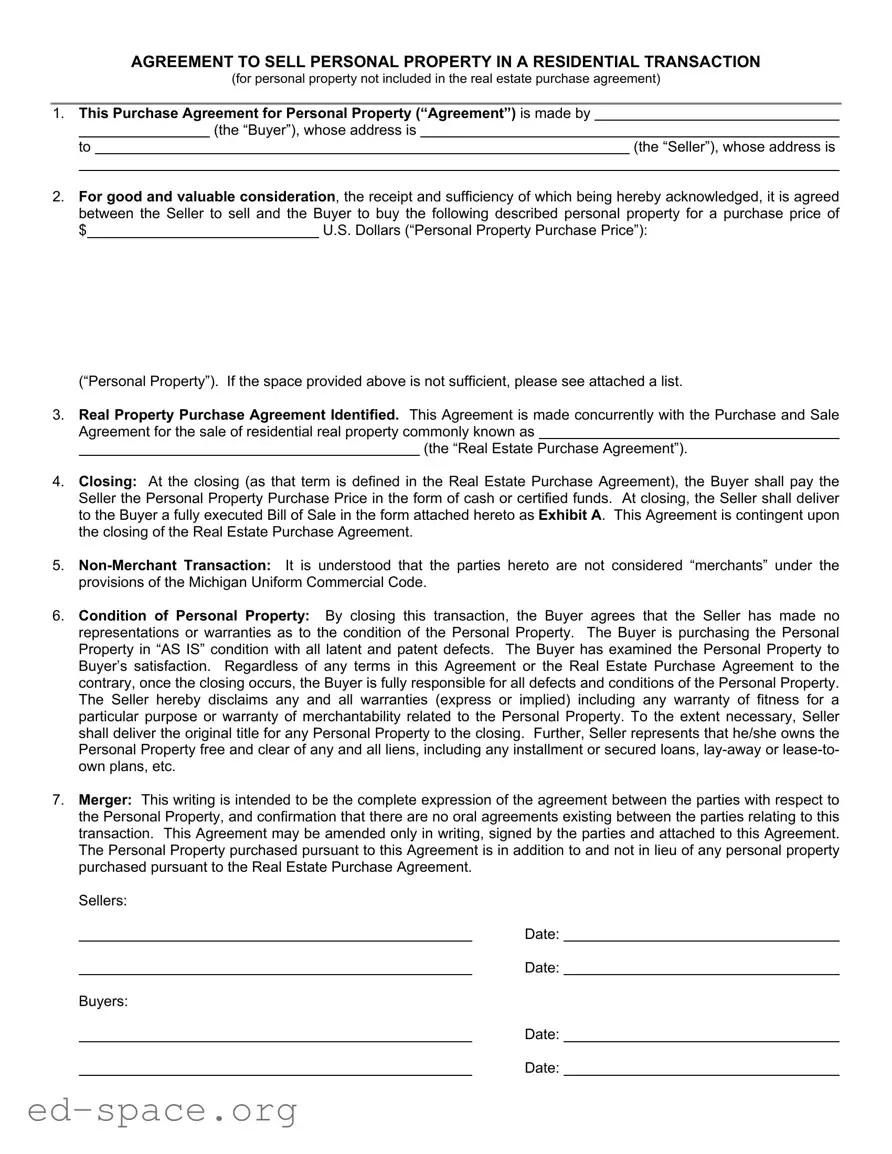
The Agreement Personal Property form is an essential document for buyers and sellers involved in residential transactions where personal property is being sold alongside real estate. This form outlines the terms under which the seller agrees to sell specific personal property to the buyer, typically not included in the main real estate purchase agreement. Key components of the form include the identification of both parties, a detailed description of the personal property being sold, and the agreed-upon purchase price. It specifies that the transaction is contingent upon the closing of the related real estate deal and outlines the payment method, which must be in cash or certified funds. Importantly, the buyer accepts the personal property in its current condition, acknowledging that the seller makes no warranties regarding its state. The form also emphasizes that the seller holds clear title to the property, free from liens, and confirms that the agreement constitutes the complete understanding between the parties. This clarity helps prevent misunderstandings and ensures a smooth transaction process.
AGREEMENT TO SELL PERSONAL PROPERTY IN A RESIDENTIAL TRANSACTION
(for personal property not included in the real estate purchase agreement)
1.This Purchase Agreement for Personal Property (“Agreement”) is made by
|
(the “Buyer”), whose address is |
to |
(the “Seller”), whose address is |
2.For good and valuable consideration, the receipt and sufficiency of which being hereby acknowledged, it is agreed between the Seller to sell and the Buyer to buy the following described personal property for a purchase price of
$ |
|
U.S. Dollars (“Personal Property Purchase Price”): |
(“Personal Property”). If the space provided above is not sufficient, please see attached a list.
3. Real Property Purchase Agreement Identified. This Agreement is made concurrently with the Purchase and Sale Agreement for the sale of residential real property commonly known as
(the “Real Estate Purchase Agreement”).
4.Closing: At the closing (as that term is defined in the Real Estate Purchase Agreement), the Buyer shall pay the Seller the Personal Property Purchase Price in the form of cash or certified funds. At closing, the Seller shall deliver to the Buyer a fully executed Bill of Sale in the form attached hereto as Exhibit A. This Agreement is contingent upon the closing of the Real Estate Purchase Agreement.
5.
6.Condition of Personal Property: By closing this transaction, the Buyer agrees that the Seller has made no representations or warranties as to the condition of the Personal Property. The Buyer is purchasing the Personal Property in “AS IS” condition with all latent and patent defects. The Buyer has examined the Personal Property to Buyer’s satisfaction. Regardless of any terms in this Agreement or the Real Estate Purchase Agreement to the contrary, once the closing occurs, the Buyer is fully responsible for all defects and conditions of the Personal Property. The Seller hereby disclaims any and all warranties (express or implied) including any warranty of fitness for a particular purpose or warranty of merchantability related to the Personal Property. To the extent necessary, Seller shall deliver the original title for any Personal Property to the closing. Further, Seller represents that he/she owns the Personal Property free and clear of any and all liens, including any installment or secured loans,
7.Merger: This writing is intended to be the complete expression of the agreement between the parties with respect to the Personal Property, and confirmation that there are no oral agreements existing between the parties relating to this transaction. This Agreement may be amended only in writing, signed by the parties and attached to this Agreement. The Personal Property purchased pursuant to this Agreement is in addition to and not in lieu of any personal property purchased pursuant to the Real Estate Purchase Agreement.
Sellers:
Date:
Date:
Buyers:
Date:
Date:
| Fact Name | Details |
|---|---|
| Purpose | This form is used to facilitate the sale of personal property that is not included in a real estate purchase agreement. |
| Parties Involved | The agreement is made between the Buyer and the Seller, both of whom must provide their addresses. |
| Purchase Price | The Buyer agrees to pay a specified amount for the personal property, referred to as the "Personal Property Purchase Price." |
| Closing Conditions | The transaction is contingent upon the closing of the related Real Estate Purchase Agreement. |
| Condition of Property | The Buyer accepts the property in "AS IS" condition, acknowledging that the Seller makes no warranties about its state. |
| Non-Merchant Status | The parties are not considered "merchants" under the Michigan Uniform Commercial Code, which affects certain legal rights. |
| Complete Agreement | This document represents the complete agreement between the parties, with no oral agreements affecting the transaction. |
| Governing Law | This agreement is governed by the laws of the state of Michigan, specifically the Michigan Uniform Commercial Code. |
Completing the Agreement Personal Property form is straightforward. This document facilitates the sale of personal property in conjunction with a residential real estate transaction. Follow the steps below to ensure all necessary information is accurately provided.
What is the purpose of the Agreement Personal Property form?
The Agreement Personal Property form is designed to facilitate the sale of personal property that is not included in the real estate purchase agreement during a residential transaction. This document outlines the terms under which the buyer agrees to purchase specific personal items from the seller, ensuring clarity and mutual understanding between both parties. It serves as a formal record of the transaction, detailing the items being sold, the agreed purchase price, and the responsibilities of each party involved.
What should be included in the Agreement Personal Property form?
The form should include the names and addresses of both the buyer and the seller, a detailed description of the personal property being sold, and the purchase price. If the space provided for the description is insufficient, an attached list can be used. Additionally, it is important to reference the concurrent real estate purchase agreement to establish the relationship between the two transactions. This ensures that both parties are aware of the context in which the personal property sale is taking place.
What does "AS IS" condition mean in this agreement?
The term "AS IS" indicates that the buyer accepts the personal property in its current condition, with all existing defects, whether visible or hidden. By agreeing to this condition, the buyer acknowledges that the seller has made no warranties or representations regarding the quality or functionality of the items. This clause emphasizes that the buyer has had the opportunity to inspect the property and accepts full responsibility for any issues that may arise after the transaction is completed.
What happens at the closing of the transaction?
At the closing, the buyer is required to pay the seller the agreed-upon purchase price for the personal property, typically in cash or certified funds. The seller must provide a fully executed Bill of Sale, which serves as proof of the transaction. This closing is contingent upon the successful completion of the associated real estate purchase agreement. It is crucial for both parties to ensure that all terms are met before finalizing the sale to avoid any misunderstandings.
Incomplete Information: Failing to provide complete names and addresses for both the Buyer and Seller can lead to confusion and legal complications. Ensure all fields are filled out accurately.
Incorrect Purchase Price: Listing the wrong amount for the Personal Property Purchase Price can create disputes. Double-check that the price reflects the agreed-upon amount.
Not Specifying the Personal Property: If the details of the personal property are vague or missing, it may result in misunderstandings. Include a clear description or an attached list if necessary.
Neglecting Contingencies: Forgetting to acknowledge that this Agreement is contingent upon the closing of the Real Estate Purchase Agreement can lead to issues. Make sure to reference this condition clearly.
Ignoring the “AS IS” Clause: Buyers should be aware that they are purchasing the property in its current condition, without warranties. It is essential to understand and accept this term before signing.
When entering into a transaction involving personal property, several other forms and documents may accompany the Agreement to Sell Personal Property. These documents help clarify the terms and conditions of the sale, ensuring that both parties understand their rights and responsibilities. Below is a list of commonly used documents in conjunction with the Agreement to Sell Personal Property.
These documents collectively help ensure a smooth transaction, protecting both the buyer and seller throughout the process. Having a clear understanding of each document's purpose can facilitate better communication and reduce the likelihood of disputes later on.
The Agreement to Sell Personal Property form shares similarities with several other documents that facilitate the sale or transfer of personal property. Below is a list of eight documents that are comparable, along with a brief explanation of how they relate to the Agreement:
When filling out the Agreement Personal Property form, it is essential to adhere to certain guidelines to ensure clarity and legality. Below are some important dos and don'ts:
Understanding the Agreement Personal Property form is crucial for both buyers and sellers involved in a residential transaction. However, several misconceptions can lead to confusion. Here’s a look at nine common misunderstandings:
By addressing these misconceptions, both buyers and sellers can navigate the Agreement Personal Property form with greater confidence and clarity.
Filling out and using the Agreement Personal Property form is an important step in a residential transaction. Here are some key takeaways to keep in mind:
Understanding these key points will help ensure a successful transaction involving personal property in a residential setting.