Homepage Fillable Affidavit of Identity Template
Article Guide

The Affidavit of Identity form serves as a crucial tool for individuals seeking to verify their identity in various legal and administrative contexts. This document is often required when someone needs to confirm their identity for reasons such as applying for a passport, opening a bank account, or participating in legal proceedings. It typically includes personal details such as the individual's name, address, and date of birth, along with a sworn statement affirming that the information provided is accurate. Additionally, the form may require the signature of a notary public, ensuring that the affidavit is legally binding. Understanding the importance and proper use of this form can help streamline processes that depend on identity verification, making it an essential resource for many individuals navigating bureaucratic requirements.

Document Preview

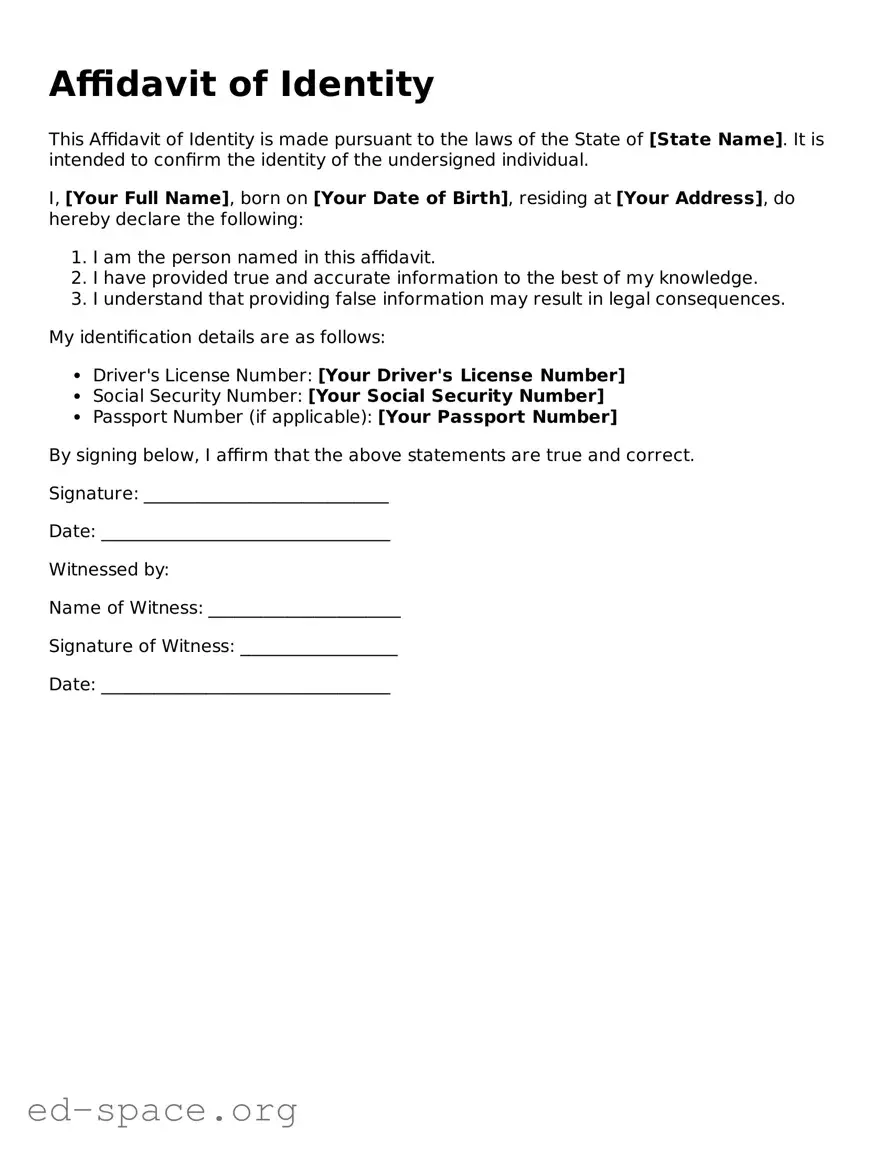
Affidavit of Identity

This Affidavit of Identity is made pursuant to the laws of the State of [State Name]. It is intended to confirm the identity of the undersigned individual.

I, [Your Full Name], born on [Your Date of Birth], residing at [Your Address], do hereby declare the following:

  1. I am the person named in this affidavit.
  2. I have provided true and accurate information to the best of my knowledge.
  3. I understand that providing false information may result in legal consequences.

My identification details are as follows:

  • Driver's License Number: [Your Driver's License Number]
  • Social Security Number: [Your Social Security Number]
  • Passport Number (if applicable): [Your Passport Number]

By signing below, I affirm that the above statements are true and correct.

Signature: ____________________________

Date: _________________________________

Witnessed by:

Name of Witness: ______________________

Signature of Witness: __________________

Date: _________________________________

PDF Form Details

Fact Name Description
Definition An Affidavit of Identity is a sworn statement used to verify a person's identity, often required in legal proceedings or transactions.
Purpose This form helps establish a person's identity, especially in cases of mistaken identity or when documents are lost or stolen.
State-Specific Forms Each state may have its own version of the Affidavit of Identity, tailored to meet local legal requirements.
Governing Laws In California, for instance, the use of the Affidavit of Identity is governed by California Evidence Code Section 1400.
Notarization Most states require the affidavit to be notarized, ensuring that the identity verification is conducted under legal supervision.
Common Uses People often use this affidavit in situations involving bank accounts, property transactions, or legal disputes.

Affidavit of Identity: Usage Guidelines

Completing the Affidavit of Identity form requires careful attention to detail. Once the form is filled out, it will need to be signed in the presence of a notary public. After notarization, the document can be submitted to the appropriate entity as required.

  1. Obtain the Affidavit of Identity form. This can usually be found online or at a local government office.
  2. Read through the entire form before filling it out. Familiarize yourself with the required information.
  3. Begin with your full legal name. Ensure that it matches your identification documents.
  4. Provide your current address. Include street number, street name, city, state, and zip code.
  5. Enter your date of birth. Use the format MM/DD/YYYY.
  6. List any other names you have used in the past, if applicable. This may include maiden names or aliases.
  7. Fill in your Social Security number. If you do not have one, indicate that on the form.
  8. Include any additional identifying information requested, such as a driver’s license number or passport number.
  9. Review all entries for accuracy. Make sure there are no typos or missing information.
  10. Sign and date the form in the designated area. Ensure that you do this in front of a notary public.
  11. Have the notary public complete their section. They will verify your identity and witness your signature.
  12. Make a copy of the completed form for your records before submitting it as required.

Your Questions, Answered

What is an Affidavit of Identity?

An Affidavit of Identity is a legal document used to confirm a person's identity. It is often utilized in situations where an individual needs to prove their identity but may not have the standard forms of identification available, such as a driver's license or passport. This affidavit serves as a sworn statement, typically signed in the presence of a notary public, affirming that the information provided is true and accurate. It can be essential for various legal processes, including applying for loans, accessing bank accounts, or resolving identity theft issues.

Who needs to use an Affidavit of Identity?

Individuals who find themselves in situations where traditional forms of identification are lacking may need to use an Affidavit of Identity. For example, someone who has lost their wallet may need this document to access their bank account or to apply for a replacement ID. Additionally, those who are victims of identity theft might use the affidavit to clarify their identity when dealing with financial institutions or law enforcement. In some cases, even businesses may require an affidavit when verifying the identity of a client or customer.

How do I complete an Affidavit of Identity?

Completing an Affidavit of Identity involves several steps. First, you will need to gather any relevant information about yourself, such as your full name, date of birth, and any other identifying details. Next, you should draft the affidavit, clearly stating your identity and the purpose for which you are using the document. It’s important to include a statement affirming the truthfulness of the information provided. Finally, you must sign the affidavit in front of a notary public, who will verify your identity and witness your signature. Some jurisdictions may have specific requirements, so it’s advisable to check local laws or seek legal guidance if needed.

Is an Affidavit of Identity legally binding?

Yes, an Affidavit of Identity is considered a legally binding document once it has been properly executed. By signing the affidavit, you are making a sworn statement, which means that you are legally responsible for the truthfulness of the information contained within it. If someone were to provide false information in an affidavit, they could face legal consequences, including potential charges of perjury. Therefore, it is crucial to ensure that all details are accurate and truthful before signing the document.

Common mistakes

  1. Incomplete Information: One common mistake is failing to provide all required details. Each section of the form must be filled out completely. Leaving out information can lead to delays or rejection of the affidavit.

  2. Incorrect Identification: People often use outdated or incorrect identification documents. It's crucial to ensure that the identification provided matches the information on the form.

  3. Signature Issues: Some individuals forget to sign the affidavit or sign it in the wrong place. Remember, your signature is a declaration of the truthfulness of the information provided.

  4. Not Notarizing: Failing to have the affidavit notarized is a frequent oversight. Many jurisdictions require a notarized affidavit to be considered valid.

  5. Using Incorrect Language: The wording used in the affidavit can be problematic. Avoid using slang or unclear terms; the language should be straightforward and formal to ensure clarity.

Documents used along the form

The Affidavit of Identity form serves as a crucial document for verifying a person's identity in various legal situations. Often, it is accompanied by other forms and documents to support the identity verification process or to fulfill legal requirements. Below is a list of related documents that are commonly used alongside the Affidavit of Identity.

  • Identification Card: A government-issued ID that includes a photo and personal information. It serves as a primary proof of identity.
  • Birth Certificate: An official document that records the birth of a person. It provides essential information such as date of birth and parentage.
  • Social Security Card: This card contains a unique number assigned to individuals for tracking earnings and benefits. It is often required for identity verification.
  • Utility Bill: A recent bill that shows the individual's name and address. It helps establish residency and can support identity claims.
  • Passport: An official travel document issued by the government. It includes personal details and is widely accepted as a proof of identity.
  • Driver's License: A state-issued document that permits an individual to operate a vehicle. It includes personal information and a photograph.
  • Voter Registration Card: A card that confirms an individual's eligibility to vote. It typically includes the person's name and address.
  • Marriage Certificate: An official document that records the marriage of two individuals. It can be used to verify name changes or relationships.

Each of these documents plays a vital role in establishing identity and supporting legal processes. When submitting an Affidavit of Identity, it is essential to consider which additional forms may be necessary to ensure a comprehensive verification of identity.

Similar forms

  • Declaration of Identity: This document serves a similar purpose by affirming a person's identity. It is often used in situations where proof of identity is required, such as in legal proceedings or when applying for certain services.
  • Identity Verification Form: This form is used to confirm a person's identity, typically by collecting personal information and supporting documents. Like the Affidavit of Identity, it aims to establish a clear and verified identity.
  • Notarized Statement: A notarized statement is a written declaration that is signed in the presence of a notary public. This document, much like the Affidavit of Identity, provides a sworn assertion regarding a person's identity and can be used in various legal contexts.
  • Identity Theft Affidavit: This document is specifically designed for individuals who believe they have been victims of identity theft. While its focus is on theft, it still includes elements that verify and affirm the identity of the individual, similar to the Affidavit of Identity.
  • Certificate of Identity: This certificate is an official document issued by a government authority that verifies a person's identity. It parallels the Affidavit of Identity in that both documents serve to confirm who a person is, often for legal or administrative purposes.
  • Personal Identification Statement: This statement is a written account provided by an individual to affirm their identity. It shares similarities with the Affidavit of Identity, as both documents are used to establish a person's identity in various situations.

Dos and Don'ts

When filling out the Affidavit of Identity form, it’s crucial to be thorough and accurate. Here’s a list of things to keep in mind:

  • Do read the instructions carefully before starting.
  • Don't leave any required fields blank; incomplete forms can cause delays.
  • Do provide accurate and truthful information.
  • Don't use nicknames or aliases; stick to your legal name.
  • Do double-check your spelling and details.
  • Don't rush through the form; take your time to ensure accuracy.
  • Do sign and date the affidavit where indicated.
  • Don't forget to have your signature notarized if required.
  • Do keep a copy of the completed form for your records.
  • Don't submit the form without reviewing it one last time.

By following these guidelines, you can help ensure that your Affidavit of Identity form is processed smoothly and efficiently.

Misconceptions

The Affidavit of Identity form is often misunderstood. Here are ten common misconceptions about this important document:

  1. It is only for legal name changes. Many believe the affidavit is solely for those changing their names. In reality, it can also verify identity in various situations, such as confirming identity for legal documents.
  2. Anyone can fill it out. Some think that any individual can complete the form without any requirements. However, it must be signed in front of a notary public to be valid.
  3. It is the same as a passport or driver’s license. An affidavit is not an official identification document like a passport or driver’s license. It serves a different purpose in confirming identity.
  4. It can be used anywhere without restrictions. This form is not universally accepted. Different institutions may have specific requirements for its use, so it’s important to check beforehand.
  5. Once signed, it cannot be changed. Many think that an affidavit is set in stone. In fact, if circumstances change, a new affidavit can be created to reflect the updated information.
  6. It requires a lawyer to complete. Some believe legal assistance is necessary to fill out this form. However, individuals can complete it on their own, as long as they follow the guidelines.
  7. It can be submitted electronically. Many assume that the affidavit can be submitted online. In most cases, it must be physically signed in front of a notary, making electronic submission impossible.
  8. It is only for adults. Some think this form is only for those over 18. Minors can also use it, but parental consent and additional documentation may be required.
  9. It is a government form. This affidavit is not a government-issued form. It is a legal document created by individuals to affirm their identity, often for personal or business use.
  10. Once completed, it is permanent. Many believe that once the affidavit is completed, it cannot be revoked. However, individuals can rescind it if necessary, following proper procedures.

Understanding these misconceptions can help individuals navigate the use of the Affidavit of Identity form more effectively.

Key takeaways

Filling out and using the Affidavit of Identity form can seem daunting at first, but understanding its purpose and requirements can make the process smoother. Here are some key takeaways to keep in mind:

  • Purpose: The Affidavit of Identity is used to verify your identity, often in situations where traditional identification may not be available.
  • Accuracy: Ensure all information provided is accurate. Mistakes can lead to delays or complications.
  • Signature Requirement: Your signature is essential. It confirms that the information you provided is true and correct.
  • Witness or Notary: Some jurisdictions require a witness or notary public to sign the affidavit, adding an extra layer of verification.
  • Supporting Documents: Be prepared to include supporting documents that can help establish your identity, such as a birth certificate or utility bill.
  • Submission Process: Understand where and how to submit the affidavit. Different agencies may have specific requirements.
  • Keep Copies: Always make copies of the completed affidavit and any supporting documents for your records.

By keeping these points in mind, you can navigate the process of completing and using the Affidavit of Identity form with confidence.