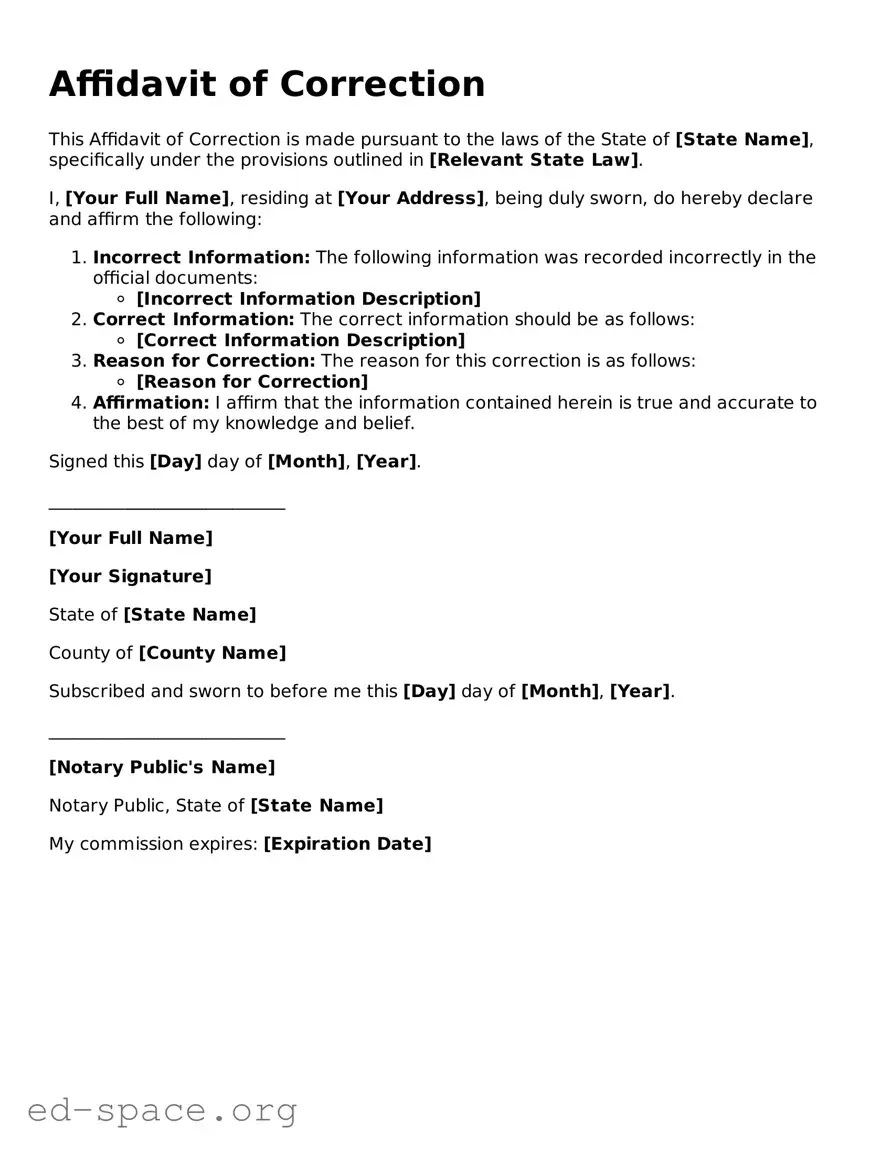
The Affidavit of Correction form serves a crucial role in the legal and administrative landscape, allowing individuals to rectify errors in official documents. Whether it’s a mistake in a property deed, a birth certificate, or any other important record, this form provides a straightforward method for making necessary corrections. By submitting this affidavit, individuals affirm that the information in question is inaccurate and outline the correct details that should replace the erroneous data. This process not only helps in maintaining accurate public records but also protects individuals from potential legal complications that may arise from incorrect information. Understanding how to properly complete and file this form is essential for anyone needing to amend a legal document. With clear guidelines and requirements, the Affidavit of Correction empowers individuals to take control of their records and ensure that they reflect the truth.
Affidavit of Correction
This Affidavit of Correction is made pursuant to the laws of the State of [State Name], specifically under the provisions outlined in [Relevant State Law].
I, [Your Full Name], residing at [Your Address], being duly sworn, do hereby declare and affirm the following:
Signed this [Day] day of [Month], [Year].
___________________________
[Your Full Name]
[Your Signature]
State of [State Name]
County of [County Name]
Subscribed and sworn to before me this [Day] day of [Month], [Year].
___________________________
[Notary Public's Name]
Notary Public, State of [State Name]
My commission expires: [Expiration Date]
| Fact Name | Description |
|---|---|
| Definition | An Affidavit of Correction is a legal document used to amend or correct errors in public records. |
| Purpose | This form is typically used to rectify mistakes in documents such as deeds, mortgages, or other legal filings. |
| Common Errors | Common errors that may necessitate this affidavit include misspellings, incorrect dates, or wrong property descriptions. |
| State Variations | Each state may have its own specific requirements and forms for filing an Affidavit of Correction. |
| Governing Law | In California, for example, the governing law is found in the California Civil Code Section 1187. |
| Signature Requirement | The affidavit must be signed by the person who executed the original document or their legal representative. |
| Filing Process | After completion, the affidavit must be filed with the appropriate county office where the original document is recorded. |
| Legal Effect | Once filed, the Affidavit of Correction serves to officially document the changes made to the original record. |
| Potential Limitations | Some states may impose limitations on what can be corrected, so it is essential to check local laws. |
After obtaining the Affidavit of Correction form, you will need to complete it accurately to ensure that any necessary corrections are made. Follow the steps outlined below to fill out the form correctly.
What is an Affidavit of Correction?
An Affidavit of Correction is a legal document used to correct errors or mistakes in previously filed documents. This form is often utilized to amend inaccuracies in public records, such as property deeds, marriage certificates, or court documents. The affidavit serves as a sworn statement that outlines the specific errors and provides the correct information.
Who can file an Affidavit of Correction?
Typically, any individual or entity that is affected by the error can file an Affidavit of Correction. This may include property owners, spouses, or representatives of an organization. It is important that the person filing the affidavit has a legitimate interest in the correction and is able to provide the necessary information to support the claim.
What information is required to complete the form?
To complete an Affidavit of Correction, you will need to provide specific details about the document being corrected. This includes the title of the document, the date it was filed, and the nature of the error. Additionally, you must include the correct information that should replace the incorrect data. Personal identification details, such as names and addresses, may also be required.
How do I file an Affidavit of Correction?
Filing an Affidavit of Correction typically involves submitting the completed form to the appropriate government office or agency where the original document was filed. This could be a county clerk’s office, a court, or another relevant authority. It is advisable to check with the specific office for any additional requirements, such as filing fees or supporting documents.
Is there a fee associated with filing an Affidavit of Correction?
Yes, there may be a fee associated with filing an Affidavit of Correction. The amount can vary depending on the jurisdiction and the type of document being corrected. It is recommended to contact the relevant office to inquire about any fees and payment methods accepted.
Will the correction be publicly recorded?
Yes, once filed, the Affidavit of Correction typically becomes part of the public record. This means that it can be accessed by anyone who requests to see the records. The purpose of this is to ensure transparency and to provide an official record of the correction made to the original document.
Can I use an Affidavit of Correction for any type of document?
While an Affidavit of Correction can be used for many types of documents, it is important to verify whether it is appropriate for your specific situation. Some documents may have their own correction procedures or requirements. Consulting with a legal professional may provide guidance tailored to your circumstances.
Incomplete Information: One common mistake is failing to provide all necessary details. Every section of the form must be filled out completely. Leaving out even a single piece of information can delay the process or lead to rejection.
Incorrect Signatures: Signatures should be clear and match the name as it appears on official documents. A mismatch can raise questions about the authenticity of the affidavit.
Not Notarizing the Document: Many people forget that an affidavit must be notarized. Without a notary's seal, the affidavit may not be considered valid.
Using Inappropriate Language: The language used in the affidavit should be straightforward and factual. Avoiding overly complex terms or emotional language helps maintain clarity.
Failing to Provide Supporting Documents: Sometimes, individuals neglect to attach necessary documents that support their corrections. These documents can be crucial for verifying the changes being made.
Ignoring Deadlines: Every jurisdiction has specific timelines for submitting an affidavit of correction. Missing these deadlines can result in additional complications or the need to restart the process.
When dealing with an Affidavit of Correction, several other forms and documents may come into play. These documents help clarify or support the corrections being made. Here’s a brief overview of some commonly used forms alongside the Affidavit of Correction.
Using these documents together can help ensure that your corrections are properly recorded and understood. Always check local requirements, as they may vary by jurisdiction.
When filling out the Affidavit of Correction form, it's important to follow some key guidelines to ensure accuracy and compliance. Here’s a straightforward list of things you should and shouldn't do:
Following these guidelines can help ensure your Affidavit of Correction is processed smoothly.
Many people have misunderstandings about the Affidavit of Correction form. Here are seven common misconceptions:
Understanding these misconceptions can help ensure that the Affidavit of Correction is used correctly and effectively.
When filling out and using the Affidavit of Correction form, there are several important points to consider. These takeaways can help ensure that the process goes smoothly.