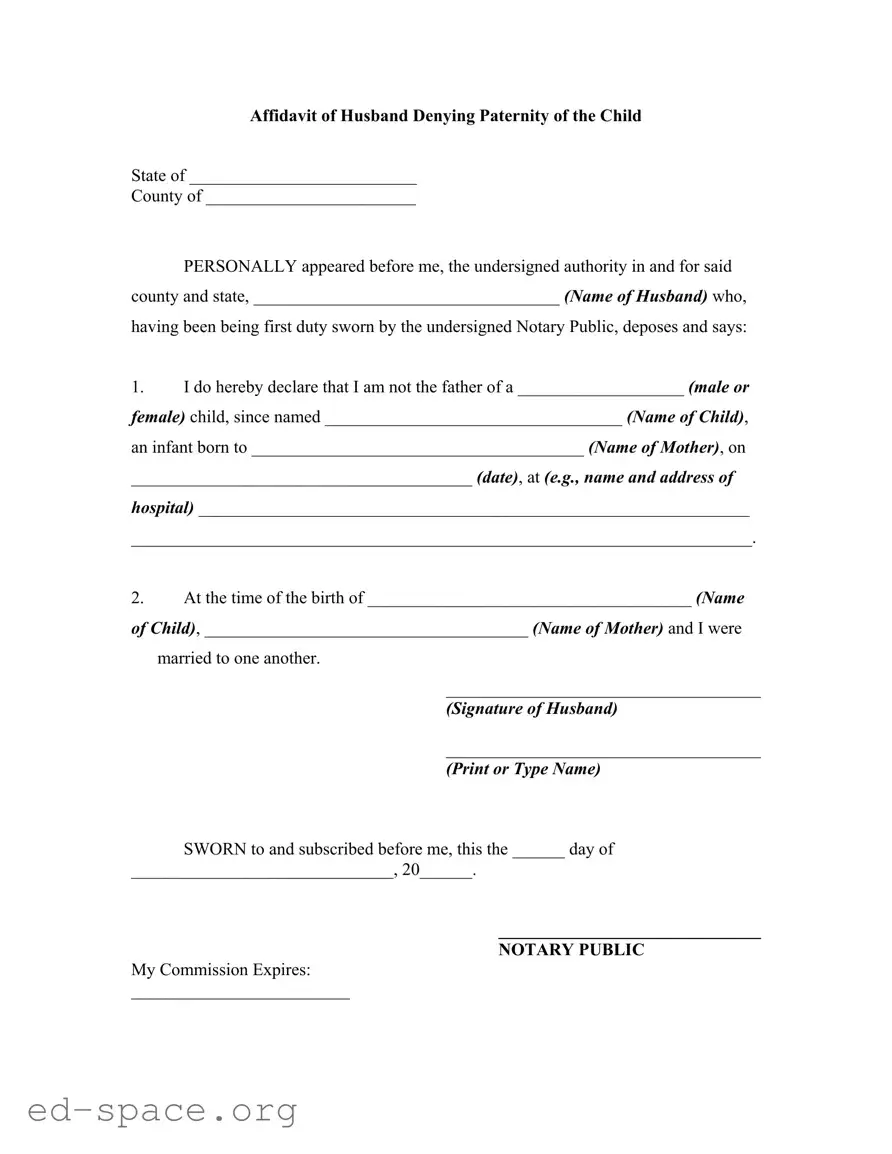
The Affidavit Denying Paternity form serves an important purpose for individuals who wish to formally declare that they are not the biological father of a child. This legal document is often utilized by husbands who find themselves in a complex situation regarding paternity, especially when they are married to the child's mother at the time of birth. By completing this affidavit, the husband can assert his position clearly, stating that he does not claim fatherhood over the child named in the document. The form requires specific details, including the names of both the husband and the mother, the name of the child, and the date and place of the child's birth. Additionally, it must be signed in the presence of a notary public, ensuring that the declaration is legally binding. This process not only protects the rights of the husband but also clarifies the child's paternity status, which can be crucial for legal and familial matters down the line.
Affidavit of Husband Denying Paternity of the Child
State of __________________________
County of ________________________
PERSONALLY appeared before me, the undersigned authority in and for said county and state, ___________________________________ (Name of Husband) who,
having been being first duty sworn by the undersigned Notary Public, deposes and says:
1.I do hereby declare that I am not the father of a ___________________ (male or female) child, since named __________________________________ (Name of Child), an infant born to ______________________________________ (Name of Mother), on
_______________________________________ (date), at (e.g., name and address of hospital) _______________________________________________________________
_______________________________________________________________________.
2.At the time of the birth of _____________________________________ (Name of Child), _____________________________________ (Name of Mother) and I were
married to one another.
____________________________________
(Signature of Husband)
____________________________________
(Print or Type Name)
SWORN to and subscribed before me, this the ______ day of
______________________________, 20______.
______________________________
NOTARY PUBLIC
My Commission Expires:
_________________________
| Fact Name | Description |
|---|---|
| Purpose | The Affidavit Denying Paternity form is used by a husband to formally declare that he is not the biological father of a child. |
| Legal Requirement | This affidavit is often required in legal proceedings to clarify paternity issues, especially when the mother is married to someone other than the biological father. |
| State-Specific Forms | Each state may have its own version of the affidavit, governed by state laws regarding paternity and family law. |
| Notary Public | The form must be signed in the presence of a Notary Public, who verifies the identity of the signer and witnesses the signature. |
| Information Required | The affidavit requires specific details, including the names of the husband, mother, and child, as well as the date and place of the child's birth. |
| Impact on Child Support | Filing this affidavit may have implications for child support obligations, as it legally establishes the husband’s denial of paternity. |
| Legal Consequences | Submitting a false affidavit can lead to legal consequences, including potential charges of perjury or fraud. |
After completing the Affidavit Denying Paternity form, it will need to be submitted to the appropriate court or agency. Ensure that all sections are accurately filled out and that the document is signed in the presence of a notary public.
What is an Affidavit Denying Paternity?
An Affidavit Denying Paternity is a legal document that a husband can sign to declare that he is not the biological father of a child. This form is often used in situations where there are doubts about paternity, particularly when the mother and husband are married at the time of the child's birth.
Why would someone need to file this affidavit?
This affidavit is typically filed to clarify legal responsibilities and rights regarding child support and custody. If a husband believes he is not the biological father, filing this affidavit helps to establish that he is not responsible for child support obligations related to the child in question.
What information is required on the form?
The form requires specific details, including the names of the husband, mother, and child, the date of birth of the child, and the location of the birth. It also requires the husband's signature and a notarization to validate the document.
How does notarization work for this affidavit?
Notarization involves a notary public who verifies the identity of the person signing the affidavit. The husband must appear in person before the notary, who will then witness the signature and affix their seal to the document. This step is crucial for ensuring the affidavit is legally binding.
Can this affidavit be contested?
What are the legal implications of signing this affidavit?
By signing the affidavit, the husband is legally stating that he denies paternity. This can affect child support obligations and parental rights. It is important to understand that once filed, the affidavit may have lasting legal effects, so consulting with a legal expert before signing is advisable.
Failing to provide accurate personal information. Ensure that the Name of Husband, Name of Child, and Name of Mother are correctly filled out.
Not including the date of birth for the child. The date must be clearly stated to avoid any confusion.
Omitting the location of the child's birth. The form requires the name and address of the hospital where the child was born.
Neglecting to sign the affidavit. The signature of the husband is essential for the document to be valid.
Forgetting to print or type the name after signing. This step is crucial for clarity and identification.
Not having the affidavit notarized. A Notary Public must witness the signature for the affidavit to be legally binding.
Leaving the commission expiration date blank. The notary's commission expiration must be included for authenticity.
Failing to understand the legal implications. It's important to recognize that denying paternity may have legal consequences.
The Affidavit Denying Paternity form is an important document for individuals who wish to formally declare that they are not the biological father of a child. When dealing with paternity issues, several other forms and documents may be necessary to support the process. Below is a list of related documents that are often used in conjunction with the Affidavit Denying Paternity.
Understanding these documents can help clarify the paternity process and ensure that all necessary steps are taken. Each form serves a specific purpose and contributes to resolving paternity-related issues effectively.
The Affidavit Denying Paternity form shares similarities with several other legal documents. Each of these documents serves a specific purpose related to parental rights and responsibilities. Below is a list of seven documents that are comparable to the Affidavit Denying Paternity:
When filling out the Affidavit Denying Paternity form, it's essential to approach the task with care. Here are seven things you should and shouldn't do:
Misconceptions about the Affidavit Denying Paternity form can lead to confusion and misinterpretation of its purpose and implications. Here are nine common misconceptions:
Understanding these misconceptions is vital for anyone considering the Affidavit Denying Paternity. Seeking legal advice can provide clarity and guidance in navigating this complex issue.
When filling out and using the Affidavit Denying Paternity form, consider the following key takeaways: