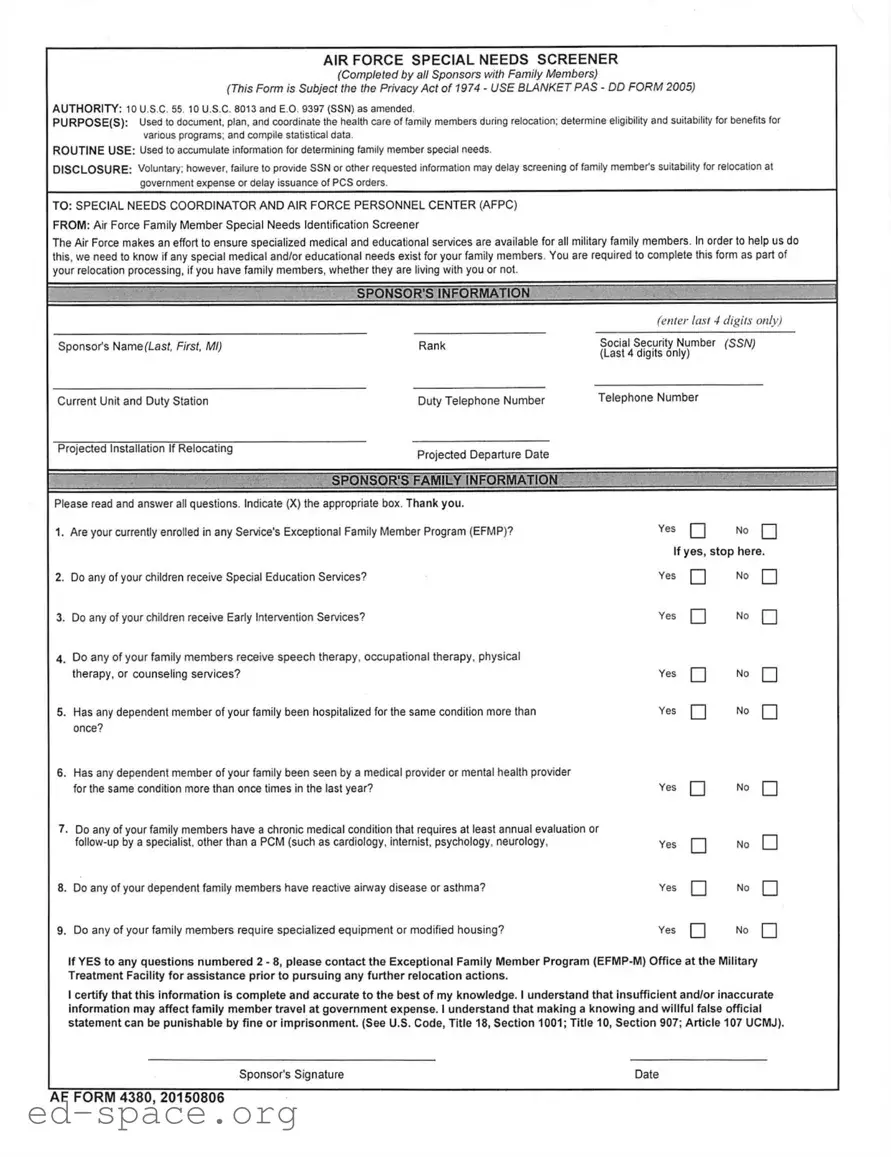
The AF 4380 form, known as the Air Force Special Needs Screener, plays a crucial role in ensuring that military families receive the necessary support during relocations. This form is mandatory for all sponsors with family members, regardless of whether those members are living with them. It serves multiple purposes, including documenting and coordinating health care needs, determining eligibility for various benefits, and gathering statistical data. The information collected helps identify any special medical or educational needs within the family, which is essential for planning appropriate services. Completing the AF 4380 is not just a bureaucratic step; it directly impacts the suitability of family members for relocation at government expense. It’s important to note that while providing information is voluntary, omitting details such as Social Security Numbers may lead to delays in processing. The form also prompts sponsors to disclose any ongoing medical or educational services their family members may require, ensuring that the Air Force can effectively support their unique needs. By taking the time to fill out this form accurately, sponsors contribute to a smoother transition for their families during the often-stressful relocation process.
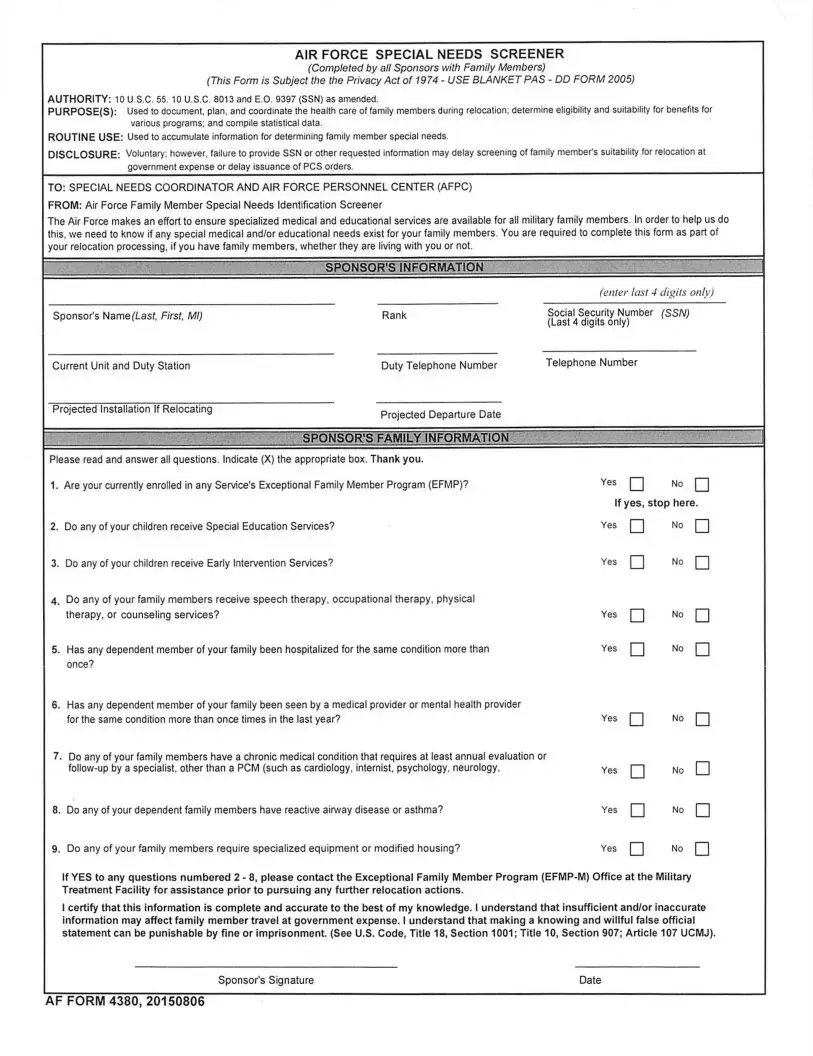
AIRFORCE SPECIAL NEEDS SCREENER
(Completed by all Sponsors with Family Members)
(This Form is Subject the the Privacy Act of 1974 - USE BLANKET PAS - DD FORM 2005)
AUTHORITY: 10 U.S.C. 55. 10 U.S.C. 8013 and E.O. 9397 (SSN) as amended.
PURPOSE(S): Used to document, plan, and coordinate the health care of family members during relocation; determine eligibility and suitability for benefits for various programs; and compile statistical data.
ROUTINE USE: Used to accumulate information for determining family member special needs.
DISCLOSURE: Voluntary; however, failure to provide SSN or other requested information may delay screening of family member's suitability for relocation at
government expense or delay issuance of PCS orders.
TO: SPECIAL NEEDS COORDINATOR AND AIR FORCE PERSONNEL CENTER (AFPC)
FROM: Air Force Family Member Special Needs Identification Screener
The Air Force makes an effort to ensure specialized medical and educational services are available for all military family members. In order to help us do this, we need to know if any special medical and/or educational needs exist for your family members. You are required to complete this form as part of
your relocation processing, if you have family members, whether they are living with you or not.
|
SPONSOR’S INFORMATION |
= |
|
|
(enter last 4 digits only) |
Sponsor’s Name (Last, First, Ml) |
Rank |
Social Security Number (SSN) |
|
|
(Last 4 digits only) |
Current Unit and Duty Station |
Duty Telephone Number |
Telephone Number |
Projected Installation If Relocating |
Projected Departure Date |
|
|
|
|
|
SPONSOR'S FAMILY INFORMATION |
|
Please read and answer all questions. Indicate (X) the appropriate box. Thank you.
1. Are your currently enrolled in any Service's Exceptional Family Member Program (EFMP)? |
Yes Q |
No | |
If yes, stop here.
2. |
Do any of your children receive Special Education Services? |
Yes |
3. |
Do any of your children receive Early Intervention Services? |
Yes |
4. Do any of your family members receive speech therapy, occupational therapy, physical |
|
|
|
therapy, or counseling services? |
Yes |
5. |
Has any dependent member of your family been hospitalized for the same condition more than |
Yes |
|
once? |
|
6. Has any dependent member of your family been seen by a medical provider or mental health provider |
|
|
|
for the same condition more than once times in the last year? |
Yes |
7. Do any of your family members have a chronic medical condition that requires at least annual evaluation or |
|
|
|
Yes |
|
8. |
Do any of your dependent family members have reactive airway disease or asthma? |
Yes |
9. |
Do any of your family members require specialized equipment or modified housing? |
Yes |
□
□
□
□
□
□
□
□
No
No
No
No
No
No
No
No
□
□
□
□
□
□
□
□
If YES to any questions numbered 2 - 8, please contact the Exceptional Family Member Program
I certify that this information is complete and accurate to the best of my knowledge. I understand that insufficient and/or inaccurate information may affect family member travel at government expense. I understand that making a knowing and willful false official statement can be punishable by fine or imprisonment. (See U.S. Code, Title 18, Section 1001; Title 10, Section 907; Article 107 UCMJ).
Sponsor's Signature |
Date |
AF FORM 4380, 20150806
| Fact Name | Description |
|---|---|
| Form Title | Air Force Special Needs Screener |
| Purpose | This form is used to document and coordinate the health care needs of family members during relocation. |
| Authority | Governed by 10 U.S.C. 55, 10 U.S.C. 8013, and E.O. 9397 (SSN) as amended. |
| Disclosure | Providing information is voluntary, but failure to do so may delay relocation screening. |
| Eligibility | Used to determine eligibility for benefits in various programs related to family members' special needs. |
| Routine Use | Information is accumulated to identify special needs for family members. |
| Completion Requirement | All sponsors with family members must complete this form as part of their relocation processing. |
Completing the AF 4380 form is an essential step in ensuring that your family members receive the necessary support during your relocation. This form collects important information regarding any special medical or educational needs that your family may have. Follow these steps carefully to fill out the form accurately.
What is the purpose of the AF 4380 form?
The AF 4380 form, also known as the Air Force Special Needs Screener, is designed to document and coordinate the health care needs of military family members during relocation. It helps determine eligibility for various benefits and compiles statistical data regarding family member special needs. Completing this form ensures that the Air Force can provide appropriate medical and educational services to families with special needs.
Who is required to complete the AF 4380 form?
All sponsors with family members are required to complete the AF 4380 form as part of their relocation process. This requirement applies regardless of whether the family members are currently living with the sponsor. By filling out this form, sponsors help the Air Force assess and address any special medical or educational needs their family members may have.
What information is collected on the AF 4380 form?
The AF 4380 form collects essential information about the sponsor and their family members, including names, current unit, duty station, and projected installation. It also includes questions about any special education services, therapies, chronic medical conditions, and the need for specialized equipment or modified housing. This information is crucial for the Air Force to ensure that adequate support is available for families with special needs.
What happens if I do not provide the requested information?
While providing information on the AF 4380 form is voluntary, failing to submit the requested details, such as Social Security Numbers or answers to specific questions, may lead to delays. These delays can affect the screening process for family member suitability for relocation at government expense and may postpone the issuance of Permanent Change of Station (PCS) orders.
What should I do if my family members have special needs?
If any of your family members have special needs, as indicated by answering "yes" to questions numbered 2 through 8 on the AF 4380 form, it is recommended that you contact the Exceptional Family Member Program (EFMP-M) Office at your Military Treatment Facility. This step is crucial before proceeding with any further relocation actions, ensuring that your family's needs are adequately addressed.
What are the consequences of providing false information on the AF 4380 form?
Providing false information on the AF 4380 form can lead to serious consequences. Making a knowingly false statement can result in penalties, including fines or imprisonment. This is outlined in U.S. Code, Title 18, Section 1001, Title 10, Section 907, and Article 107 of the Uniform Code of Military Justice (UCMJ). It is essential to ensure that all information provided is complete and accurate to avoid any potential legal repercussions.
Failing to provide the last four digits of the Social Security Number (SSN). This information is crucial for processing.
Not answering all questions in the family information section. Each question is designed to assess the needs of family members.
Overlooking the requirement to indicate if enrolled in the Exceptional Family Member Program (EFMP). This can impact relocation decisions.
Providing incomplete or inaccurate information about family members' medical conditions. This can lead to delays in care and relocation.
Not contacting the EFMP Office if any conditions are marked "yes" on questions 2-8. This step is essential for further relocation actions.
Failing to sign and date the form. A signature is required to certify the accuracy of the information provided.
Ignoring the instructions regarding the voluntary disclosure of information. While it's voluntary, not providing requested details may delay processing.
Submitting the form without reviewing it for errors or missing information. A thorough review can prevent complications later.
Not keeping a copy of the completed form for personal records. This can be useful for future reference or follow-up.
The AF 4380 form is essential for documenting the special needs of military family members during relocations. Alongside this form, several other documents may be required to ensure a smooth transition. Here’s a list of commonly used forms and documents that often accompany the AF 4380.
Having these documents ready can streamline the relocation process and ensure that all family members receive the care and support they need. It’s important to stay organized and informed to make the transition as smooth as possible.
The AF 4380 form, known as the Air Force Special Needs Screener, plays a crucial role in documenting and coordinating the healthcare needs of military families. Several other documents serve similar purposes in various contexts, particularly in assessing needs, eligibility, and providing necessary support. Here’s a list of eight documents that share similarities with the AF 4380 form:
Each of these forms serves a specific purpose, yet they share the common goal of gathering essential information to support individuals and families in need. Understanding these documents can enhance the effectiveness of the services provided to military families and ensure that their unique needs are met.
When filling out the AF 4380 form, it's essential to approach the task with care. Here are five important dos and don'ts to keep in mind:
Misconceptions about the AF 4380 form can lead to confusion and delays in processing. Here are five common misunderstandings:
Filling out the AF 4380 form is an essential step for military sponsors with family members who may have special needs. Here are key takeaways to consider: