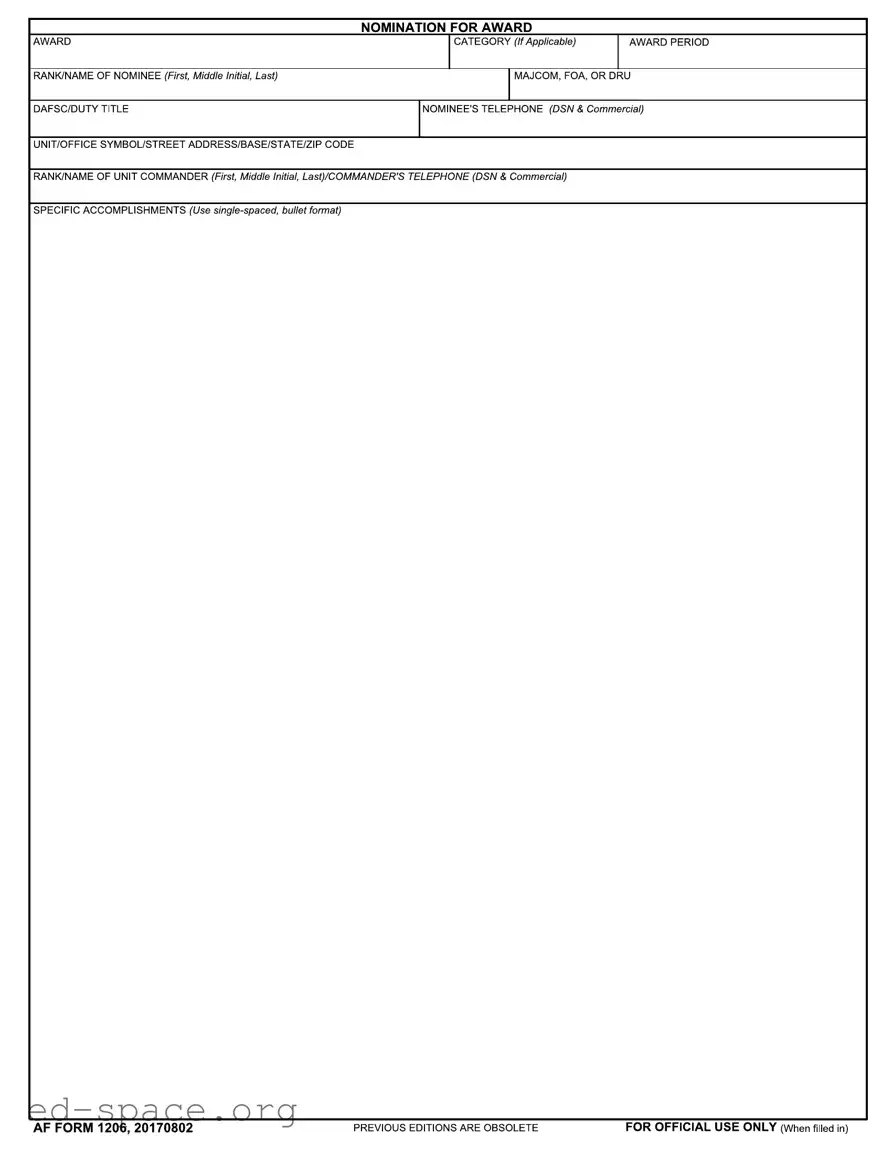
The AF 1206 form plays a crucial role in the nomination process for awards within the U.S. Air Force. This form is designed to collect essential information about the nominee, including their rank, name, duty title, and contact details. It also requires the nominee's unit and the commander's information, ensuring that all relevant parties are involved in the nomination. The form emphasizes the importance of specific accomplishments, which must be presented in a clear, bullet-point format. This structured approach allows for a straightforward evaluation of the nominee's achievements during the specified award period. Additionally, the AF 1206 form is designated for official use only, underscoring the significance of the information it contains. Proper completion of this form is vital for a successful nomination, as it sets the foundation for recognizing outstanding service and dedication within the Air Force.


| Fact Name | Detail |
|---|---|
| Form Purpose | The AF 1206 form is used for nominating individuals for awards within the U.S. Air Force. |
| Nominee Information | It requires the rank and name of the nominee, including first, middle initial, and last name. |
| Duty Information | The form asks for the nominee's DAFSC (Duty Air Force Specialty Code) and duty title. |
| Unit Details | Information about the nominee's unit, office symbol, and address is also needed. |
| Award Category | There is an option to specify the award category, if applicable. |
| Award Period | The form includes a section to indicate the period for which the award is being nominated. |
| Major Command | Nominees must specify their Major Command (MAJCOM), Field Operating Agency (FOA), or Direct Reporting Unit (DRU). |
| Contact Information | Nominees must provide their telephone number, including both DSN and commercial formats. |
| Commander Details | The rank and name of the unit commander must be included, along with their contact number. |
| Accomplishments | Specific accomplishments should be listed in a single-spaced, bullet format to highlight the nominee's achievements. |
Filling out the AF 1206 form is an important step in the nomination process for an award. Completing this form accurately will help ensure that the nominee's achievements are clearly communicated and recognized. Below are the steps to guide you through the process.
Once you have completed the form, review it for accuracy and completeness. Make sure all required fields are filled out correctly before submitting it for consideration.
What is the AF Form 1206 used for?
The AF Form 1206 is primarily used to nominate individuals for awards within the U.S. Air Force. It captures essential information about the nominee, including their rank, name, and specific accomplishments that justify the nomination. This form helps ensure that deserving personnel receive recognition for their contributions and achievements.
What information is required on the AF Form 1206?
The form requires several key pieces of information. Nominees must provide their rank, full name, duty title, and contact details. Additionally, the form asks for the unit or office symbol, the award period, and the name and contact information of the unit commander. Most importantly, nominees must outline their specific accomplishments in a clear, bullet-point format.
How should I format the specific accomplishments section?
The specific accomplishments should be listed in a single-spaced bullet format. Each bullet point should clearly describe an achievement or contribution made by the nominee. It’s important to be concise yet detailed enough to convey the significance of each accomplishment. This section is crucial, as it directly influences the evaluation of the nomination.
Who can submit an AF Form 1206?
The AF Form 1206 can be submitted by any member of the U.S. Air Force who wishes to nominate a fellow service member for an award. This includes peers, supervisors, or commanders. The form must be completed thoroughly to ensure that the nominee receives proper consideration for the award.
Is there a deadline for submitting the AF Form 1206?
Deadlines for submitting the AF Form 1206 can vary depending on the specific award being sought. It is essential to check with the relevant authority or award guidelines to determine the submission timeline. Late submissions may result in disqualification from consideration, so timely submission is critical.
What happens after the AF Form 1206 is submitted?
Once the AF Form 1206 is submitted, it undergoes a review process. The nomination will be evaluated based on the accomplishments listed and the overall impact of the nominee's contributions. Depending on the award, the nomination may go through several levels of approval before a decision is made. Nominees and submitters should remain informed about the status of their nominations through the appropriate channels.
Incomplete Nominee Information: Failing to provide the full name, including the middle initial, can lead to confusion and delays in processing.
Incorrect Contact Information: Not including accurate telephone numbers for both the nominee and the unit commander can hinder communication.
Neglecting the Award Period: Omitting the specific time frame for which the nominee is being recognized may result in disqualification.
Improper Formatting of Accomplishments: Using inconsistent bullet points or spacing in the accomplishments section can make the form difficult to read.
Leaving Out the Unit/Office Symbol: This detail is essential for proper identification and routing of the nomination.
Ignoring Category Specifications: Not selecting the appropriate category, if applicable, may lead to misclassification of the nomination.
Submitting Previous Editions: Using outdated versions of the AF 1206 form can result in rejection of the nomination.
Failing to Review for Errors: Not double-checking for typos or inaccuracies can undermine the professionalism of the nomination.
The AF Form 1206 is an essential document used for nominating individuals for awards within the military. However, several other forms and documents often accompany this form to provide additional context or support for the nomination. Below is a list of these commonly used forms, along with brief descriptions of each.
Understanding the purpose of these accompanying documents can enhance the nomination process. Each form plays a vital role in presenting a well-rounded view of the nominee's qualifications and achievements, ultimately supporting their candidacy for recognition.
The AF 1206 form is a nomination document used primarily within the U.S. Air Force to recognize individuals for their achievements. Several other documents serve similar purposes in various contexts. Below are five documents that share similarities with the AF 1206 form:
When filling out the AF 1206 form, it's important to follow certain guidelines to ensure clarity and accuracy. Here are some dos and don'ts to keep in mind:
Following these guidelines can help make the nomination process smoother and more effective.
Understanding the AF 1206 form is crucial for those involved in military award nominations. However, several misconceptions persist. Below are ten common misunderstandings, clarified for better comprehension.
By addressing these misconceptions, individuals can navigate the nomination process more effectively and ensure that their submissions are both accurate and impactful.
Filling out the AF 1206 form is a crucial step in the nomination process for military awards. Here are some key takeaways to ensure you navigate it effectively:
By keeping these points in mind, you can enhance the quality of your nomination and increase the chances of recognition for deserving individuals.