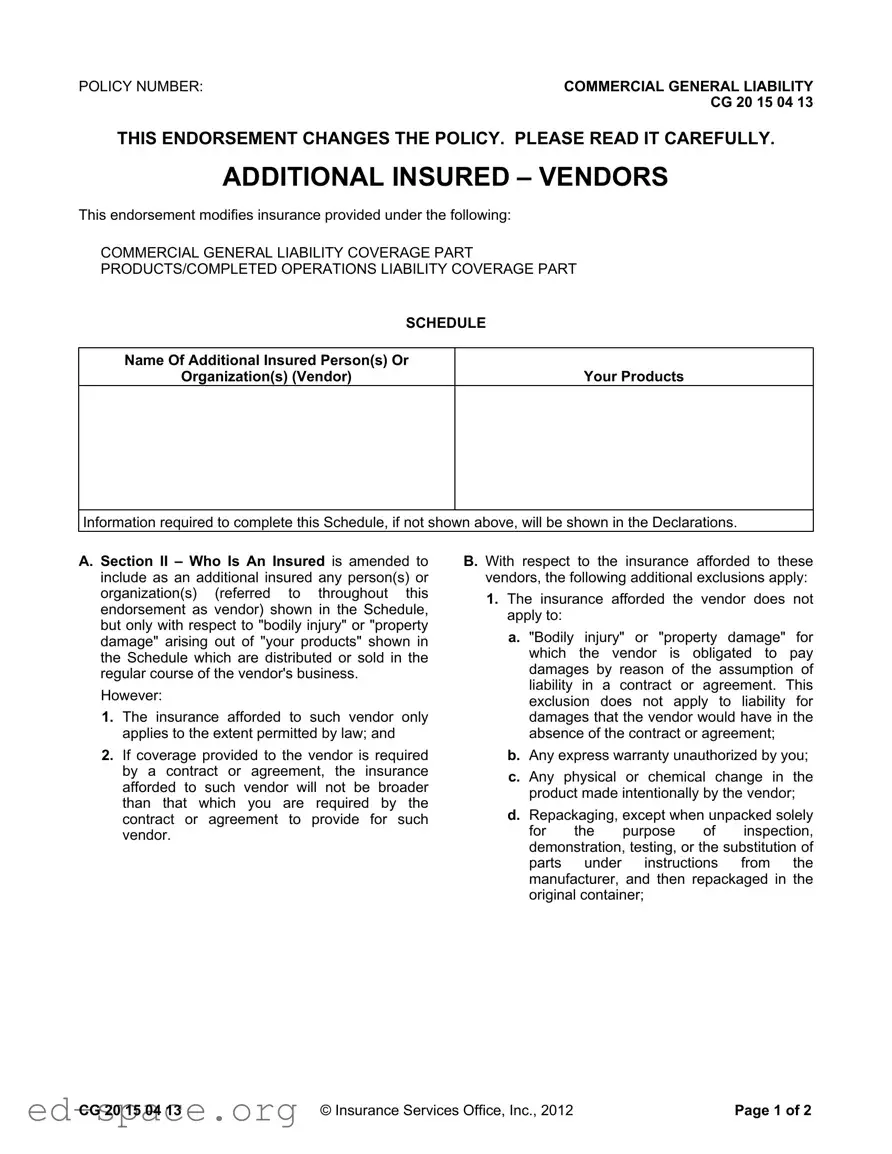
The Additional Insured Vendors form, known as CG 20 15 04 13, serves as an important endorsement that modifies the coverage provided under a Commercial General Liability policy. This form is designed to extend insurance protection to vendors, allowing them to be included as additional insured parties under specific circumstances. It primarily covers bodily injury or property damage arising from products sold or distributed by the vendor, as long as those products are listed in the endorsement's schedule. However, it is crucial to note that the coverage is limited to the extent permitted by law and cannot exceed what is stipulated in any contractual agreements. Additionally, the form outlines various exclusions that delineate the boundaries of coverage. For instance, it does not cover liabilities that vendors assume through contracts, unauthorized warranties, or damages resulting from the vendor's own negligence. It also specifies limitations on the amount of insurance available, ensuring that the vendor's coverage aligns with contractual requirements or the policy's limits, whichever is lower. Understanding the nuances of this endorsement is essential for both businesses and vendors to navigate their insurance obligations effectively.
POLICY NUMBER: |
COMMERCIAL GENERAL LIABILITY |
|
CG 20 15 04 13 |
THIS ENDORSEMENT CHANGES THE POLICY. PLEASE READ IT CAREFULLY.
ADDITIONAL INSURED – VENDORS
This endorsement modifies insurance provided under the following:
COMMERCIAL GENERAL LIABILITY COVERAGE PART
PRODUCTS/COMPLETED OPERATIONS LIABILITY COVERAGE PART
SCHEDULE
Name Of Additional Insured Person(s) Or
Organization(s) (Vendor)
Your Products
Information required to complete this Schedule, if not shown above, will be shown in the Declarations.
A. Section II – Who Is An Insured is amended to include as an additional insured any person(s) or organization(s) (referred to throughout this endorsement as vendor) shown in the Schedule, but only with respect to "bodily injury" or "property damage" arising out of "your products" shown in the Schedule which are distributed or sold in the regular course of the vendor's business.
However:
1.The insurance afforded to such vendor only applies to the extent permitted by law; and
2.If coverage provided to the vendor is required by a contract or agreement, the insurance afforded to such vendor will not be broader than that which you are required by the contract or agreement to provide for such vendor.
B. With respect to the insurance afforded to these vendors, the following additional exclusions apply:
1.The insurance afforded the vendor does not apply to:
a."Bodily injury" or "property damage" for which the vendor is obligated to pay damages by reason of the assumption of liability in a contract or agreement. This exclusion does not apply to liability for damages that the vendor would have in the absence of the contract or agreement;
b.Any express warranty unauthorized by you;
c.Any physical or chemical change in the product made intentionally by the vendor;
d.Repackaging, except when unpacked solely for the purpose of inspection, demonstration, testing, or the substitution of parts under instructions from the manufacturer, and then repackaged in the original container;
CG 20 15 04 13 |
© Insurance Services Office, Inc., 2012 |
Page 1 of 2 |
e. Any failure to make such inspections, adjustments, tests or servicing as the vendor has agreed to make or normally undertakes to make in the usual course of business, in connection with the distribution or sale of the products;
f. Demonstration, installation, servicing or repair operations, except such operations performed at the vendor's premises in connection with the sale of the product;
g.Products which, after distribution or sale by you, have been labeled or relabeled or used as a container, part or ingredient of any other thing or substance by or for the vendor; or
h."Bodily injury" or "property damage" arising out of the sole negligence of the vendor for its own acts or omissions or those of its employees or anyone else acting on its behalf. However, this exclusion does not apply to:
(1)The exceptions contained in Sub- paragraphs d. or f.; or
(2)Such inspections, adjustments, tests or servicing as the vendor has agreed to make or normally undertakes to make in the usual course of business, in connection with the distribution or sale of the products.
2.This insurance does not apply to any insured person or organization, from whom you have acquired such products, or any ingredient, part or container, entering into, accompanying or containing such products.
C.With respect to the insurance afforded to these vendors, the following is added to Section III – Limits Of Insurance:
If coverage provided to the vendor is required by a contract or agreement, the most we will pay on behalf of the vendor is the amount of insurance:
1.Required by the contract or agreement; or
2.Available under the applicable Limits of Insurance shown in the Declarations;
whichever is less.
This endorsement shall not increase the applicable Limits of Insurance shown in the Declarations.
Page 2 of 2 |
© Insurance Services Office, Inc., 2012 |
CG 20 15 04 13 |
| Fact Name | Description |
|---|---|
| Policy Number | The form is identified by the policy number CG 20 15 04 13, which refers to the Commercial General Liability coverage. |
| Purpose | This endorsement adds additional insured status for vendors, specifically for bodily injury or property damage related to the insured's products. |
| Coverage Scope | Coverage applies only to incidents arising out of products sold or distributed by the vendor in the regular course of their business. |
| Legal Limitations | The insurance provided to vendors is limited by law and cannot exceed what is required by contract. |
| Exclusions | Several exclusions apply, including liabilities assumed by contract, unauthorized warranties, and negligence solely attributable to the vendor. |
| Inspection Responsibilities | Vendors are not covered for failures in inspections or servicing they are obligated to perform. |
| Limit of Insurance | The maximum payout for vendors is the lesser of the contract-required amount or the limits outlined in the Declarations. |
| State-Specific Forms | Some states may have specific requirements or variations in the endorsement; always check local regulations. |
| Importance of Review | It's crucial to read and understand the endorsement thoroughly to ensure proper coverage and compliance with contractual obligations. |
Filling out the Additional Insured Vendors form is a straightforward process. This form is essential for ensuring that vendors are recognized as additional insured parties under your commercial general liability policy. Completing it accurately helps to clarify the coverage provided to vendors related to your products.
What is the Additional Insured Vendors form?
The Additional Insured Vendors form is an endorsement that modifies a Commercial General Liability (CGL) insurance policy. It allows vendors, listed in the endorsement, to be added as additional insured parties. This means they are covered for certain liabilities that may arise from your products, as long as those products are sold or distributed in the vendor's normal business operations.
What types of coverage does this endorsement provide?
This endorsement provides coverage for bodily injury and property damage that arises from your products. However, this coverage is limited to what is allowed by law and is not broader than what you are required to provide under any contract or agreement with the vendor. It's important to note that the coverage only applies to incidents related to the vendor’s distribution or sale of your products.
Are there any exclusions I should be aware of?
Yes, there are several exclusions. For instance, the coverage does not apply if the vendor is liable due to a contract they signed, any unauthorized warranties, or if they made changes to the product. It also excludes incidents arising from the vendor's sole negligence or any failures in inspections or servicing that the vendor was supposed to conduct. Understanding these exclusions can help you assess your risks more accurately.
How are limits of insurance determined for vendors?
The limits of insurance for vendors are based on what is required by the contract or agreement with them, or the limits available under your policy, whichever is less. This means that if a contract specifies a certain amount of coverage, that amount will be the maximum available to the vendor. The endorsement does not increase the overall limits of your policy.
Incomplete Information: Failing to provide all required details, such as the name of the additional insured vendor or the policy number, can lead to processing delays.
Incorrect Vendor Names: Using misspelled or incorrect names for vendors can result in the endorsement being invalid. Always double-check the spelling.
Omitting Product Information: Not including the specific products associated with the vendor can create gaps in coverage.
Not Understanding Coverage Limits: Ignoring the limits of insurance specified in the declarations can lead to misunderstandings about the extent of coverage.
Ignoring Exclusions: Failing to review the exclusions listed in the endorsement can result in unexpected liabilities not being covered.
Assuming Automatic Coverage: Believing that all vendors automatically qualify for coverage without proper documentation can lead to issues during claims.
Not Updating the Schedule: Neglecting to update the schedule when new vendors are added or when existing vendors change can leave gaps in coverage.
Misunderstanding Contractual Obligations: Overlooking the contractual obligations related to coverage can lead to providing inadequate insurance for vendors.
Submitting Late: Delaying the submission of the form can result in coverage not being in effect when needed, exposing the business to potential risks.
The Additional Insured Vendors form is a key document in the realm of commercial general liability insurance. It allows vendors to be added as additional insured parties under a primary policy, providing them with coverage for specific liabilities. Several other forms and documents often accompany this endorsement to clarify terms, outline responsibilities, and ensure compliance with contractual obligations. Below is a list of related documents commonly used alongside the Additional Insured Vendors form.
These documents play a crucial role in managing risk and ensuring that all parties involved in a business transaction are adequately protected. Understanding each document's purpose can help streamline the process of securing and maintaining insurance coverage while fostering positive vendor relationships.
The Additional Insured Vendors form is a specific endorsement within a commercial general liability policy that extends coverage to vendors. Several other documents serve similar purposes in the realm of insurance and risk management. Here’s a look at seven of those documents:
Each of these documents shares a common goal: to extend liability coverage to third parties in specific contexts, thus managing risk effectively while ensuring compliance with contractual obligations.
When filling out the Additional Insured Vendors form, it is crucial to follow specific guidelines to ensure accuracy and compliance. Here are five things to do and five things to avoid:
This form does not offer unlimited coverage. The insurance provided is limited to specific circumstances, such as "bodily injury" or "property damage" arising from your products sold in the vendor's regular business operations. Coverage is also contingent upon the terms of any existing contracts.
Not all vendors are automatically included. Only those explicitly listed in the Schedule of the form are considered additional insureds. It is essential to specify each vendor to ensure they receive coverage.
This endorsement does not cover every type of liability. For instance, it excludes liabilities arising from contracts, express warranties not authorized by you, and any negligence solely attributed to the vendor.
Coverage is not blanket protection. If a vendor engages in certain actions, such as intentional changes to the product or failing to conduct agreed-upon inspections, they may not be covered under this form.
The endorsement does not increase the limits of insurance. The maximum payout for a vendor is the lesser of what is required by contract or what is available under the policy's limits, as stated in the Declarations.
When filling out and using the Additional Insured Vendors form, consider the following key takeaways:
By following these guidelines, you can ensure that the Additional Insured Vendors form is filled out correctly and used effectively.