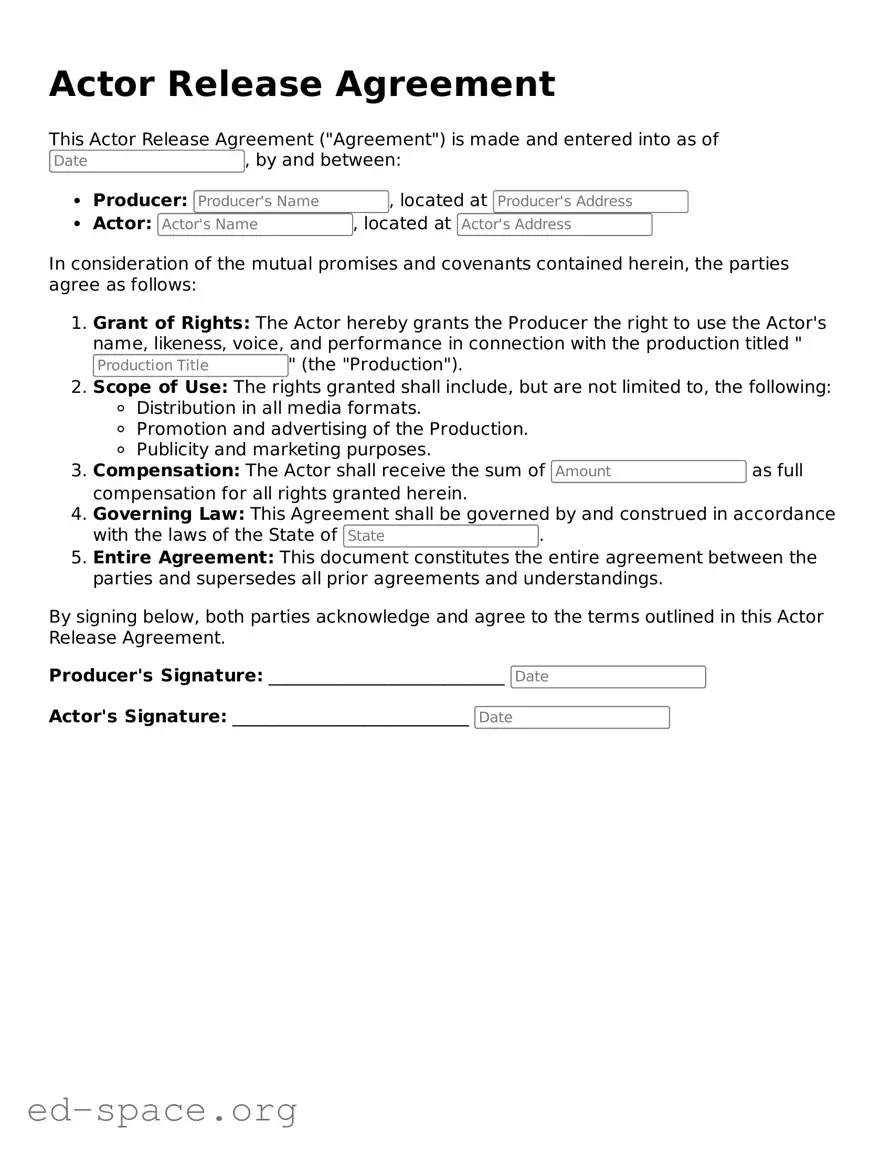
The Actor Release form is an essential document for anyone involved in film, television, or theater productions. This form serves to protect the rights of both the actor and the production company. It grants permission for the use of an actor's likeness, voice, and performance in various media formats. By signing this form, actors acknowledge that they understand how their performances will be used, which can include promotional materials, trailers, and even merchandise. Additionally, the Actor Release form often outlines compensation terms, ensuring that actors are aware of their payment structure. It is vital for productions to have this document in place to avoid potential legal disputes and to maintain a professional relationship with the talent involved. Understanding the nuances of this form can help both actors and producers navigate the complexities of the entertainment industry effectively.
Actor Release Agreement
This Actor Release Agreement ("Agreement") is made and entered into as of , by and between:
In consideration of the mutual promises and covenants contained herein, the parties agree as follows:
By signing below, both parties acknowledge and agree to the terms outlined in this Actor Release Agreement.
Producer's Signature: ___________________________
Actor's Signature: ___________________________
| Fact Name | Description |
|---|---|
| Purpose | The Actor Release form is used to obtain permission from actors to use their likeness in various media productions. |
| Consent | Actors must provide their consent for their performances to be recorded and distributed. |
| Rights Granted | The form typically grants the production company rights to use the actor's image, voice, and performance. |
| State-Specific Forms | Some states have specific requirements for release forms, so it’s important to check local laws. |
| Governing Law (California) | In California, the form may be governed by Civil Code Section 3344, which protects an individual's right of publicity. |
| Governing Law (New York) | New York law, particularly Civil Rights Law Sections 50 and 51, governs the use of an individual's likeness. |
| Revocation | Actors may have the right to revoke their consent under certain circumstances, depending on state laws. |
| Importance | Having a signed Actor Release form helps protect the production from legal issues related to image and likeness rights. |
After obtaining the Actor Release form, the next step involves accurately completing it to ensure that all necessary information is provided. This process is straightforward but requires attention to detail. Follow the steps outlined below to fill out the form correctly.
Once the form is filled out, it should be submitted to the relevant production team member for processing. Ensure that a copy is retained for personal records.
What is an Actor Release form?
An Actor Release form is a legal document that grants permission for filmmakers, producers, or production companies to use an actor's likeness, voice, and performance in a project. This form ensures that the actor agrees to the terms under which their image and work will be used, protecting both the actor's rights and the production's interests. It's a crucial step in the filmmaking process, as it helps avoid potential disputes over ownership and usage rights in the future.
Why is it important to have an Actor Release form?
Having an Actor Release form is essential for several reasons. First, it provides legal protection for the production team, ensuring they have the right to use the actor's performance without fear of legal repercussions. Second, it protects the actor by clearly outlining how their image and work will be used, which can include details about distribution, duration, and any potential compensation. This clarity helps maintain a professional relationship between the actor and the production team.
What should be included in an Actor Release form?
An effective Actor Release form should include several key components. It should clearly state the names of the parties involved, including the actor and the production company. The document must outline the specific project and the scope of usage, detailing how the actor's likeness and performance will be utilized. Additionally, it should address any compensation agreements, the duration of the rights granted, and any limitations or restrictions on usage. Lastly, both parties should sign and date the form to make it legally binding.
Can an Actor Release form be revoked?
Inaccurate Personal Information: Many individuals fail to provide their full legal name, address, or contact details. Ensure that all personal information is complete and accurate to avoid issues later.
Missing Signature: Some forget to sign the form entirely. A signature is crucial as it indicates consent. Always double-check for a signature before submission.
Improper Date: Failing to date the form can lead to confusion about when consent was given. Always include the correct date next to your signature.
Neglecting to Read the Terms: Skimming through the terms and conditions can result in misunderstandings. Take time to read and understand what rights you are granting.
Not Specifying the Project: Some forms lack details about the specific project or production. Clearly state the project name to avoid ambiguity.
Failure to Include Contact Information: Omitting a phone number or email address can hinder communication. Always provide multiple ways to reach you.
Ignoring Additional Clauses: Some overlook optional clauses that may be beneficial. Review these sections carefully to ensure they align with your preferences.
Submitting Without a Witness: Certain situations may require a witness signature. Check if this is necessary for your specific release form.
When working in the entertainment industry, particularly in film and television, several documents are essential for protecting the rights of all parties involved. The Actor Release form is one such document, but it often accompanies other forms that serve various purposes. Below is a list of commonly used documents that complement the Actor Release form.
Each of these documents plays a vital role in the smooth operation of a production. They help clarify expectations, protect rights, and mitigate risks for everyone involved. Understanding these forms can contribute to a more organized and legally sound project.
When filling out an Actor Release form, it's essential to approach the process with care. Here’s a list of dos and don’ts to ensure everything goes smoothly.
Misconceptions about the Actor Release form can lead to confusion for both actors and producers. Below are eight common misunderstandings, along with clarifications.
This is not true. While actors grant permission for their image to be used, they still retain certain rights. The release form specifies how the image can be used.
Every production, regardless of size, should use a release form. This protects both the actor and the producer, ensuring clear agreements.
Payment is a separate issue. The release form simply allows the use of the actor's image and does not guarantee compensation.
Each project may have unique requirements. It's essential to review and customize the release form to fit the specific needs of the production.
While it’s difficult to retract a release, discussions can sometimes lead to amendments or new agreements if both parties agree.
Release forms are also important for still photography, live performances, and any situation where an actor's image may be used.
The enforceability of a release form can depend on various factors, including clarity and consent. Not all forms hold up in court.
While release forms are generally intended to be permanent, actors can negotiate terms that allow for certain limitations or timeframes.
When filling out and using the Actor Release form, keep the following key points in mind: