Homepage Blank Act 221 Disclosure PDF Form
Article Guide

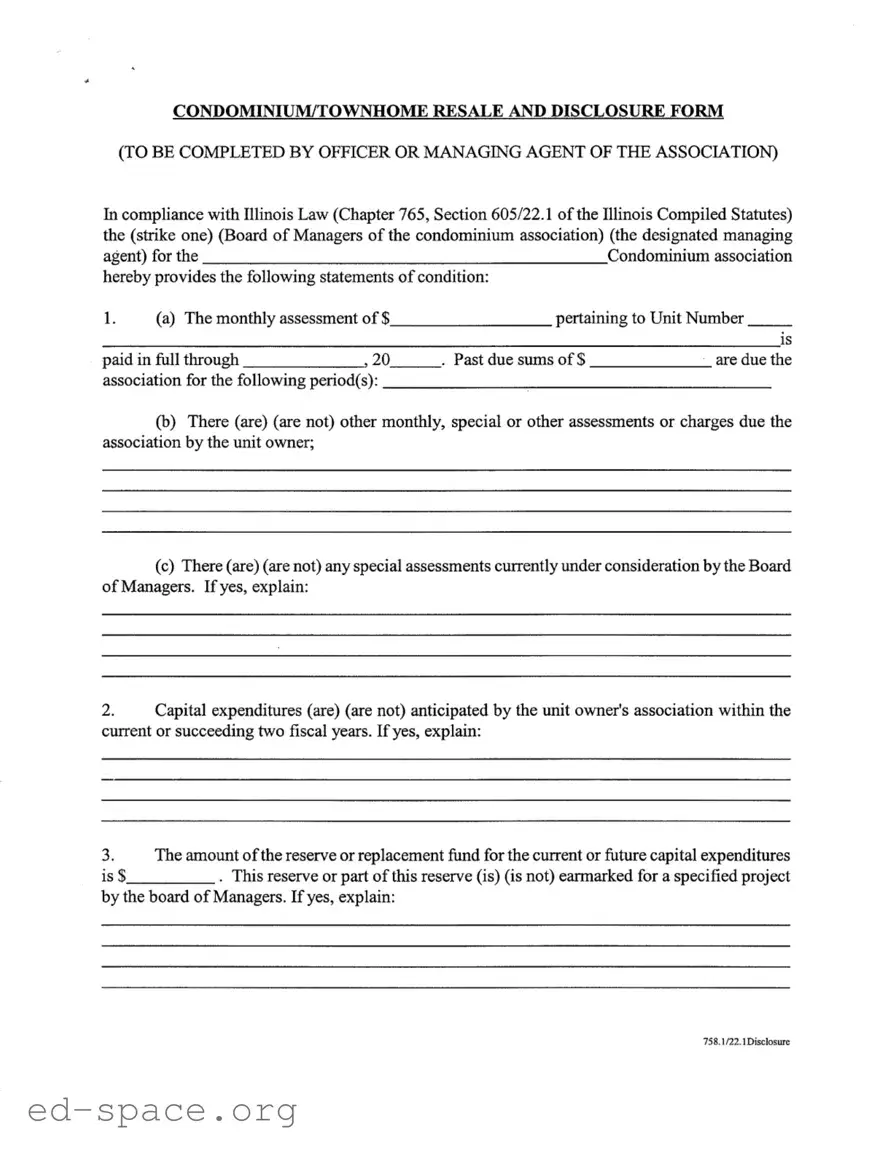
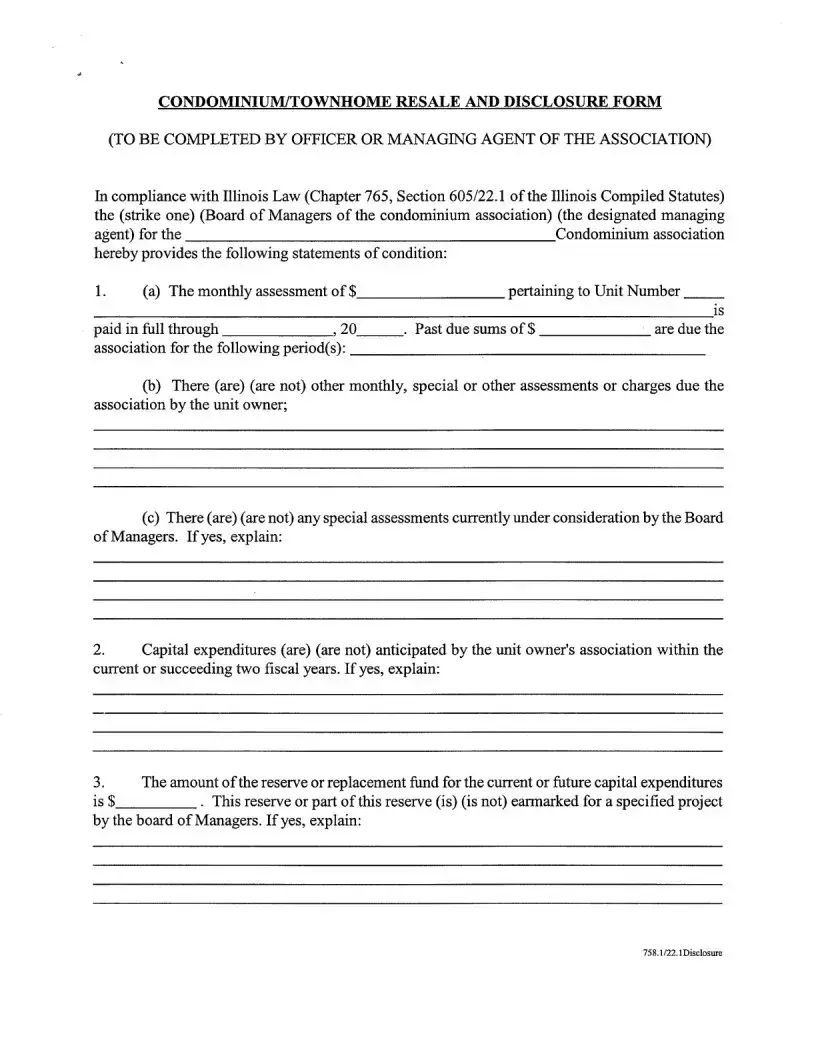
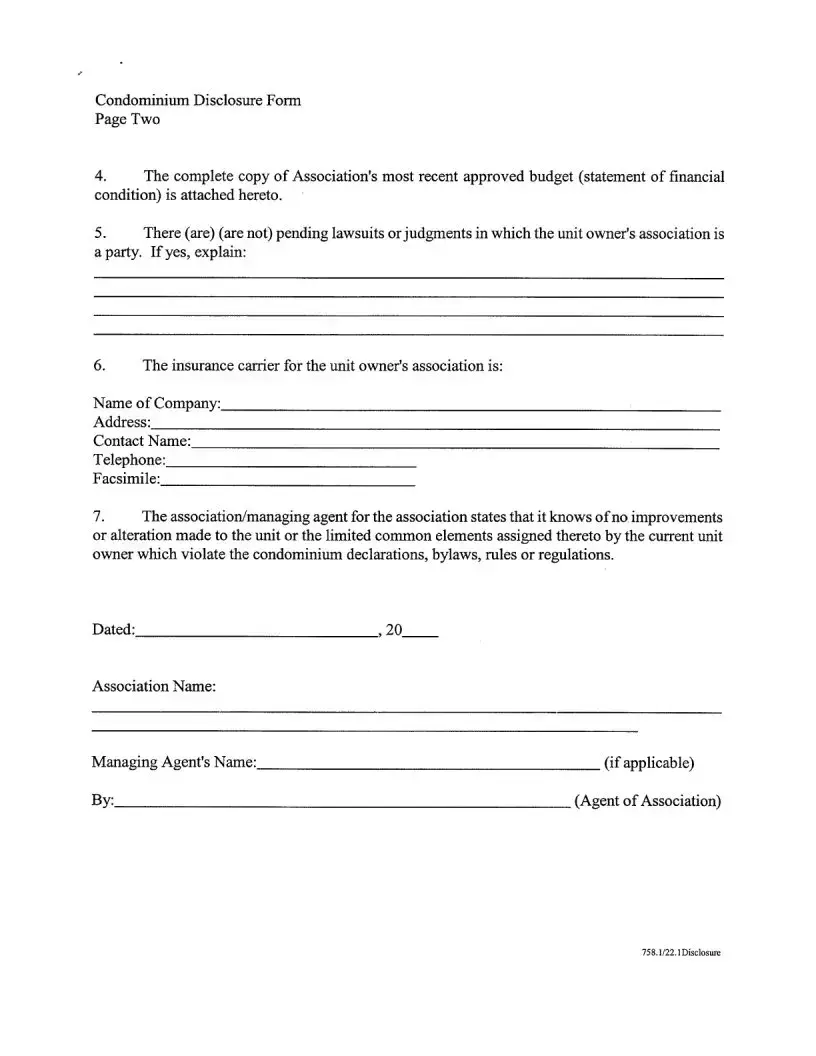
The Act 221 Disclosure form plays a crucial role in the resale of condominiums and townhomes in Illinois, ensuring transparency between sellers and potential buyers. This form is completed by an officer or managing agent of the condominium association and provides essential information regarding the financial status and legal standing of the property in question. Key aspects of the form include the current status of monthly assessments, any past due sums owed to the association, and the existence of special assessments that may impact the unit owner. Additionally, it outlines anticipated capital expenditures and details about the reserve or replacement fund, which is critical for future financial planning. The form also includes a summary of pending lawsuits involving the association and provides contact information for the insurance carrier covering the unit owner's association. By requiring a complete copy of the association's most recent approved budget, the form ensures that buyers are well-informed about the financial health of the community. Overall, the Act 221 Disclosure form serves as a vital tool for promoting informed decision-making in real estate transactions involving condominiums and townhomes.
Document Preview

Form Specifications

Fact Name Description
Governing Law This form is governed by Illinois Law, specifically Chapter 765, Section 605/22.1 of the Illinois Compiled Statutes.
Purpose The form serves to disclose important information regarding the financial and legal status of a condominium or townhome association to potential buyers.
Monthly Assessments It includes details about the payment status of monthly assessments for the unit, including any past due amounts.
Special Assessments The form indicates whether there are any special assessments currently under consideration by the Board of Managers.
Capital Expenditures Potential capital expenditures anticipated by the association within the next two fiscal years must be disclosed, along with explanations if applicable.
Pending Lawsuits It must be stated whether there are any pending lawsuits or judgments involving the unit owner's association, with explanations if so.

Act 221 Disclosure: Usage Guidelines

Completing the Act 221 Disclosure form is essential for providing accurate information about the condominium or townhome being sold. This form requires specific details about the unit, financial obligations, and any pending issues that may affect the property. Once the form is filled out, it will be used to inform potential buyers about the current status of the property and the association.

  1. Begin by identifying whether you are the Board of Managers of the condominium association or the designated managing agent. Strike the option that does not apply.
  2. Fill in the Unit Number for which the disclosure is being completed.
  3. State whether the monthly assessment is paid in full through the specified date. Include any past due sums and the relevant periods.
  4. Indicate if there are any other monthly, special, or other assessments due by the unit owner. Choose the appropriate option.
  5. Check if there are any special assessments currently under consideration by the Board of Managers. If so, provide an explanation.
  6. State whether capital expenditures are anticipated within the current or next two fiscal years. If yes, include an explanation.
  7. Provide the amount of the reserve or replacement fund for current or future capital expenditures. Specify if any part of this reserve is earmarked for a project, and explain if applicable.
  8. Attach a complete copy of the association's most recent approved budget or statement of financial condition.
  9. Indicate if there are any pending lawsuits or judgments involving the unit owner's association. Provide explanations if necessary.
  10. List the name of the insurance carrier for the unit owner's association, along with the address, contact name, telephone, and facsimile number.
  11. Confirm that you are aware of no improvements or alterations made to the unit or the assigned limited common elements that violate the condominium declarations, bylaws, rules, or regulations.
  12. Finally, include the name of the association, the managing agent’s name (if applicable), and the signature of the agent of the association.

Your Questions, Answered

What is the purpose of the Act 221 Disclosure form?

The Act 221 Disclosure form serves to inform potential buyers about the financial and legal status of a condominium or townhome association. This form is required by Illinois law and must be completed by either the Board of Managers or the designated managing agent of the association. It provides essential details regarding monthly assessments, special assessments, pending lawsuits, and the association's financial condition, helping buyers make informed decisions before purchasing a unit.

What information is included in the Act 221 Disclosure form?

The form includes several key pieces of information. It outlines the current status of monthly assessments for a specific unit, any past due amounts, and whether there are additional charges or special assessments due. It also addresses anticipated capital expenditures, the reserve fund for future projects, and any pending lawsuits involving the association. Furthermore, it includes the name and contact information of the insurance carrier for the association, ensuring buyers are aware of the coverage in place.

How does the Act 221 Disclosure form affect potential buyers?

For potential buyers, the Act 221 Disclosure form is crucial. It provides transparency regarding the financial health and legal standing of the condominium association. Buyers can assess the likelihood of future assessments, understand any existing financial obligations, and evaluate potential risks associated with pending lawsuits. This information helps buyers gauge the overall stability of the association and the unit they are considering purchasing.

Who is responsible for completing the Act 221 Disclosure form?

The responsibility for completing the Act 221 Disclosure form falls on the Board of Managers of the condominium association or the designated managing agent. They must ensure that the information provided is accurate and up-to-date. This obligation helps maintain transparency and protects the interests of both current and prospective unit owners, fostering a more informed community.

Common mistakes

  1. Incomplete Information: One common mistake is failing to provide complete information in the required fields. For instance, if the monthly assessment for a unit is not fully reported, it can lead to confusion for potential buyers.

  2. Incorrect Selection: Another frequent error occurs when individuals misinterpret the options provided, such as incorrectly indicating whether there are pending lawsuits or special assessments. This can mislead prospective buyers about the financial health of the association.

  3. Neglecting to Attach Necessary Documents: Often, people forget to attach the most recent approved budget or other required documents. This omission can delay the resale process and create unnecessary complications.

  4. Failure to Update Information: Lastly, failing to update the form with the most current information can be problematic. For example, if there are new capital expenditures or changes in assessments, these should be reflected to ensure transparency and accuracy.

Documents used along the form

The Act 221 Disclosure form serves as a vital document in the sale of condominiums and townhomes in Illinois. It provides prospective buyers with essential information regarding the financial and legal status of the condominium association. Several other forms and documents are commonly used alongside this disclosure to ensure a comprehensive understanding of the property and its governing body.

  • Condominium Bylaws: This document outlines the rules and regulations governing the condominium association. It includes details on the rights and responsibilities of unit owners, the management structure, and procedures for meetings and voting.
  • Rules and Regulations: These are specific guidelines set by the condominium association that unit owners must follow. They cover various aspects such as noise restrictions, pet policies, and use of common areas, ensuring a harmonious living environment.
  • Most Recent Budget: This financial document provides an overview of the association's income and expenses for the current fiscal year. It details how funds are allocated for maintenance, reserves, and other operational costs, giving buyers insight into the financial health of the association.
  • Reserve Study: A reserve study assesses the condition of the condominium's common elements and estimates future repair and replacement costs. It helps determine if the association has adequate funds set aside for upcoming capital expenditures, which is crucial for long-term financial planning.

Understanding these documents in conjunction with the Act 221 Disclosure form is essential for potential buyers. They provide a clearer picture of the condominium's operational status and help ensure informed decision-making during the purchasing process.

Similar forms

The Act 221 Disclosure form serves as an important document for potential buyers of condominium or townhome units in Illinois. It provides essential information about the financial and legal status of the association managing the property. Several other documents share similarities with the Act 221 Disclosure form in terms of purpose and content. Here are five such documents:

  • Property Condition Disclosure Statement: This document outlines the condition of the property being sold. Like the Act 221 Disclosure form, it provides potential buyers with critical information about any known issues or repairs needed, ensuring transparency in the sale process.
  • Seller's Disclosure of Real Property Condition: This disclosure is required in many states and informs buyers about the property's condition, including any past or present issues. Similar to the Act 221 form, it aims to protect buyers by revealing important facts that could influence their decision.
  • Homeowners Association (HOA) Disclosure: This document details the rules, regulations, and financial obligations associated with living in a community governed by an HOA. It parallels the Act 221 Disclosure form by providing insights into assessments and potential changes that may affect the unit owner.
  • Lead-Based Paint Disclosure: Required for homes built before 1978, this disclosure informs buyers about potential lead hazards. While focused on health risks, it shares the same goal of ensuring buyers are aware of important issues related to the property, much like the Act 221 form.
  • Financial Statement of the Association: This document offers a snapshot of the association's financial health, including budgets and reserves. It is akin to the Act 221 Disclosure form as it gives prospective buyers a clear understanding of the financial obligations they may inherit.

Dos and Don'ts

When filling out the Act 221 Disclosure form, there are important dos and don'ts to keep in mind. Here’s a list to help guide you through the process.

  • Do ensure that all information is accurate and up to date.
  • Do clearly indicate whether assessments are due or not.
  • Do provide explanations for any anticipated capital expenditures.
  • Do attach the most recent approved budget as required.
  • Do disclose any pending lawsuits involving the association.
  • Don't leave any sections blank; fill in all required fields.
  • Don't provide misleading or incomplete information.
  • Don't forget to include contact information for the insurance carrier.
  • Don't ignore any violations of the condominium declarations or rules.
  • Don't rush through the form; take your time to ensure accuracy.

Following these guidelines can help ensure that the form is completed correctly and efficiently.

Misconceptions

The Act 221 Disclosure form is essential for potential buyers of condominium or townhome units in Illinois. However, several misconceptions exist regarding this document. Below is a list of common misunderstandings, along with clarifications.

  • The form guarantees that the unit is free of issues. The disclosure form provides information about the financial and legal status of the association, but it does not ensure that the unit itself is free from defects or problems.
  • All assessments are disclosed. The form indicates whether there are any assessments due, but it may not cover all potential future assessments that could arise.
  • The form is only for buyers. While it is primarily aimed at potential buyers, current owners also benefit from understanding the financial health of their association.
  • Past due amounts are always disclosed. The form states whether past due amounts exist, but it may not provide detailed information about the reasons for those dues.
  • Pending lawsuits do not affect the buyer. Any pending lawsuits involving the association can impact the financial stability of the community and, consequently, the buyer's investment.
  • The reserve fund is always sufficient. The form indicates the amount of the reserve fund, but it does not guarantee that it will cover future capital expenditures or emergencies.
  • Insurance coverage is comprehensive. The form provides the name of the insurance carrier but does not detail the extent of coverage or any exclusions that may apply.
  • The managing agent knows all violations. The form states that the managing agent is unaware of any violations, but this does not mean that violations do not exist.
  • The form is optional. In Illinois, the disclosure form is a legal requirement for condominium and townhome sales, making it a necessary part of the transaction.
  • Buyers can rely solely on the form. While the form provides valuable information, buyers should conduct their own inspections and research to make informed decisions.

Understanding these misconceptions can help individuals navigate the complexities of purchasing a condominium or townhome more effectively.

Key takeaways

Filling out and using the Act 221 Disclosure form is an important process for both condominium associations and potential buyers. Here are some key takeaways to consider:

  • Purpose of the Form: The Act 221 Disclosure form serves to inform potential buyers about the financial and legal status of a condominium association.
  • Completing the Form: This form must be filled out by an officer or managing agent of the condominium association, ensuring accuracy and compliance with Illinois law.
  • Financial Obligations: The form requires disclosure of any outstanding assessments or charges owed by the unit owner, which can impact a buyer's decision.
  • Special Assessments: It is crucial to indicate whether there are any special assessments under consideration, as these can lead to additional costs for the new owner.
  • Capital Expenditures: The form should disclose any anticipated capital expenditures, which may affect the association's financial health and the unit's value.
  • Reserve Funds: Understanding the status of reserve funds is vital. The form requires information on whether these funds are earmarked for specific projects.
  • Pending Legal Issues: The form must disclose any pending lawsuits or judgments involving the association, as these can have significant implications for potential buyers.
  • Insurance Information: Buyers should be informed about the association’s insurance carrier, as this protects against potential liabilities and damages.

These takeaways highlight the importance of transparency and thoroughness when using the Act 221 Disclosure form. Both buyers and sellers benefit from clear communication regarding the condition and obligations of the condominium association.