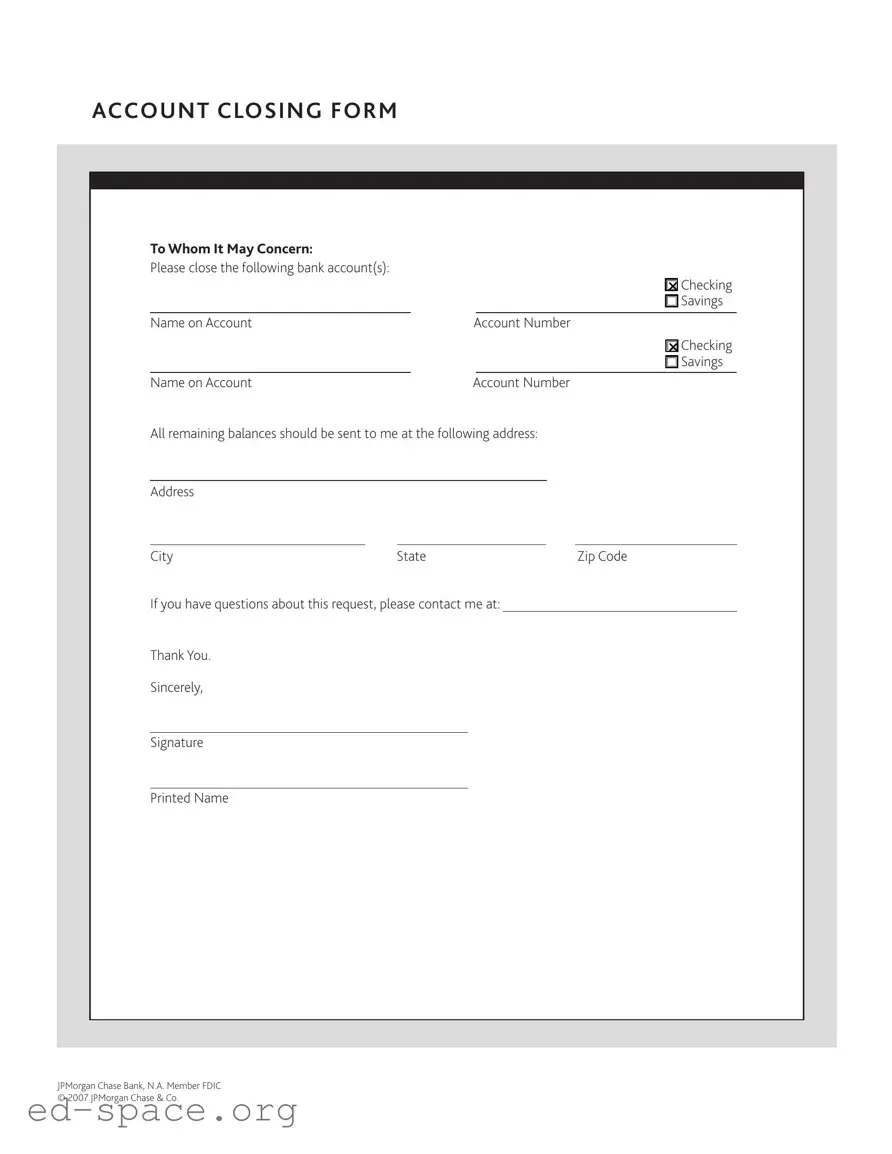
When it comes time to close a bank account, understanding the process and having the right documentation is essential. The Account Closing Form serves as a formal request to your financial institution, ensuring that your account is closed properly and that any remaining funds are handled according to your wishes. This form typically requires you to specify which type of account you wish to close, whether it be checking or savings, and includes spaces for the account name and number. Additionally, it provides a section for you to indicate where any remaining balances should be sent, ensuring that you receive your funds in a timely manner. The form also encourages communication, allowing you to provide your contact information in case the bank has any questions regarding your request. By filling out this form accurately and completely, you can help facilitate a smooth account closure process while safeguarding your financial interests.

ACCOUNT CLOSING FORM
To Whom It May Concern: |
|
|
|
|
|
|
|
Please close the following bank account(s): |
|
|
|
|
|
|
|
|
|
|
|
|
|
|
oChecking |
|
|
|
|
|
|
|
oSavings |
|
|
|
|
|
|
|
|
Name on Account |
|
|
Account Number |
||||
|
|
|
|
|
|
|
oChecking |
|
|
|
|
|
|
|
oSavings |
|
|
|
|
|
|
|
|
Name on Account |
|
|
Account Number |
||||
All remaining balances should be sent to me at the following address: |
|||||||
|
|
|
|
|
|
|
|
Address |
|
|
|
|
|
|
|
|
|
|
|
|
|
|
|
City |
State |
|
|
|
Zip Code |
||
If you have questions about this request, please contact me at:
Thank You.
Sincerely,
Signature
Printed Name
JPMorgan Chase Bank, N.A. Member FDIC © 2007 JPMorgan Chase & Co.
| Fact Name | Description |
|---|---|
| Purpose | The Account Closing Form is used to formally request the closure of bank accounts, such as checking and savings accounts. |
| Required Information | To complete the form, you must provide the account name, account number, and your contact information for any remaining balances. |
| Balance Transfer | All remaining balances will be sent to the address specified on the form after the account is closed. |
| Signature Requirement | A signature is required to validate the request, ensuring that the request is authorized by the account holder. |
| Contact Information | It is important to include your phone number or email address for any follow-up questions regarding the closure. |
| Submission | The completed form should be submitted to your bank branch or through the bank's designated submission process. |
| State-Specific Forms | Some states may have specific requirements or variations of the form based on local banking laws. |
| Governing Laws | Each state has its own banking regulations that govern account closures, which should be reviewed for compliance. |
| Bank Affiliation | This form is associated with JPMorgan Chase Bank, N.A., which is a member of the FDIC. |
After you complete the Account Closing form, submit it to your bank. They will process your request and confirm the closure of your account. Make sure to follow these steps carefully to ensure everything is filled out correctly.
What is the purpose of the Account Closing form?
The Account Closing form is a document used by customers to formally request the closure of their bank accounts, such as checking or savings accounts. By submitting this form, customers provide the bank with the necessary information to process their request efficiently and ensure that any remaining balances are sent to the specified address.
What information do I need to provide on the form?
When filling out the Account Closing form, you will need to include specific details. This includes selecting the type of account you wish to close (checking or savings), providing the name on the account, and the account number. Additionally, you must specify where any remaining balance should be sent by providing your address, including city, state, and zip code.
How will I receive my remaining balance after closing the account?
After the account is closed, any remaining balance will be sent to the address you provided on the form. It is important to ensure that the address is accurate and complete to avoid any delays in receiving your funds. The bank typically processes these requests promptly, but the exact timeline may vary.
What should I do if I have questions about my account closure?
If you have questions regarding your account closure or the form itself, the form provides a space for you to include your contact information. You can reach out to the bank directly using the contact details you provided, and a representative will assist you with your inquiries.
Is there a fee for closing my account?
In general, banks may have different policies regarding account closure fees. Some banks do not charge a fee, while others may impose a fee if the account is closed within a certain period after opening. It is advisable to check with your bank for specific information regarding any potential fees associated with closing your account.
What happens if I change my mind after submitting the form?
If you change your mind about closing your account after submitting the form, it is crucial to contact the bank as soon as possible. Depending on the bank's policies and the status of your request, they may be able to halt the closure process. However, once the account is officially closed, it may not be possible to reopen it, and you may need to open a new account.
Failing to provide the correct account number. This can lead to delays in processing the request.
Not including a return address. Without a valid address, the bank cannot send any remaining balance after the account is closed.
Leaving out the signature. A signature is necessary to authorize the account closure, and its absence may result in rejection of the form.
Not specifying all accounts to be closed. If multiple accounts are held, each one must be listed clearly on the form to ensure proper closure.
Overlooking to provide contact information. Including a phone number or email can help the bank reach out for clarification if needed.
When closing a bank account, several forms and documents may be necessary to ensure a smooth process. Each document serves a specific purpose and helps facilitate the account closure efficiently. Below is a list of common forms that often accompany the Account Closing form.
Gathering these documents can help ensure that the account closure process is efficient and problem-free. Each form plays a vital role in confirming the account holder's intentions and protecting both the customer and the bank.
The Account Closing form serves a specific purpose, but it shares similarities with several other important documents. Each of these documents plays a role in managing financial accounts or transactions. Here are seven documents that are similar to the Account Closing form:
Understanding these documents can help individuals navigate their financial responsibilities more effectively. Each serves a unique purpose while contributing to the overall management of financial accounts.
When filling out the Account Closing form, it’s important to follow specific guidelines to ensure a smooth process. Here are some dos and don’ts to keep in mind:
There are several misconceptions regarding the Account Closing form that can lead to confusion. Below are some common misunderstandings along with clarifications.
Understanding these misconceptions can help streamline the account closing process and ensure that your requests are handled smoothly.
When filling out the Account Closing form, it is essential to follow certain guidelines to ensure a smooth process. Here are some key takeaways:
By keeping these points in mind, you can ensure that your account closing process is efficient and hassle-free.