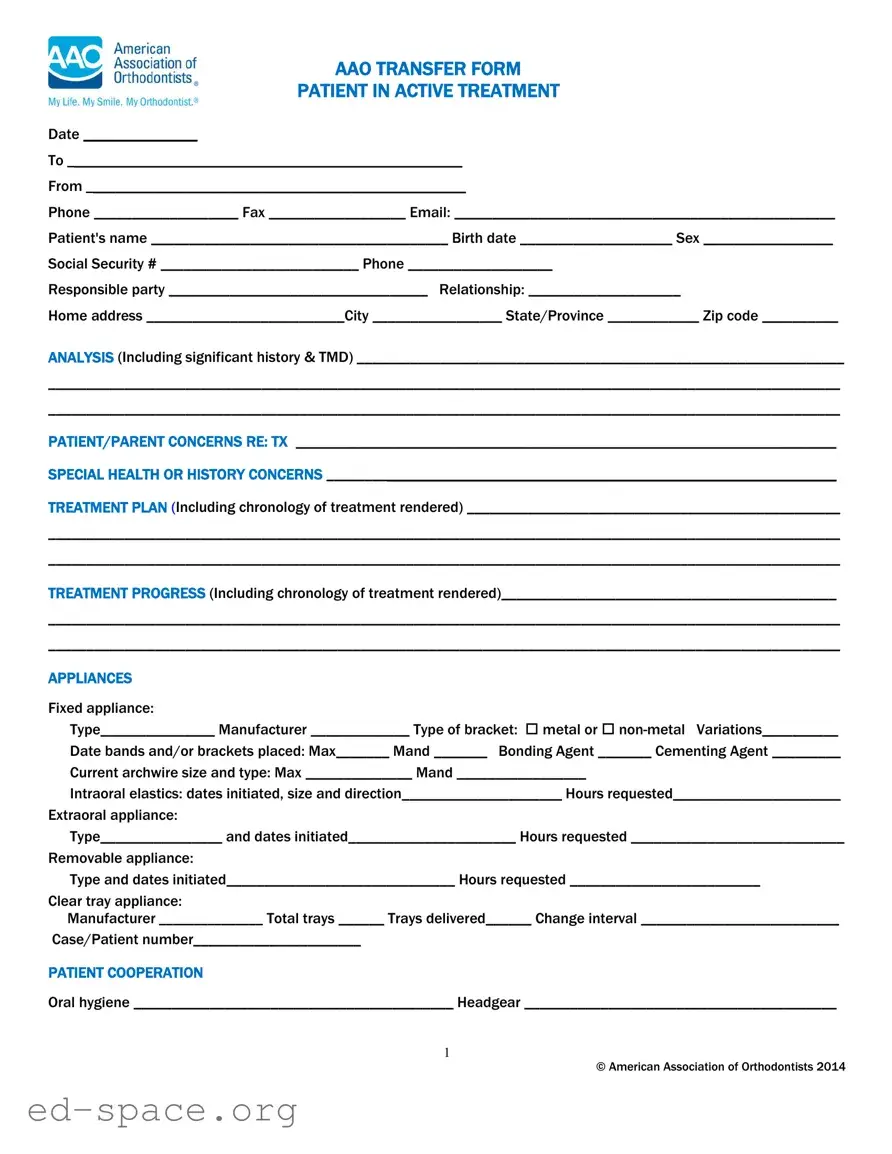
The Aao Transfer form plays a crucial role in the continuity of orthodontic care when a patient needs to change providers during active treatment. This form facilitates the transfer of essential patient information, ensuring that the new orthodontist has all necessary details to provide seamless care. Key components of the form include the patient's personal information, treatment history, and any specific concerns that may affect ongoing treatment. Additionally, it outlines the treatment plan, progress made, and the types of appliances used. Financial details, including fees and payment arrangements, are also addressed, highlighting the potential for changes in costs when transferring care. By capturing both clinical and administrative data, the Aao Transfer form serves as a comprehensive tool to support effective communication between healthcare providers, ultimately prioritizing the patient's needs and treatment outcomes.

AAO TRANSFER FORM
PATIENT IN ACTIVE TREATMENT
Date _______________
To ____________________________________________________
From __________________________________________________
Phone ___________________ Fax __________________ Email: __________________________________________________
Patient's name _______________________________________ Birth date ____________________ Sex _________________
Social Security # __________________________ Phone ___________________
Responsible party __________________________________ Relationship: ____________________
Home address __________________________City _________________ State/Province ____________ Zip code __________
ANALYSIS (Including significant history & TMD) ________________________________________________________________
________________________________________________________________________________________________________
________________________________________________________________________________________________________
PATIENT/PARENT CONCERNS RE: TX _______________________________________________________________________
SPECIAL HEALTH OR HISTORY CONCERNS ___________________________________________________________________
TREATMENT PLAN (Including chronology of treatment rendered) _________________________________________________
________________________________________________________________________________________________________
________________________________________________________________________________________________________
TREATMENT PROGRESS (Including chronology of treatment rendered)____________________________________________
________________________________________________________________________________________________________
________________________________________________________________________________________________________
APPLIANCES
Fixed appliance:
Type_______________ Manufacturer _____________ Type of bracket: metal or
Date bands and/or brackets placed: Max_______ Mand _______ Bonding Agent _______ Cementing Agent _________
Current archwire size and type: Max ______________ Mand _________________
Intraoral elastics: dates initiated, size and direction_____________________ Hours requested______________________
Extraoral appliance:
Type________________ and dates initiated______________________ Hours requested ____________________________
Removable appliance:
Type and dates initiated______________________________ Hours requested _________________________
Clear tray appliance:
Manufacturer _______________ Total trays ______ Trays delivered______ Change interval __________________________
Case/Patient number______________________
PATIENT COOPERATION
Oral hygiene __________________________________________ Headgear _________________________________________
1
© American Association of Orthodontists 2014
Elastics ______________________________________________ Clear trays _______________________________________
Appointments _________________________________________ Broken appliances ________________________________
Patient's attitude toward treatment ________________________________________________________________________
Suggestions for patient motivation _________________________________________________________________________
ACTIVE TX TIME ESTIMATES Original _________________________ Remaining _____ % of active treatment completed
RECOMMENDATIONS FOR CONTINUED TREATMENT __________________________________________________________
______________________________________________________________________________________________________
RECOMMENDATIONS FOR RETENTION _____________________________________________________________________
ADDITIONAL COMMENTS _______________________________________________________________________________
_____________________________________________________________________________________________________
FINANCIAL
Closed ______________ Open End (Fixed) _______________Other ______________________
Fees: Active _______________ Extras ______________________________________________
Terms ________________________________________________________________________
Third party payment ____________________________________________________________
Total charges before transfer _________________________
Total amount paid before transfer _____________________
Unpaid amount still owed transferring office ____________
Balance of original quoted fee not yet charged ______________ or overpaid at transfer ______________
This patient/parent has been advised that orthodontic treatment fees vary widely throughout the country and the world and it is reasonable for them to expect that a transfer may increase treatment fees and may involve changes in payment policies. For most people who transfer during their orthodontic treatment, the total treatment cost is likely to increase.
AVAILABLE RECORDS FOR TRANSFER |
|
||
Casts |
Initial |
Date ________ |
Progress Date ________ Articulator type________ |
Ceph |
Initial Date ________ |
Progress Date ________ |
|
Tracings |
Initial |
Date ________ |
Progress Date ________ |
Panoramic |
Initial Date ________ |
Progress Date ________ |
|
CBCT |
Initial Date ________ |
Progress Date ________ |
|
Initial |
Date ________ |
Progress Date ________ |
|
files |
|
|
|
Intraoral |
Initial |
Date ________ |
Progress Date ________ |
Facial photos |
Initial Date ________ |
Progress Date ________ |
|
Intraoral photos |
Initial Date ________ |
Progress Date ________ |
|
Check appropriate status of records:
Record duplicates sent upon request (may be an additional charge to patient) Yes No
Records enclosed Yes No Records sent under separate cover Yes No
Signature: __________________________________________________Date_______________________
(Orthodontist)
2
© American Association of Orthodontists 2014
REQUEST TO TRANSFER RECORDS TO NEW PROVIDER
When a patient moves, or, for other reasons, there is a necessity to change orthodontists during the course of ongoing orthodontic treatment, it is highly advantageous for all involved parties that the transfer be as prompt and convenient as possible. Of paramount importance is the identification of an orthodontist who will accept the patient and successfully complete the treatment.
The American Association of Orthodontists represents over ninety percent of the orthodontic specialists in the U.S. and Canada. Your current doctor is a member and will assist you in finding a qualified orthodontist.
It is necessary that your records be transferred to assure that the receiving orthodontist is knowledgeable of your orthodontic condition(s), orthodontic treatment goals, the current treatment plan, and related financial arrangements. To facilitate the transfer of these records, it is necessary that you complete the following:
I authorize Dr. ____________________ to release all records of ____________________ (patient’s name) for the
purpose of continuation of treatment by Dr. ___________________(new provider’s name).
Signature: __________________________________________________________Date_______________________
(Patient or Guardian)
Print Name ________________________________________
Relationship to Patient ______________________________
3
© American Association of Orthodontists 2014
| Fact Name | Description | Governing Law |
|---|---|---|
| Purpose of the Form | The Aao Transfer Form facilitates the transfer of patient records between orthodontic providers, ensuring continuity of care. | State-specific regulations may apply. |
| Patient Information | The form requires detailed patient information, including name, birth date, and contact details, to accurately identify the patient. | HIPAA Privacy Rule governs patient information handling. |
| Treatment History | It includes sections for documenting the patient's treatment history, concerns, and progress, which are crucial for the new provider. | State dental practice acts may regulate treatment documentation. |
| Financial Considerations | The form addresses financial arrangements, informing patients about potential changes in fees when transferring care. | Consumer protection laws may influence fee disclosures. |
Filling out the AAO Transfer form is an important step in ensuring a smooth transition of care when changing orthodontic providers. Accurate completion of the form will help the new provider understand the patient's treatment history and current status. Follow these steps carefully to ensure all necessary information is provided.
What is the purpose of the AAO Transfer Form?
The AAO Transfer Form is designed to facilitate the transfer of orthodontic records when a patient changes orthodontists. It ensures that the new provider has all necessary information regarding the patient's treatment history, current status, and financial arrangements. This helps maintain continuity of care and supports the new orthodontist in providing effective treatment.
What information is required on the AAO Transfer Form?
The form requires detailed patient information, including the patient's name, birth date, contact details, and responsible party information. Additionally, it asks for treatment history, patient concerns, treatment plans, progress, and appliance details. Financial information and records status are also included to ensure a comprehensive transfer.
How does a patient authorize the transfer of their records?
A patient or their guardian must sign the authorization section of the AAO Transfer Form. This section includes the names of both the current and new orthodontists and confirms the patient's consent to release their records for continued treatment.
Can a patient expect changes in treatment fees after transferring?
Yes, it is common for treatment fees to vary between orthodontists. The form advises patients that transferring may increase treatment costs and involve changes in payment policies. Patients should discuss these potential changes with their new provider.
What types of records can be transferred?
The AAO Transfer Form allows for the transfer of various records, including casts, cephalometric tracings, panoramic images, CBCT scans, intraoral scans, and photographs. The form indicates whether these records are included or if they will be sent separately.
What should a patient do if they have concerns about their treatment?
Patients are encouraged to express any concerns regarding their treatment on the form. This section allows them to detail their specific worries or issues, which can help the new orthodontist address these matters effectively.
How can patients ensure a smooth transfer process?
To ensure a smooth transfer, patients should complete the AAO Transfer Form accurately and provide all requested information. They should also communicate with both their current and new orthodontists to confirm that the transfer is being handled promptly.
What happens if records are not transferred promptly?
If records are not transferred in a timely manner, it may delay the new orthodontist's ability to continue treatment. This can impact the patient's care and prolong the overall treatment process. It is important for patients to follow up with both offices to ensure the transfer is completed.
Who can assist patients in finding a new orthodontist?
The current orthodontist can assist patients in finding a new provider. The American Association of Orthodontists, which represents a majority of orthodontic specialists in the U.S. and Canada, can also help locate qualified orthodontists for ongoing treatment.
Incomplete Patient Information: Failing to provide all necessary details about the patient, such as their full name, date of birth, or social security number, can lead to delays in processing the transfer.
Incorrect Contact Information: Providing an incorrect phone number or email address for the current orthodontist or the new provider can hinder communication.
Missing Signatures: Not signing the form or having the wrong person sign it can invalidate the transfer request.
Omitting Treatment History: Failing to include a comprehensive treatment history can leave the new orthodontist without essential information needed for continuing care.
Neglecting Financial Details: Not accurately reporting any outstanding balances or financial arrangements can create confusion regarding payment responsibilities.
Ignoring Health Concerns: Overlooking significant health or history concerns can impact the new provider's ability to deliver safe and effective treatment.
Inaccurate Appliance Information: Providing incorrect details about appliances, such as type or manufacturer, may lead to complications in treatment continuity.
Failure to Document Cooperation: Not detailing the patient’s cooperation level regarding treatment can mislead the new provider about the patient’s commitment to their care.
Not Checking Record Status: Failing to indicate whether records are enclosed or need to be sent separately can lead to incomplete transfers.
Ignoring Additional Comments: Leaving the additional comments section blank can miss an opportunity to convey important information that might assist the new provider.
When transferring orthodontic care, several forms and documents accompany the AAO Transfer Form to ensure a smooth transition. Each document serves a specific purpose, providing essential information to the new provider about the patient's treatment history and needs. Below is a list of commonly used forms that help facilitate this process.
Each of these documents plays a crucial role in ensuring that the new orthodontist has all the necessary information to continue treatment effectively. By preparing these forms, both the patient and the orthodontists can work together to make the transition as seamless as possible.
Patient Transfer Form: This document serves a similar purpose to the AAO Transfer form by facilitating the transfer of patient information from one healthcare provider to another. It typically includes personal details, treatment history, and any relevant medical concerns, ensuring continuity of care.
Medical Records Release Form: Like the AAO Transfer form, this document allows patients to authorize the release of their medical records. It is essential for ensuring that new providers have access to comprehensive medical histories, treatment plans, and any ongoing health issues that may impact care.
Continuity of Care Form: This form is similar in that it outlines the patient’s treatment history and current health status. It aims to provide the new provider with a clear understanding of the patient's ongoing needs, thus promoting effective treatment continuity.
Referral Form: A referral form often accompanies the transfer of care, detailing the reasons for the referral and any specific treatment recommendations. This document parallels the AAO Transfer form by ensuring that the receiving provider is fully informed about the patient's condition and treatment history.
Authorization for Release of Information: This document is crucial for allowing healthcare providers to share patient information legally. Similar to the AAO Transfer form, it ensures that all necessary patient data is transferred to the new provider, facilitating a seamless transition in care.
When filling out the AAO Transfer Form, attention to detail is crucial. Here’s a guide to help you navigate the process smoothly. Below are six important do's and don'ts:
By following these guidelines, the transfer process can be more efficient, ensuring that the patient's treatment continues seamlessly.
This form can be used for various reasons, including relocation or changes in insurance, not just dissatisfaction.
While the form initiates the process, the actual transfer depends on the current provider's response and timing.
The form is designed to be straightforward, requiring basic patient information and treatment details.
While some providers may charge for record duplication, many do not impose extra fees for the transfer itself.
Not every orthodontist has the capacity or willingness to take on new patients, especially those in active treatment.
The form is essential to ensure that the new provider has all necessary information to continue treatment effectively.
Different orthodontists may have varying approaches, which can lead to adjustments in the treatment plan.
Financial details are a crucial part of the form, as they inform the new provider of any outstanding balances or payment arrangements.
Guardians or responsible parties can also complete the form on behalf of minors or patients unable to do so.
Prompt completion of the Aao Transfer form can actually expedite the process, ensuring a smoother transition.
When filling out and using the AAO Transfer Form, keep these key takeaways in mind: