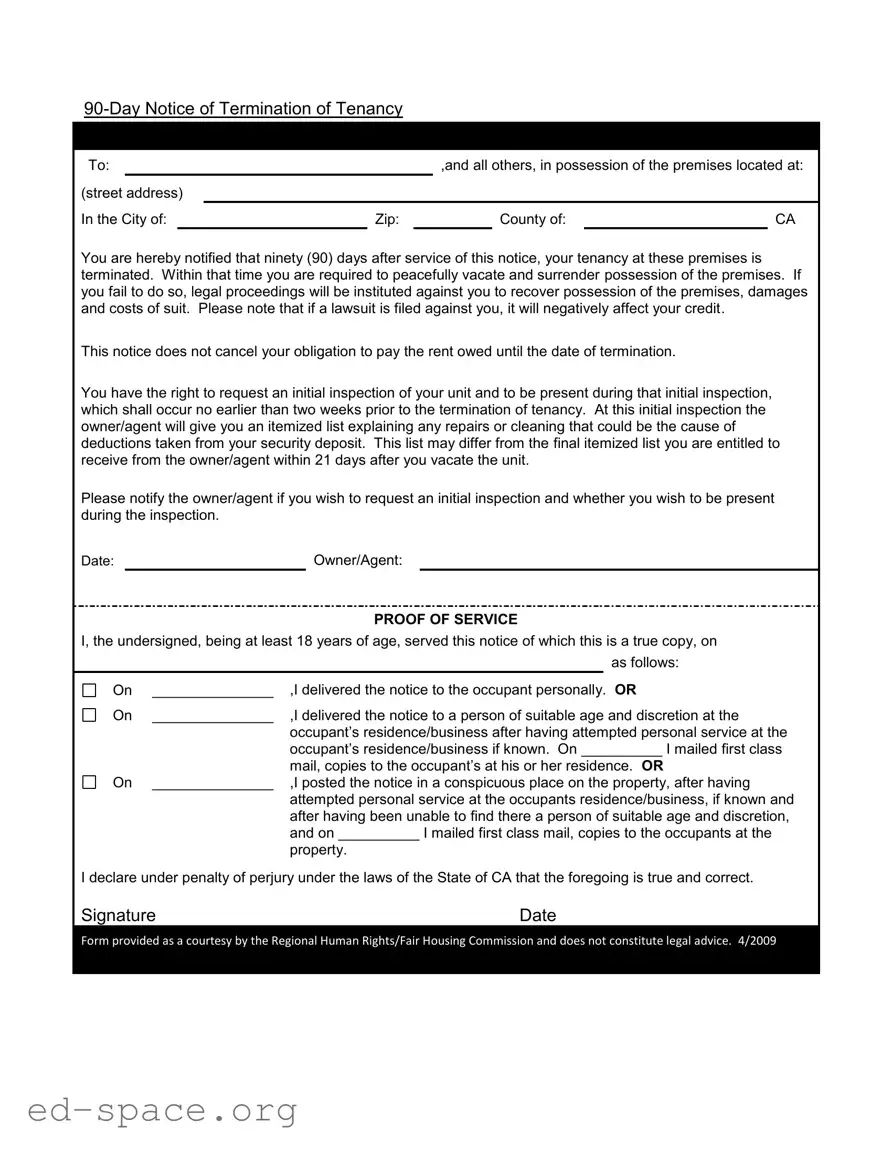
Understanding the 90 Day Notice To Move Out form is crucial for both tenants and landlords navigating the complexities of tenancy termination in California. This form serves as an official notification, informing tenants that their lease will end in ninety days. It outlines the responsibilities of the tenant to vacate the premises peacefully, emphasizing the importance of adhering to this timeline to avoid potential legal consequences. If a tenant fails to move out by the specified date, the landlord may initiate legal proceedings, which could negatively impact the tenant's credit. Additionally, the notice reminds tenants that their obligation to pay rent remains until the termination date. Tenants also have the right to request an initial inspection of their unit before moving out, allowing them to understand any potential deductions from their security deposit. This inspection must occur at least two weeks prior to the end of the tenancy, and tenants are encouraged to be present during this process. Overall, the 90 Day Notice To Move Out form is not just a simple document; it encapsulates essential rights and responsibilities that can significantly affect a tenant's future housing and financial standing.
To: |
|
|
|
|
|
,and all others, in possession of the premises located at: |
||||
(street address) |
|
|
|
|
|
|
|
|
||
In the City of: |
|
|
|
Zip: |
|
|
County of: |
|
CA |
|
You are hereby notified that ninety (90) days after service of this notice, your tenancy at these premises is terminated. Within that time you are required to peacefully vacate and surrender possession of the premises. If you fail to do so, legal proceedings will be instituted against you to recover possession of the premises, damages and costs of suit. Please note that if a lawsuit is filed against you, it will negatively affect your credit.
This notice does not cancel your obligation to pay the rent owed until the date of termination.
You have the right to request an initial inspection of your unit and to be present during that initial inspection, which shall occur no earlier than two weeks prior to the termination of tenancy. At this initial inspection the owner/agent will give you an itemized list explaining any repairs or cleaning that could be the cause of deductions taken from your security deposit. This list may differ from the final itemized list you are entitled to receive from the owner/agent within 21 days after you vacate the unit.
Please notify the owner/agent if you wish to request an initial inspection and whether you wish to be present during the inspection.
Date:Owner/Agent:
PROOF OF SERVICE
I, the undersigned, being at least 18 years of age, served this notice of which this is a true copy, on
|
|
|
as follows: |
On |
_______________ |
,I delivered the notice to the occupant personally. OR |
|
On |
_______________ |
,I delivered the notice to a person of suitable age and discretion at the |
|
|
|
occupant’s residence/business after having attempted personal service at the |
|
|
|
occupant’s residence/business if known. On __________ I mailed first class |
|
|
|
mail, copies to the occupant’s at his or her residence. OR |
|
On |
_______________ |
,I posted the notice in a conspicuous place on the property, after having |
|
|
|
attempted personal service at the occupants residence/business, if known and |
|
|
|
after having been unable to find there a person of suitable age and discretion, |
|
|
|
and on __________ I mailed first class mail, copies to the occupants at the |
|
|
|
property. |
|
I declare under penalty of perjury under the laws of the State of CA that the foregoing is true and correct.
Signature |
Date |
Form provided as a courtesy by the Regional Human Rights/Fair Housing Commission and does not constitute legal advice. 4/2009
| Fact Name | Details |
|---|---|
| Purpose | The 90-Day Notice To Move Out informs tenants that their tenancy will end in 90 days. |
| Legal Requirement | In California, landlords must provide this notice under California Civil Code Section 1946.1. |
| Delivery Methods | The notice can be delivered personally, to a suitable person at the residence, mailed, or posted on the property. |
| Initial Inspection | Tenants have the right to request an initial inspection of the unit before moving out. |
| Security Deposit | Tenants may receive an itemized list of potential deductions from their security deposit after the initial inspection. |
| Consequences of Non-Compliance | If tenants do not vacate, landlords may initiate legal proceedings, which can impact the tenant's credit. |
| Rent Obligation | Tenants are still required to pay rent until the termination date, even after receiving the notice. |
Completing the 90 Day Notice To Move Out form is an important step in the process of ending a tenancy. Once the form is filled out and served properly, it will initiate the timeline for vacating the premises. Here are the steps to follow in order to fill out the form correctly:
After completing the form, it must be served to the tenant in one of the specified ways. Ensure that all details are accurate to avoid any complications. Keeping a copy for your records is also advisable.
What is the 90-Day Notice To Move Out form?
The 90-Day Notice To Move Out form is a legal document used by landlords in California to inform tenants that their tenancy will be terminated. This notice gives tenants 90 days to vacate the premises. It is essential for landlords to provide this notice in writing to ensure that tenants are aware of their obligation to leave the property by the specified date.
How does the 90-Day Notice affect my tenancy?
This notice officially ends your tenancy at the specified property. After receiving the notice, you have 90 days to move out. If you do not vacate the premises by the end of this period, the landlord may initiate legal proceedings to recover possession of the property. This can also result in additional costs and potential damage to your credit if a lawsuit is filed.
Can I request an initial inspection of my unit?
Yes, you have the right to request an initial inspection of your unit. This inspection can occur no earlier than two weeks before your tenancy ends. During this inspection, the landlord or their agent will provide you with an itemized list of any repairs or cleaning that may affect your security deposit. You should notify the landlord if you wish to be present for this inspection.
What happens if I do not move out by the deadline?
If you fail to vacate the premises by the end of the 90-day notice period, the landlord may file a lawsuit to regain possession of the property. This legal action can lead to additional costs for you and may negatively impact your credit history. It is important to take this notice seriously and plan your move accordingly.
Do I still need to pay rent after receiving the notice?
Yes, you are still responsible for paying rent until the date of termination specified in the notice. The obligation to pay rent does not end with the receipt of the 90-Day Notice To Move Out. Ensure that all rent payments are made on time to avoid any further complications.
What should I do if I have questions about the notice?
If you have questions or concerns regarding the 90-Day Notice To Move Out, it is advisable to contact the landlord or their agent directly. You may also seek assistance from local tenant rights organizations or legal aid services for further guidance on your rights and responsibilities.
Incomplete Information: Failing to fill in all required fields, such as the street address, city, and county, can render the notice ineffective. Ensure that every section is completed accurately.
Incorrect Dates: Not specifying the correct date of service or the intended move-out date can lead to confusion. Double-check the timeline to ensure it aligns with the 90-day requirement.
Failure to Notify: Not informing the owner or agent about the desire for an initial inspection can result in missing out on important information regarding potential deductions from the security deposit.
Missing Signature: Forgetting to sign the notice can invalidate it. Always remember to sign and date the form before submission.
Improper Service Method: Using an incorrect method to serve the notice, such as not delivering it personally or failing to mail it as required, can lead to legal complications.
Ignoring Rent Obligations: Assuming that submitting the notice cancels the obligation to pay rent until the termination date is a common mistake. Rent must still be paid until the official end of tenancy.
Not Keeping Copies: Failing to keep a copy of the notice for personal records can create issues later on. Always retain a copy for your own documentation.
Neglecting to Check Local Laws: Not being aware of local regulations regarding notice periods and tenant rights can lead to misunderstandings. Researching local laws is crucial for compliance.
When preparing to move out, several forms and documents may accompany the 90-Day Notice to Move Out. Each document serves a specific purpose in ensuring a smooth transition for both tenants and landlords. Here’s a list of commonly used documents:
Having these documents ready can simplify the moving process and help avoid potential disputes. Always keep copies of all correspondence for your records.
When filling out the 90-Day Notice To Move Out form, it's important to approach the process carefully. Here’s a list of things you should and shouldn’t do to ensure a smooth experience.
By following these guidelines, you can help ensure that your notice is processed correctly and that your rights are protected during the moving process.
Misconception 1: A 90-Day Notice To Move Out automatically cancels the lease.
This is not true. The notice informs tenants that their tenancy will end in 90 days, but it does not cancel their obligation to pay rent until the termination date. Rent is still due until the very last day of the lease.
Misconception 2: Tenants can ignore the notice if they don’t agree with it.
Ignoring the notice is not a viable option. If tenants do not vacate the premises by the specified date, the landlord can initiate legal proceedings to recover possession. This could lead to eviction and other legal consequences.
Misconception 3: The landlord can evict a tenant immediately after the notice period ends.
While the notice provides a timeline, landlords must follow legal procedures to evict a tenant. This includes filing a lawsuit if the tenant does not leave by the end of the 90 days. Eviction is not instantaneous and must adhere to local laws.
Misconception 4: Tenants are not entitled to an inspection of the unit before moving out.
This is incorrect. Tenants have the right to request an initial inspection of their unit. They can be present during this inspection, which helps them understand any potential deductions from their security deposit.
Misconception 5: A 90-Day Notice To Move Out does not affect a tenant’s credit.
This is misleading. If a lawsuit is filed against a tenant due to failure to vacate, it can negatively impact their credit score. It’s important for tenants to take the notice seriously to avoid potential financial repercussions.