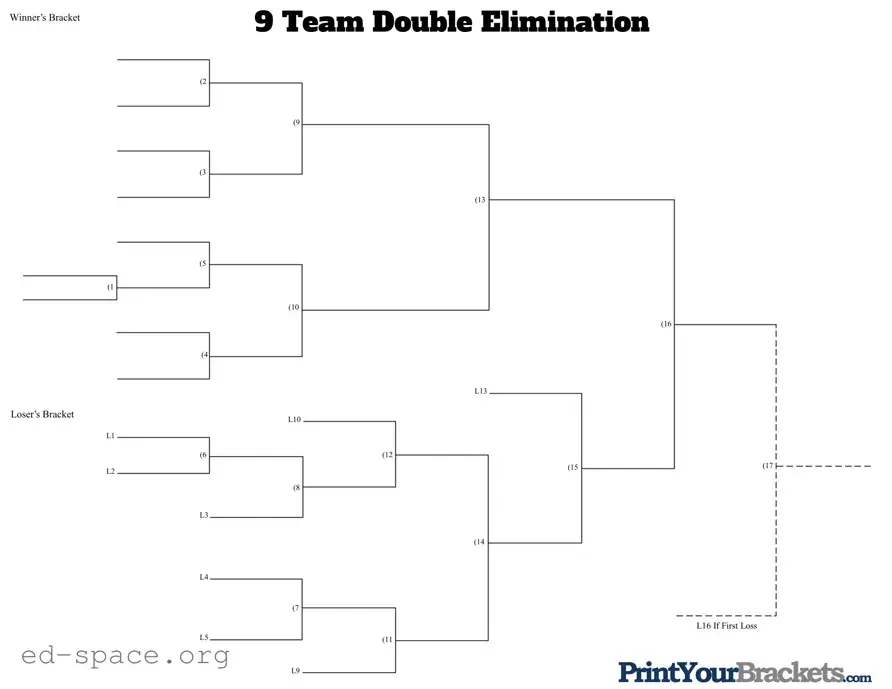
Organizing a tournament can be a complex task, but using a 9 Team Double Elimination Bracket can simplify the process. This format allows teams to compete in a way that gives them a second chance, even after a loss. In this bracket, teams are divided into two main sections: the Winner’s Bracket and the Loser’s Bracket. The Winner’s Bracket is where teams initially compete, and it follows a straightforward path until a champion emerges. Meanwhile, the Loser’s Bracket provides an opportunity for teams that lose in the Winner’s Bracket to continue competing for the title. The structure is designed so that a team must lose twice to be eliminated from the tournament. This ensures that the best teams have a fair chance to showcase their skills, making the competition more exciting and engaging for both players and spectators. Understanding how to navigate this bracket is crucial for effective tournament management.

Winner’s Bracket
(2
(3
(5
(1
(4
Loser’s Bracket
L1
(6
L2
L3
L4
L5
9 Team Double Elimination
(9
(13
(10
(16
L13
L10
(12
(15 |
(17 |
(8
(14
(7
L16 If First Loss
(11
L9PrintYourBrackets.com
| Fact Name | Details |
|---|---|
| Number of Teams | The bracket accommodates 9 teams competing in a double elimination format. |
| Winner's Bracket | Teams that win their matches advance to the winner's bracket, providing a path to the championship. |
| Loser's Bracket | Teams that lose a match move to the loser's bracket, where they still have a chance to win the tournament. |
| First Loss Impact | A team that loses for the first time in the winner's bracket drops to the loser's bracket. |
| Finals Structure | The finals typically feature the winner of the winner's bracket against the winner of the loser's bracket. |
| Elimination Rule | A team is eliminated from the tournament after losing two matches. |
| Match Progression | Teams compete in a series of matches, with the structure allowing for multiple rounds. |
| Governing Law | State-specific regulations may apply, including local sports commission rules and tournament guidelines. |
| Seeding Importance | Teams are often seeded based on performance, affecting their placement in the bracket. |
| Scheduling | Match schedules are determined based on the bracket's progression, ensuring timely completion of the tournament. |
Once you have the 9 Team Double Elimination Bracket form ready, you can start filling it out. This form will help you organize the matches and track the progress of each team throughout the tournament.
What is a 9 Team Double Elimination Bracket?
A 9 Team Double Elimination Bracket is a tournament format that allows each team to lose twice before being eliminated from the competition. This format ensures that teams have a second chance to compete after their first loss, making it a fairer way to determine the overall winner. Teams progress through a winner's bracket and a loser's bracket, providing multiple opportunities to advance.
How does the bracket work?
The tournament begins with all 9 teams entering the winner's bracket. As teams lose, they move to the loser's bracket. The winner's bracket continues until only one team remains undefeated. The loser's bracket allows teams that have lost to compete for a chance to face the winner of the winner's bracket in the final match. If a team loses in the loser's bracket, they are eliminated from the tournament.
How are matchups determined?
Matchups in the bracket are typically determined by a seeding process based on team rankings or random draws. In the first round, teams are paired to compete against each other. The winners advance in the winner's bracket, while the losers drop down to the loser's bracket. Subsequent matchups are based on the outcomes of previous games, ensuring that teams compete against others with similar progress in the tournament.
What happens if a team loses in the winner's bracket?
If a team loses in the winner's bracket, they move to the loser's bracket. This gives them a second chance to continue in the tournament. The team must win all subsequent matches in the loser's bracket to stay in the competition. If they lose again, they are eliminated from the tournament.
How is the champion determined?
The champion of the tournament is determined through the final matches between the last remaining teams in both the winner's and loser's brackets. If the team from the winner's bracket loses, they must face the team from the loser's bracket again, as they have not yet lost twice. The first team to win the final match becomes the tournament champion.
Incorrect Team Names: Participants often fail to accurately enter the names of the teams. This can lead to confusion during the tournament.
Misplaced Bracket Entries: Some individuals place teams in the wrong sections of the bracket. For example, a team may be listed in the winner's bracket instead of the loser's bracket after their first loss.
Failure to Update After Losses: After a team loses, it is crucial to update their status in the bracket. Neglecting to do this can result in an inaccurate representation of the tournament's progress.
Ignoring Match Results: Some users forget to record match outcomes. Without these results, the bracket cannot accurately reflect which teams advance or are eliminated.
Inconsistent Formatting: Participants may use different formats for entering scores or team names, leading to inconsistencies that complicate the tournament tracking.
Not Following the Elimination Rules: A misunderstanding of the double elimination format can lead to errors in how teams are placed in the bracket after losses. This is critical for maintaining the integrity of the competition.
When organizing a tournament with a 9 Team Double Elimination Bracket, several other documents can enhance the management and clarity of the event. These forms help streamline processes and ensure that everyone involved understands the rules and structure. Here’s a brief overview of some commonly used documents alongside the bracket form.
These documents work together to create a well-organized and enjoyable tournament experience. By using them in conjunction with the 9 Team Double Elimination Bracket form, organizers can ensure that everything runs smoothly from start to finish.
The 9 Team Double Elimination Bracket form is similar to several other documents used for organizing tournaments and competitions. Here are eight documents that share similarities:
When filling out the 9 Team Double Elimination Bracket form, it is essential to follow certain guidelines to ensure accuracy and clarity. Here are some important do's and don'ts:
Misconceptions about the 9 Team Double Elimination Bracket can lead to confusion when organizing or participating in tournaments. Here are nine common misunderstandings:
Understanding these misconceptions can help participants navigate the tournament more effectively and appreciate the structure of a double elimination bracket.
When filling out and using the 9 Team Double Elimination Bracket form, it's essential to understand the structure and rules. Here are some key takeaways to guide you: