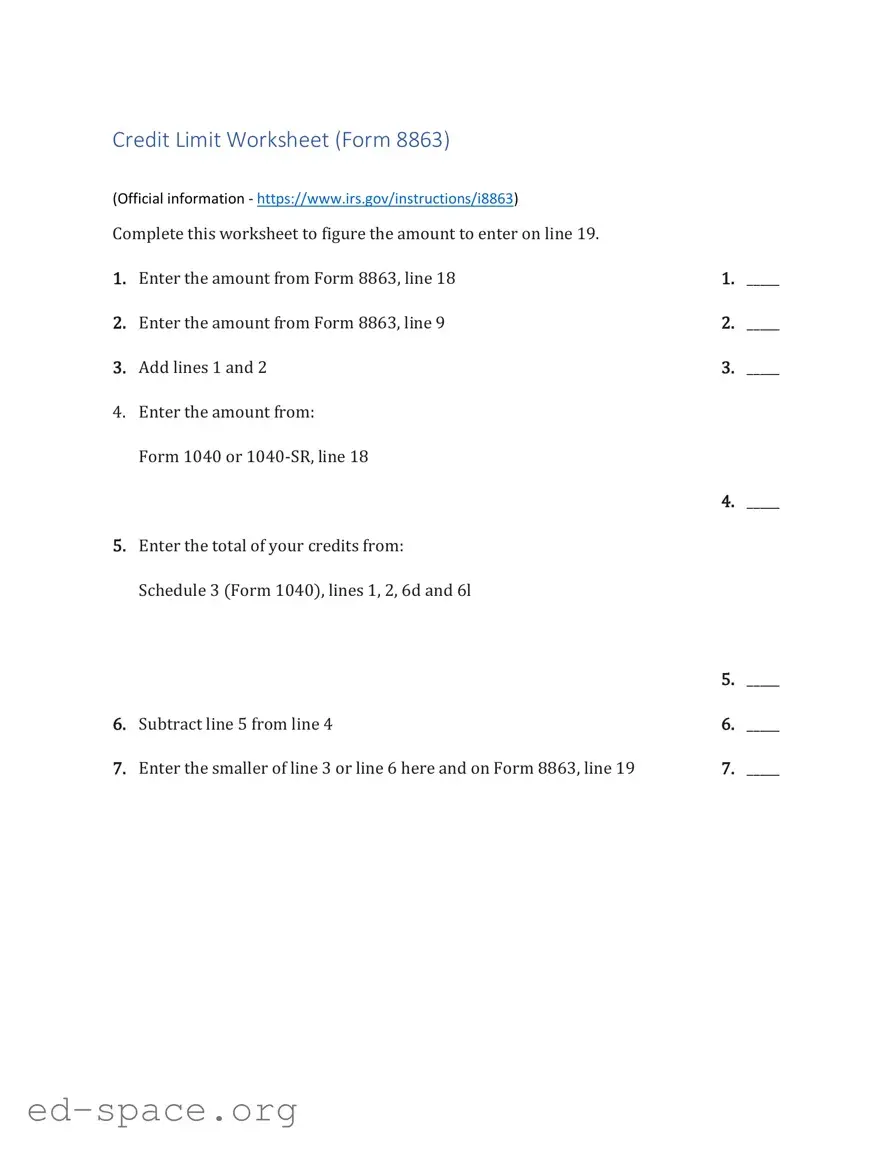
The 8863 Credit Limit Worksheet is an essential tool for taxpayers looking to accurately calculate their education credits. It guides you through determining the amount to report on line 19 of Form 8863. This worksheet requires you to input specific figures from various lines of Form 8863 and your tax return, including amounts from lines 18 and 9 of Form 8863, as well as line 18 from Form 1040 or 1040-SR. You’ll also need to account for any credits listed on Schedule 3. By following the steps outlined, you can subtract your total credits from your qualified education expenses to find the correct amount to claim. It’s important to complete a separate worksheet for each student for each academic period in 2022, ensuring you capture all relevant expenses and adjustments. This includes any tax-free educational assistance and refunds received. With this worksheet, you can confidently navigate the complexities of education credits and maximize your tax benefits.
Credit Limit Worksheet (Form 8863)
(Official information - https://www.irs.gov/instructions/i8863) |
|
|
|
Complete this worksheet to figure the amount to enter on line 19. |
|
|
|
1. |
Enter the amount from Form 8863, line 18 |
1. |
_____ |
2. |
Enter the amount from Form 8863, line 9 |
2. |
_____ |
3. |
Add lines 1 and 2 |
3. |
_____ |
4.Enter the amount from:
Form 1040 or
4. _____
5.Enter the total of your credits from: Schedule 3 (Form 1040), lines 1, 2, 6d and 6l
|
|
5. |
_____ |
6. |
Subtract line 5 from line 4 |
6. |
_____ |
7. |
Enter the smaller of line 3 or line 6 here and on Form 8863, line 19 |
7. |
_____ |
Line 31
Complete a separate worksheet for each student for each academic period beginning or treated as beginning (see below) in 2022 for which you paid (or are treated as having paid) qualified education expenses in 2022.
1. |
Total qualified education expenses paid for or on behalf of the |
_____ |
|
|
student in 2022 for the academic period |
|
|
2. |
Less adjustments: |
|
|
|
a. |
_____ |
|
|
allocable to the academic period |
|
|
|
b. |
_____ |
|
|
(and before you file your 2022 tax return) allocable |
|
|
|
to the academic period |
|
|
|
c. Refunds of qualified education expenses paid in |
_____ |
|
|
2022 if the refund is received in 2022 or in 2023 |
|
|
|
before you file your 2022 tax return |
|
|
3. |
Total adjustments (add lines 2a, 2b, and 2c) |
|
_____ |
4. |
Adjusted qualified education expenses. Subtract line 3 from line |
_____ |
|
|
1. If zero or less, enter |
|
|
| Fact Name | Description |
|---|---|
| Purpose | The Credit Limit Worksheet (Form 8863) is designed to help taxpayers calculate the amount to enter on line 19 of Form 8863. |
| Initial Entries | Taxpayers begin by entering amounts from specific lines of Form 8863, ensuring accurate calculations. |
| Line Additions | Lines 1 and 2 are added together to determine a preliminary total, which is crucial for subsequent calculations. |
| Form 1040 Reference | Line 4 requires the amount from Form 1040 or 1040-SR, emphasizing the connection between different tax forms. |
| Credit Calculation | Taxpayers must calculate total credits from Schedule 3, which includes various lines that reflect different credit types. |
| Subtraction Step | Line 6 involves subtracting the total credits from line 4, which helps in determining the taxpayer's credit limit. |
| Final Calculation | Line 7 requires taxpayers to enter the smaller amount between line 3 and line 6, guiding them to the final credit limit. |
| Academic Period Requirement | A separate worksheet must be completed for each student for each academic period, ensuring clarity in education expense tracking. |
| Adjustments Section | Adjustments for tax-free educational assistance and refunds must be calculated, impacting the total qualified education expenses. |
Filling out the 8863 Credit Limit Worksheet is a straightforward process that requires accurate data entry from various forms. This worksheet will help determine the correct amount to report on your tax return. Follow the steps below to complete the form correctly.
Next, if you are completing the worksheet for multiple students or academic periods, be sure to fill out a separate worksheet for each. This ensures that all qualified education expenses are accurately accounted for.
What is the purpose of the 8863 Credit Limit Worksheet?
The 8863 Credit Limit Worksheet is designed to help taxpayers calculate the amount of education credits they can claim on their tax returns. Specifically, it assists in determining the correct figure to enter on line 19 of Form 8863. This worksheet takes into account various inputs from the taxpayer's financial documents, ensuring that they accurately report their qualified education expenses and any applicable tax credits.
Who should complete the 8863 Credit Limit Worksheet?
Any taxpayer who is claiming education credits for qualified education expenses should complete the 8863 Credit Limit Worksheet. This includes individuals who have paid for their own education or for someone else's education, such as a dependent. Each student must have a separate worksheet for each academic period in which qualified expenses were incurred.
What information is required to fill out the worksheet?
To complete the worksheet, taxpayers need to gather specific information from their tax forms. This includes amounts from Form 8863 (lines 9 and 18), Form 1040 or 1040-SR (line 18), and Schedule 3 (Form 1040). Additionally, details about total qualified education expenses paid, as well as any tax-free educational assistance or refunds received, are necessary for accurate calculations.
How do I determine the adjusted qualified education expenses?
To find the adjusted qualified education expenses, you will first need to calculate the total qualified expenses paid for the student. Then, subtract any adjustments, such as tax-free educational assistance and refunds, from this total. If the resulting amount is zero or less, you should enter -0- on the worksheet.
What should I do if I have multiple students?
If you have multiple students, you must complete a separate worksheet for each one. This means that for each academic period where qualified education expenses were paid, you will need to gather the necessary information and fill out an individual worksheet. This ensures that each student's education credits are accurately calculated and reported on your tax return.
Not using the correct lines from Form 8863: Many people mistakenly enter amounts from the wrong lines, leading to incorrect calculations.
Failing to add correctly: When adding lines 1 and 2, simple math errors can occur, which can affect the final credit limit.
Ignoring adjustments: Some individuals forget to account for tax-free educational assistance or refunds, which can significantly alter their qualified education expenses.
Not completing a separate worksheet for each student: If there are multiple students, each one needs a separate worksheet for accurate calculations.
Missing the deadline: Submitting the worksheet after the deadline can result in losing out on the credit altogether.
Not double-checking entries: A lack of review can lead to overlooked mistakes, such as transposed numbers or missing amounts.
Failing to follow instructions: Skipping over the specific instructions provided by the IRS can lead to errors that might have been easily avoided.
The 8863 Credit Limit Worksheet is an important tool for calculating education tax credits. To effectively use this form, you may need several other documents that provide essential information. Below is a list of related forms and documents that are commonly used alongside the 8863 Credit Limit Worksheet.
Having these forms and documents on hand can streamline the process of claiming education credits. They provide the necessary information to ensure accuracy and maximize your potential benefits.
The 8863 Credit Limit Worksheet form is essential for calculating education credits. Several other documents share similarities in structure and purpose. Here’s a list of nine such documents:
Each of these documents plays a critical role in tax preparation and may require careful attention to detail, just like the 8863 Credit Limit Worksheet.
When filling out the 8863 Credit Limit Worksheet form, follow these guidelines to ensure accuracy and compliance. Here are nine things you should and shouldn't do:
Misconceptions about the 8863 Credit Limit Worksheet form can lead to confusion during tax preparation. Here are five common misunderstandings:
When it comes to utilizing the 8863 Credit Limit Worksheet, understanding its structure and purpose is essential for maximizing your education tax credits. Here are some key takeaways to keep in mind:
By keeping these takeaways in mind, you can navigate the 8863 Credit Limit Worksheet with greater confidence and clarity. Properly filling it out can lead to substantial financial benefits, making your educational investments more affordable.