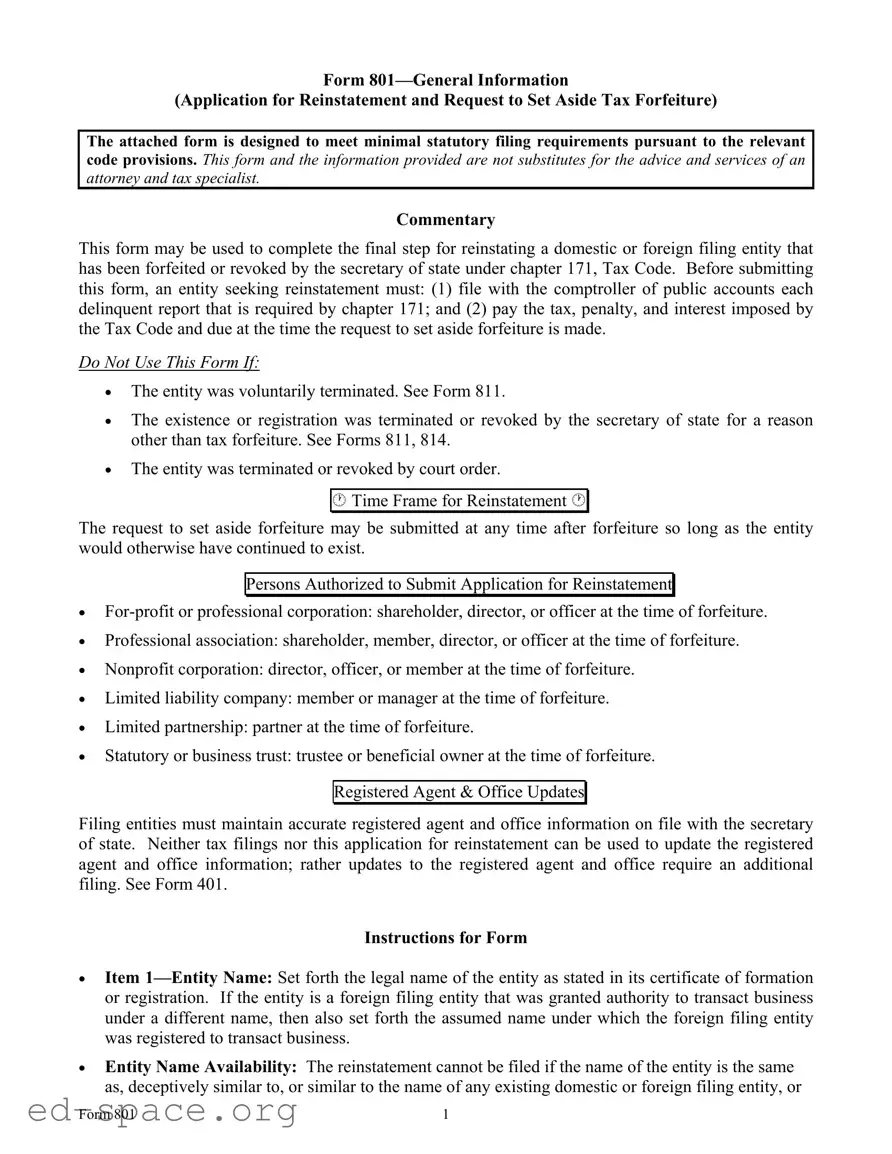
The 801 Texas form serves as a crucial tool for businesses seeking to reinstate their status after a tax forfeiture. This application is specifically designed for entities that have been forfeited or revoked by the Secretary of State due to tax issues, as outlined in Chapter 171 of the Texas Tax Code. To successfully complete the reinstatement process, entities must first ensure that all required delinquent tax reports have been filed and that any outstanding taxes, penalties, and interest have been paid. The form requires detailed information, including the entity's legal name, Secretary of State file number, and the date of forfeiture. Additionally, it is essential to attach a tax clearance letter from the Texas Comptroller, confirming that all franchise tax obligations have been met. Certain individuals, such as shareholders, directors, or members of the entity at the time of forfeiture, are authorized to submit this application. It's important to note that this form cannot be used if the entity was voluntarily terminated or if the revocation was due to reasons other than tax forfeiture. Therefore, understanding the specific requirements and conditions surrounding the use of the 801 Texas form is vital for any entity looking to regain its standing in Texas.

Form
(Application for Reinstatement and Request to Set Aside Tax Forfeiture)
The attached form is designed to meet minimal statutory filing requirements pursuant to the relevant code provisions. This form and the information provided are not substitutes for the advice and services of an attorney and tax specialist.
Commentary
This form may be used to complete the final step for reinstating a domestic or foreign filing entity that has been forfeited or revoked by the secretary of state under chapter 171, Tax Code. Before submitting this form, an entity seeking reinstatement must: (1) file with the comptroller of public accounts each delinquent report that is required by chapter 171; and (2) pay the tax, penalty, and interest imposed by the Tax Code and due at the time the request to set aside forfeiture is made.
Do Not Use This Form If:
クThe entity was voluntarily terminated. See Form 811.
クThe existence or registration was terminated or revoked by the secretary of state for a reason other than tax forfeiture. See Forms 811, 814.
クThe entity was terminated or revoked by court order.
ン Time Frame for Reinstatement ン
The request to set aside forfeiture may be submitted at any time after forfeiture so long as the entity would otherwise have continued to exist.
Persons Authorized to Submit Application for Reinstatement
ク
クProfessional association: shareholder, member, director, or officer at the time of forfeiture.
クNonprofit corporation: director, officer, or member at the time of forfeiture.
クLimited liability company: member or manager at the time of forfeiture.
クLimited partnership: partner at the time of forfeiture.
クStatutory or business trust: trustee or beneficial owner at the time of forfeiture.
Registered Agent & Office Updates
Filing entities must maintain accurate registered agent and office information on file with the secretary of state. Neither tax filings nor this application for reinstatement can be used to update the registered agent and office information; rather updates to the registered agent and office require an additional filing. See Form 401.
Instructions for Form
クItem
クEntity Name Availability: The reinstatement cannot be filed if the name of the entity is the same as, deceptively similar to, or similar to the name of any existing domestic or foreign filing entity, or
Form 801 |
1 |
any name reservation or registration filed with the secretary of state. The administrative rules adopted for determining entity name availability (Texas Administrative Code, title 1, part 4, chapter 79, subchapter C) may be viewed at http://www.sos.state.tx.us/tac/index.shtml.
If the entity name is no longer available, the application for reinstatement must be accompanied by a letter of consent or an amendment to the entity’s formation document or registration, as applicable.
クItem
クItem
クItem
クTax Clearance: A certificate of reinstatement must be accompanied by a tax clearance letter from the Texas Comptroller of Public Accounts stating that the entity has satisfied all franchise tax liabilities and may be reinstated.
Contact the Comptroller for assistance in complying with franchise tax filing requirements and obtaining the necessary tax clearance letter. The Comptroller may be contacted by
クExecution: The application must be signed by a person who is authorized to apply for and request a reinstatement of the forfeited entity. (See “Persons Authorized to Apply” on page 1 of these instructions.)
クPayment and Delivery Instructions: The filing fee for an application for reinstatement is $75, unless the entity is a nonprofit corporation. There is no fee for filing the reinstatement of a nonprofit corporation following a tax forfeiture. Fees may be paid by personal checks, money orders, LegalEase debit cards, or American Express, Discover, MasterCard, and Visa credit cards. Checks or money orders must be payable through a U.S. bank or financial institution and made payable to the secretary of state. Fees paid by credit card are subject to a statutorily authorized convenience fee of 2.7 percent of the total fees.
Applicable fees for any additional filing that may be required as a condition for reinstatement (such as an amendment to change the entity’s name) must be submitted together with the appropriate filing.
Submit the completed form in duplicate along with the filing fee. The form may be mailed to P.O. Box 13697, Austin, Texas
Revised 05/11
Form 801 |
2 |

Form 801 (Revised 05/11)
Submit in duplicate to: Secretary of State P.O. Box 13697 Austin, TX
512
Filing Fee: See instructions
This space reserved for office use.
Application for Reinstatement
And Request to Set Aside
Tax Forfeiture
1. The entity name is:
The entity is a foreign entity that was required to obtain its registration under a name that differs from the legal name stated above. The name under which the entity is registered is:
2.The file number issued to the entity by the secretary of state is:
3.The entity was forfeited or revoked under the provisions of the Tax Code on:
mm/dd/yyyy
4.The undersigned requests that the forfeiture or revocation of the entity be set aside, and certifies that:
a. The entity has filed each delinquent report that is required by chapter 171 of the Tax Code and has made payment for the tax, penalty, and interest imposed and that is due at the time of this application as evidenced by the attached tax clearance letter; and
b. On the date of forfeiture or revocation, the undersigned person was:
ク an officer, director or shareholder of the
ク an officer, director, or member of the
ク a partner of the
ク a trustee or beneficial owner of the
Additional Required Documentation or Filings
Comptroller of Public Accounts Tax Clearance Letter
Letter of Consent or Amendment to Certificate of Formation or Registration (Required when entity name
is no longer available.)
Execution
The undersigned declares under penalty of perjury, and the penalties imposed by law for the submission of a materially false or fraudulent instrument, that the undersigned is authorized to make this request; that the statements contained herein are true and correct, and that tax clearance was not obtained by providing false or fraudulent information.
Date:
BY:
Signature of authorized person (see instructions)
Printed or typed name of authorized person
Form 801 |
3 |
| Fact Name | Description |
|---|---|
| Purpose | The 801 Texas form is used for reinstating a forfeited or revoked entity under the Texas Tax Code. |
| Governing Law | This form is governed by Chapter 171 of the Texas Tax Code. |
| Eligibility | Entities that have been forfeited due to tax issues can apply for reinstatement using this form. |
| Submission Timing | The request can be submitted anytime after forfeiture, as long as the entity could have continued to exist. |
| Required Documents | A tax clearance letter from the Texas Comptroller is necessary to accompany the application. |
| Authorized Submitters | Shareholders, directors, or officers of the entity at the time of forfeiture are authorized to submit the application. |
| Filing Fee | The fee for filing is $75, except for nonprofit corporations, which are exempt from this fee. |
| Entity Name Availability | The entity name must not be similar to any existing entity's name to be eligible for reinstatement. |
| Payment Methods | Payments can be made via checks, money orders, or credit cards, with a convenience fee for card payments. |
| Execution Requirement | The application must be signed by an authorized person, certifying the truth of the statements made. |
Completing Form 801 is a crucial step for entities seeking reinstatement after a tax forfeiture. This process ensures that all necessary information is provided and that the correct fees are submitted. Follow these steps to fill out the form accurately.
What is Form 801 in Texas?
Form 801 is an application used for reinstating a domestic or foreign filing entity that has been forfeited or revoked by the Secretary of State under Chapter 171 of the Texas Tax Code. This form also requests to set aside the tax forfeiture. It is crucial to meet certain filing requirements before submitting this form, such as paying any outstanding taxes, penalties, and interest.
Who can submit Form 801?
The individuals authorized to submit Form 801 vary based on the type of entity. For-profit or professional corporations allow shareholders, directors, or officers at the time of forfeiture to apply. Nonprofit corporations permit directors, officers, or members, while limited liability companies allow members or managers. Limited partnerships require partners, and statutory or business trusts need trustees or beneficial owners to submit the application.
What steps must be taken before submitting Form 801?
Before filing Form 801, the entity must complete two essential steps. First, all delinquent reports required by Chapter 171 must be filed with the Comptroller of Public Accounts. Second, the entity must pay any taxes, penalties, and interest due at the time of the reinstatement request. This ensures compliance with the Texas Tax Code.
Can I use Form 801 if my entity was voluntarily terminated?
No, Form 801 is not applicable if the entity was voluntarily terminated. In such cases, you should refer to Form 811 instead. This form is specifically designed for entities that wish to formally terminate their existence.
What happens if my entity name is no longer available?
If the name of your entity is no longer available for reinstatement, you must provide a letter of consent or an amendment to your entity’s formation document. This additional documentation is necessary to proceed with the reinstatement process under a different name.
How much does it cost to file Form 801?
The filing fee for Form 801 is $75, unless the entity is a nonprofit corporation, which does not incur any fees for reinstatement following a tax forfeiture. Payment can be made via personal checks, money orders, or credit cards, with a convenience fee of 2.7 percent applied to credit card transactions.
What is the time frame for reinstatement?
A request to set aside forfeiture can be submitted at any time after the forfeiture has occurred, as long as the entity would otherwise have continued to exist. This flexibility allows entities to reinstate themselves even after a considerable period of forfeiture.
Do I need to update my registered agent information when filing Form 801?
Form 801 cannot be used to update registered agent or office information. If you need to make changes to your registered agent or office, you must file an additional form, specifically Form 401, to ensure that your records are accurate and up to date.
What documentation is required to accompany Form 801?
When submitting Form 801, it is essential to include a tax clearance letter from the Texas Comptroller of Public Accounts. This letter confirms that all franchise tax liabilities have been satisfied. Additionally, if your entity name is not available, include a letter of consent or an amendment to the formation document.
Incorrect Entity Name: Many individuals fail to provide the legal name of the entity as stated in its certificate of formation. This oversight can lead to processing delays or rejection of the application.
Missing Secretary of State File Number: Not including the file number assigned by the secretary of state can complicate the processing of the application. It is advisable to double-check that this number is accurately provided.
Wrong Date of Forfeiture: Some applicants mistakenly enter the wrong date of forfeiture or revocation. If unsure, it’s essential to verify this date by contacting the secretary of state.
Failure to Certify Statements: Although notarization is not required, applicants often overlook the importance of carefully reading and certifying the statements in item 4. This can lead to unintended legal consequences.
Neglecting Tax Clearance: A common mistake is submitting the application without the necessary tax clearance letter from the Texas Comptroller. This letter confirms that all franchise tax liabilities have been satisfied.
Unauthorized Signatures: Only individuals authorized to apply for reinstatement should sign the application. Using an unauthorized person’s signature can invalidate the application.
Incorrect Payment Method: Applicants sometimes fail to follow the specific payment instructions. It is crucial to ensure that the payment method aligns with the guidelines provided, including the correct fee amount.
Improper Submission: Some people do not submit the application in duplicate, which is a requirement. Not following this guideline can result in processing delays.
Outdated Registered Agent Information: Individuals often forget to update their registered agent and office information. This form does not serve as a means to update that information, which requires a separate filing.
When navigating the process of reinstating a forfeited entity in Texas, several additional forms and documents may be necessary to ensure compliance with state regulations. Each of these documents serves a specific purpose and can facilitate the reinstatement process. Here is a list of commonly used forms that accompany Form 801:
Understanding these forms and their purposes can greatly streamline the reinstatement process for entities in Texas. Each document plays a vital role in ensuring compliance and facilitating a smoother path to reinstatement. It is advisable to review each requirement carefully and seek assistance if needed, as proper adherence to these guidelines is crucial for a successful outcome.
The Texas Form 801 serves a specific purpose in the reinstatement of entities that have faced tax forfeiture. Several other forms share similarities with Form 801 in terms of function, requirements, or the context in which they are used. Below is a list of seven documents that are comparable to Form 801:
When filling out the 801 Texas form, it's important to follow specific guidelines to ensure your application is processed smoothly. Here are four things you should and shouldn't do:
Misconceptions about the Texas Form 801 can lead to confusion and delays in the reinstatement process. Here are nine common misunderstandings:
Understanding these misconceptions can help ensure a smoother process for reinstating an entity in Texas.
Filling out and using the 801 Texas form requires careful attention to detail. Here are some key takeaways to keep in mind:
Following these guidelines will help streamline the reinstatement process and minimize potential issues.