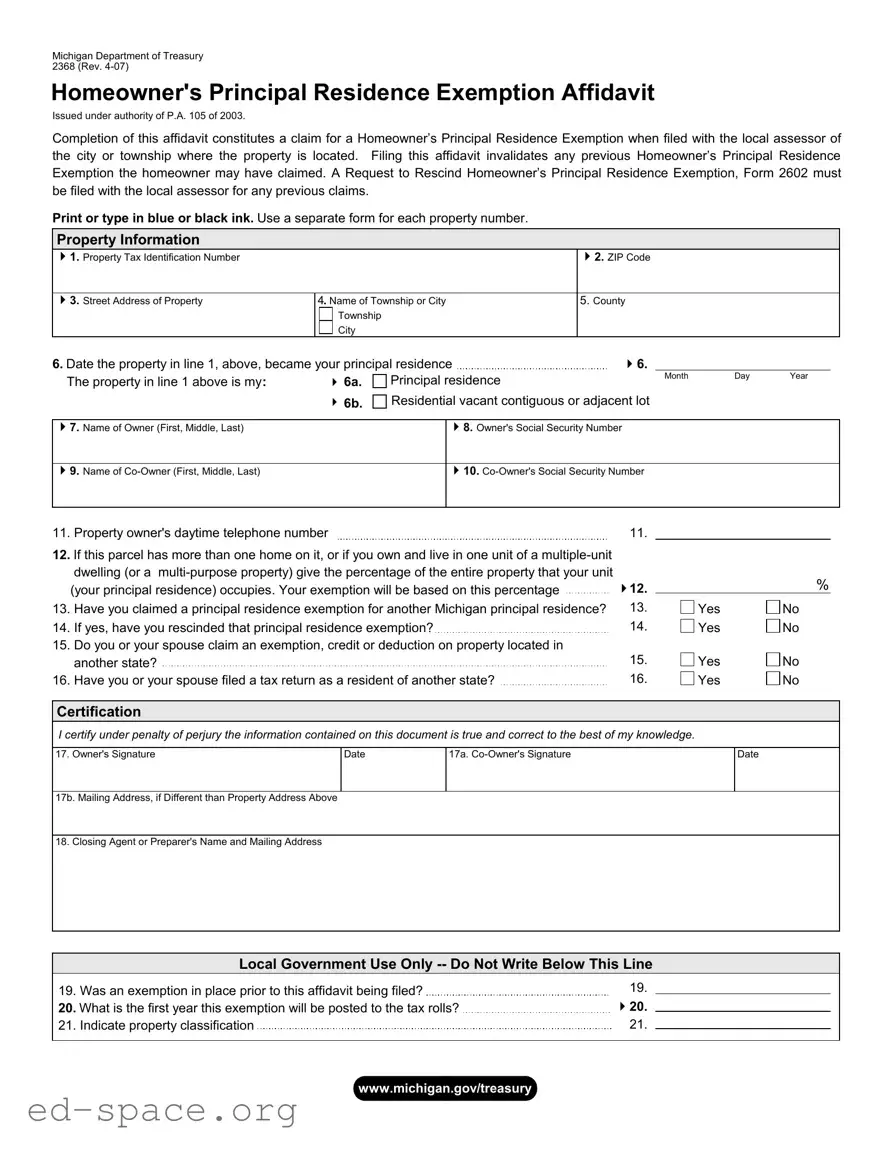
The Michigan Department of Treasury Form 2368, known as the Homeowner's Principal Residence Exemption Affidavit, is a vital document for homeowners seeking tax relief. This form must be filed with the local assessor of the city or township where the property is located. By completing this affidavit, homeowners declare their property as their principal residence, which may exempt them from a portion of local school operating taxes. It's important to note that filing this form will invalidate any previous exemptions claimed, necessitating the submission of Form 2602 to rescind those prior claims. The form requires essential property information, including the property tax identification number, address, and the date the property became the principal residence. Homeowners must also provide their names, Social Security numbers, and contact information. If the property has multiple units, homeowners must indicate the percentage of the property they occupy. The affidavit includes questions about previous exemptions in Michigan or other states, ensuring that homeowners comply with tax regulations. The completed form must be submitted by May 1st to ensure adjustments to property taxes on the next bill. Failure to notify the assessor of any changes in residency status may result in penalties. Thus, understanding and accurately completing Form 2368 is crucial for homeowners looking to maximize their tax benefits.
Michigan Department of Treasury 2368 (Rev.
Homeowner's Principal Residence Exemption Affidavit
Issued under authority of P.A. 105 of 2003.
Completion of this affidavit constitutes a claim for a Homeowner’s Principal Residence Exemption when filed with the local assessor of the city or township where the property is located. Filing this affidavit invalidates any previous Homeowner’s Principal Residence Exemption the homeowner may have claimed. A Request to Rescind Homeowner’s Principal Residence Exemption, Form 2602 must be filed with the local assessor for any previous claims.
Print or type in blue or black ink. Use a separate form for each property number.
Property Information |
|
|
|
|
|
|
|
|
|
|
1. |
Property Tax Identification Number |
|
|
|
|
2. ZIP Code |
|
|
|
|
|
|
|
|
|
|
|
||||
3. |
Street Address of Property |
4. Name of Township or City |
5. County |
|
|
|
||||
|
|
|
|
Township |
|
|
|
|
|
|
|
|
|
|
City |
|
|
|
|
|
|
|
|
|
|
|
|
|
||||
6. Date the property in line 1, above, became your principal residence |
6. |
|
|
|
|
|||||
The property in line 1 above is my: |
|
|
6a. |
Principal residence |
|
Month |
Day |
Year |
|
|
|
|
|
|
|
|
|
||||
|
|
|
|
6b. |
Residential vacant contiguous or adjacent lot |
|
|
|
||
7.Name of Owner (First, Middle, Last)
8.Owner's Social Security Number
9.Name of
10.
11. Property owner's daytime telephone number |
11. |
12.If this parcel has more than one home on it, or if you own and live in one unit of a
(your principal residence) occupies. Your exemption will be based on this percentage |
12. |
|
13. |
Have you claimed a principal residence exemption for another Michigan principal residence? |
13. |
14. |
If yes, have you rescinded that principal residence exemption? |
14. |
15. |
Do you or your spouse claim an exemption, credit or deduction on property located in |
|
|
another state? |
15. |
16. |
Have you or your spouse filed a tax return as a resident of another state? |
16. |
%
Yes |
No |
Yes |
No |
Yes |
No |
Yes |
No |
Certification
I certify under penalty of perjury the information contained on this document is true and correct to the best of my knowledge.
17. |
Owner's Signature |
Date |
17a. |
Date |
|
|
|
|
|
17b. Mailing Address, if Different than Property Address Above |
|
|
|
|
|
|
|
|
|
18. |
Closing Agent or Preparer's Name and Mailing Address |
|
|
|
|
|
|
|
|
Local Government Use Only
19. |
Was an exemption in place prior to this affidavit being filed? |
19. |
20. What is the first year this exemption will be posted to the tax rolls? |
20. |
|
21. |
Indicate property classification |
21. |
www.michigan.gov/treasury

Instructions for Form 2368,
Homeowner’s Principal Residence Exemption Affidavit
General Information
If you own and occupy your principal residence, it may be exempt from a portion of your local school operating taxes. To claim an exemption, complete this affidavit and file it with your township or city by May 1st of the year of the claim. Your local assessor will adjust your taxes on your next property tax bill. Note that this is an exemption from part of the taxes and does not affect your assessment.
Owning means you hold the legal title to the principal residence or that you are currently buying it on a notarized or recorded land contract. Renters should not file this form.
Occupying means this is your principal residence, the place you intend to return to whenever you go away. It is the address that appears on your driver's license or voter registration card. You may have only one principal residence at a time. Vacation homes and income property which you do not occupy as your principal residence, may not be claimed.
Rescinding Your Exemption. If you claim an exemption, then stop using it as a principal residence, you must notify your township or city assessor within 90 days of the change or you may be penalized. This can be done using the Form 2602, Request to Rescind Homeowner's PrincipAL Residence Exemption.
Interest and Penalty. If it is determined that you claimed property that is not your principal residence, you may be subject to the additional tax plus penalty and interest as determined under the Property Tax Act.
Lines not listed here are explained on the form.
Property Information
Line 1. Property is identified with a property tax identification number. This number will be found on your tax bill and on your property tax assessment notice. Enter this number in the space indicated. If you cannot find this number, call your township or city assessor. Submit a separate affi davit for each property being claimed.
Your property number is vital. Without it, your township or city cannot adjust your property taxes accurately.
Lines
Line 6. Your principal residence is the dwelling that you occupy as your permanent home and any vacant adjacent or contiguous properties that are classed residential. Indicate the date this property became your principal residence.
Lines
Note: The request for the Social Security number is authorized under section 42 USC 405 (c) (2) (C) (i). It is used by the Department of Treasury to verify tax exemption claims and to deter fraudulent filings. Any use of the number by closing agents or local units of government is illegal and subject to penalty.
Line 12.
If the parcel of property you are claiming has more than one home on it, you must determine the percentage that you own and occupy as your principal residence. A second residence on the same property (e.g., a mobile home or second house) is not part of your personal residence, even if it is not rented to another person. Your local assessor can tell you the assessed value of each residence to help you determine the percentage that is your personal residence.
If you rent part of your home to another person, you may have to prorate your exemption. If your home is a single- family dwelling and the renters enter through a common door or your living area to get to their rooms, you may claim a 100 percent exemption if less than 50 percent of your home is rented to others who use it as a residence. However, if part of the home was converted to an apartment with a separate entrance, you must calculate the percentage that is your principal residence, by dividing the floor area of your principal residence by the floor area of the entire building.
Lines
Certification
Sign and date the form. Enter your mailing address if it is different from the address at the top of the form.
Mailing Information
Mail your completed form to the township or city assessor in which the property is located. This address may be on your most recent tax bill or assessment notice. Do not send this form directly to the Department of Treasury.
If you have any questions, visit our Web site at www.michigan.gov/treasury or call
| Fact Name | Fact Details |
|---|---|
| Form Title | Homeowner's Principal Residence Exemption Affidavit |
| Governing Law | Issued under authority of P.A. 105 of 2003 |
| Filing Deadline | Must be filed by May 1st of the year of the claim |
| Invalidation of Previous Claims | Filing this affidavit invalidates any previous Homeowner’s Principal Residence Exemption claimed |
| Property Identification | Requires a Property Tax Identification Number found on tax bills or assessment notices |
| Owner's Certification | Owner must certify under penalty of perjury that the information is true and correct |
| Multiple Properties | A separate form is required for each property number |
| Rescission Requirement | If exemption is no longer applicable, Form 2602 must be filed to rescind the exemption |
Filling out the Michigan Department of Treasury Form 2368 is a straightforward process that requires accurate information about your property and personal details. This form is essential for claiming a Homeowner’s Principal Residence Exemption, which can help reduce your local school operating taxes. Once completed, the form needs to be submitted to your local assessor's office. Below are the steps to guide you through the process of filling out this form.
Once your form is submitted, the local assessor will review your application and adjust your property taxes accordingly. If you have questions during this process, consider reaching out to your local assessor’s office for assistance.
What is the purpose of the Michigan Form 2368?
The Michigan Form 2368, also known as the Homeowner's Principal Residence Exemption Affidavit, is used to claim an exemption on a portion of local school operating taxes for your principal residence. By completing and submitting this form to your local assessor, you can potentially lower your property tax bill. This exemption applies only to the property you occupy as your primary home, not to vacation homes or rental properties.
Who is eligible to file this form?
To be eligible to file Form 2368, you must own and occupy the property as your principal residence. This means you hold the legal title or are in the process of buying it through a land contract. Additionally, the address must be where you intend to return whenever you leave. Only one principal residence can be claimed at a time, and renters are not eligible to file this form.
When is the deadline for filing the form?
The completed Form 2368 must be filed with your local township or city assessor by May 1st of the year you wish to claim the exemption. If you submit the form after this date, your exemption may not be applied until the following year.
What happens if I previously claimed an exemption?
If you have previously claimed a Homeowner’s Principal Residence Exemption and are now filing Form 2368 for a different property, your previous exemption will be invalidated. You must also file a separate form, known as Form 2602, to rescind your earlier exemption. This ensures that only one exemption is active at any given time.
What information do I need to provide on the form?
When filling out Form 2368, you will need to provide several pieces of information, including your property tax identification number, the address of the property, the date it became your principal residence, and personal details such as your name and Social Security number. If applicable, you will also need to indicate if you own a portion of a multi-unit property and provide the percentage of the property that is your principal residence.
What if my property has multiple units?
If your property is a multi-unit or multi-purpose dwelling, you can only claim an exemption for the portion that you occupy as your principal residence. You will need to calculate the percentage of the property that you use as your primary home. This can be done by comparing the floor area of your unit to the total floor area of the entire building. Your local assessor can assist you in determining these values.
What should I do if I stop using my property as my principal residence?
If you stop using the property as your principal residence, you are required to notify your local assessor within 90 days. Failing to do so may result in penalties. You can rescind your exemption by filing Form 2602, which officially informs the assessor of the change in your residency status.
How do I submit the completed form?
Once you have completed Form 2368, you must mail it to the township or city assessor where your property is located. Do not send the form directly to the Michigan Department of Treasury. You can find the appropriate mailing address on your most recent tax bill or assessment notice.
What if I have questions about the form or the exemption process?
If you have any questions regarding Form 2368 or the Homeowner's Principal Residence Exemption process, you can visit the Michigan Department of Treasury's website or call their office directly. They provide resources and assistance to help you understand the requirements and ensure your application is processed correctly.
Failing to provide the Property Tax Identification Number. This number is crucial for identifying your property and can be found on your tax bill or assessment notice. Without it, your claim may not be processed correctly.
Not using the correct ink color. The form specifically requires that you print or type in blue or black ink. Using other colors may lead to your form being rejected or delayed.
Neglecting to submit a separate form for each property. If you own multiple properties, each one requires its own affidavit. Failing to do this can lead to confusion and potential denial of your exemption claim.
Omitting the date when the property became your principal residence. This information is essential for determining eligibility. If this date is missing, it could result in complications with your exemption.
Providing incorrect or incomplete owner information. Make sure to include the full names and Social Security Numbers of all legal owners. Missing or incorrect details can lead to issues with verification.
Failing to check the appropriate boxes regarding previous exemptions. If you have claimed a principal residence exemption elsewhere, this must be disclosed. Not doing so may result in penalties.
Not signing and dating the form. Certification is a critical part of the process. Without your signature, the affidavit is considered incomplete, and your claim may be denied.
The Michigan Department of Treasury Form 2368 is essential for homeowners seeking a Principal Residence Exemption. This form must be filed with the local assessor to claim the exemption. In addition to this form, several other documents may be required or beneficial for homeowners during the exemption process. Below is a list of related forms and documents that are often utilized alongside Form 2368.
These forms and documents play a significant role in the process of claiming or managing property tax exemptions. Homeowners should ensure they have the necessary paperwork ready when filing for the exemption to avoid delays or complications.
The Michigan Department of Treasury 2368 form is essential for homeowners seeking a Principal Residence Exemption. Several other documents serve similar purposes in different contexts. Here’s a list of nine forms that share similarities with the 2368 Michigan form:
When filling out the Michigan Department of Treasury Form 2368, it's essential to follow specific guidelines to ensure your application is processed correctly. Here’s a list of things you should and shouldn't do:
Following these guidelines can help prevent delays or issues with your exemption claim. Act promptly to ensure your application is submitted on time and accurately.
Here are some common misconceptions about the Michigan Form 2368, the Homeowner's Principal Residence Exemption Affidavit:
Filling out the Michigan Department of Treasury Form 2368 is an important step for homeowners seeking a property tax exemption. Here are key takeaways to ensure you navigate the process smoothly:
Following these guidelines will help you effectively manage your property tax exemption claim. If you have further questions or need assistance, consider reaching out to your local assessor or visiting the Michigan Department of Treasury's website for more information.