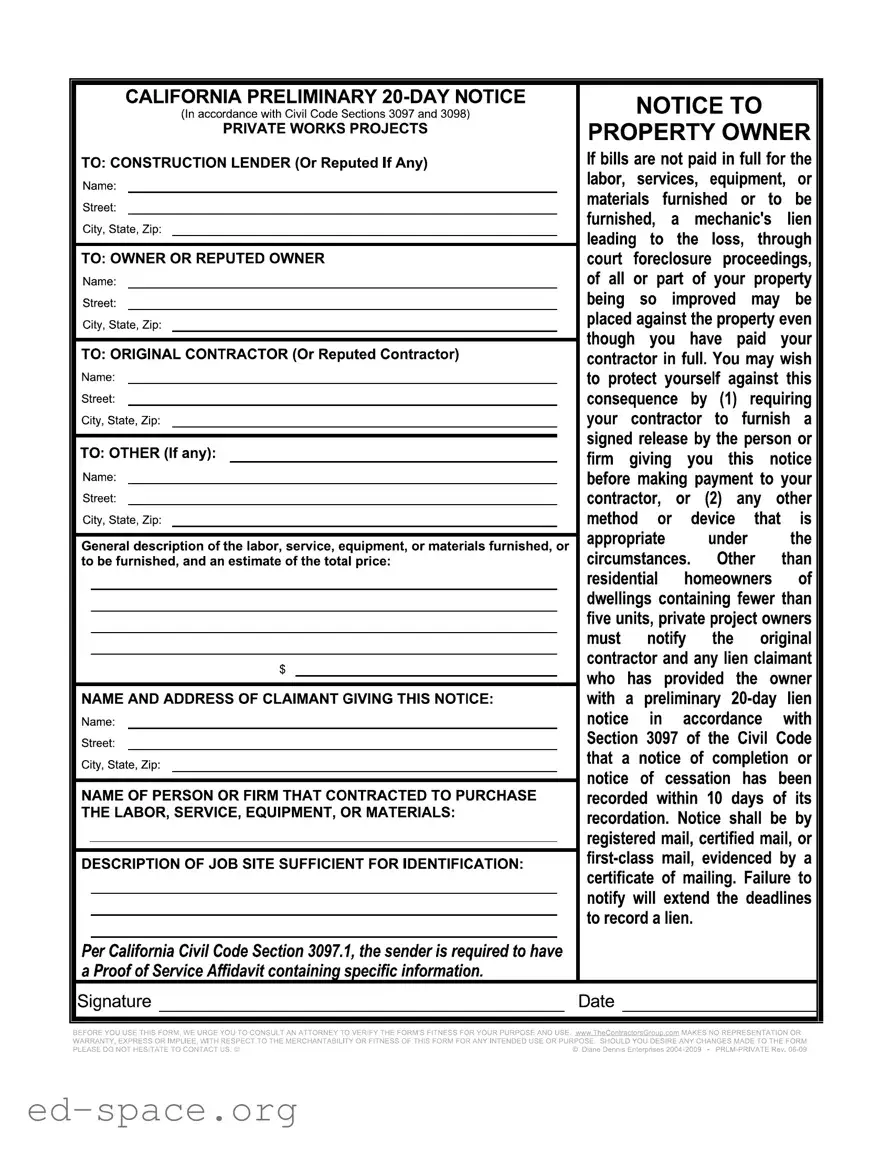
The 20 Day Notice form in California serves as an essential tool for those involved in private works projects, ensuring that all parties are informed of potential lien rights. This notice is particularly relevant for contractors, suppliers, and property owners, as it outlines the necessary information regarding labor, services, equipment, or materials that have been provided or are expected to be provided. It requires details such as the names and addresses of the construction lender, owner, and original contractor, as well as a description of the job site. The form also emphasizes the importance of timely communication, warning property owners that failure to settle bills could result in a mechanic's lien against their property, regardless of payments made to contractors. Additionally, it mandates that property owners notify original contractors and lien claimants of any recorded notices of completion or cessation within a specified timeframe. By understanding the implications of this notice, individuals can take proactive steps to protect their interests in construction projects, thereby minimizing potential legal complications.
| Fact Name | Fact Description |
|---|---|
| Purpose | The 20 Day Notice is a legal document used in California to inform property owners and contractors of unpaid labor, services, equipment, or materials on private works projects. |
| Governing Law | This form is governed by California Civil Code Sections 3097 and 3098. |
| Recipients | The notice must be sent to the construction lender, owner or reputed owner, original contractor, and any other relevant parties. |
| Claimant Information | The form requires the name and address of the claimant who is giving the notice. |
| Job Site Description | A description of the job site must be included, which helps in identifying the location of the work performed. |
| Mechanic's Lien Warning | The notice warns property owners that unpaid bills could lead to a mechanic's lien, risking the loss of property through court foreclosure. |
| Notification Requirement | Property owners must notify the original contractor and any lien claimants of a recorded notice of completion or cessation within 10 days. |
| Proof of Service | A Proof of Service Affidavit is required to confirm that the notice was sent, containing specific information as outlined in Section 3097.1. |
| Consultation Recommendation | The form advises users to consult an attorney to ensure its appropriateness for their specific situation. |
| Liability Disclaimer | The document includes a disclaimer stating that no warranty is made regarding its fitness for any intended use or purpose. |
Completing the 20 Day Notice form is an important step in ensuring that all parties involved in a construction project are informed about the labor, services, equipment, or materials provided. After filling out the form, it is crucial to send it to the appropriate recipients to maintain compliance with California law. Below are the steps to fill out the form correctly.
After completing the form, ensure that it is sent to all relevant parties promptly. This will help protect the rights of those who provided services or materials for the project.
What is the purpose of the 20 Day Notice in California?
The 20 Day Notice is a legal document used in California for private works projects. It serves as a preliminary notice to property owners, contractors, and construction lenders about the labor, services, equipment, or materials provided or to be provided on a construction project. This notice helps protect the rights of those providing services by informing property owners that they may face a mechanic's lien if bills are not paid in full, even if they have paid their contractor.
Who should receive the 20 Day Notice?
The 20 Day Notice should be sent to several parties involved in the construction project. This includes the construction lender (if any), the property owner or reputed owner, the original contractor, and any other relevant parties. It is crucial that all parties who may have a financial interest in the project receive this notice to ensure they are aware of potential claims against the property.
What happens if the property owner does not respond to the 20 Day Notice?
If the property owner does not respond or take action after receiving the 20 Day Notice, they may risk having a mechanic's lien placed against their property. This lien can lead to court foreclosure proceedings, which could result in the loss of the property or a portion of it. To mitigate this risk, property owners are advised to either obtain a signed release from the contractor before making payments or use other protective measures as appropriate.
What are the notification requirements for property owners after receiving a 20 Day Notice?
Property owners must notify the original contractor and any lien claimants who provided a 20 Day Notice when a notice of completion or notice of cessation has been recorded. This notification must occur within 10 days of the recordation and can be done via registered mail, certified mail, or first-class mail, with proof of mailing. Failing to provide this notification can extend the deadlines for recording a lien, which may complicate the resolution of any payment disputes.
Failing to include all necessary recipient names and addresses. It's crucial to ensure that the names and addresses of the construction lender, owner, original contractor, and any other relevant parties are complete and accurate.
Not providing a clear description of the labor, services, equipment, or materials. A vague description can lead to confusion or disputes later on.
Neglecting to state the total estimated price. This information is essential for all parties to understand the financial implications of the work being performed.
Omitting the name and address of the claimant giving the notice. This detail is vital for establishing who is making the claim.
Not identifying the job site adequately. A sufficient description of the job site is necessary for proper identification and to avoid any potential disputes.
Failing to notify the original contractor and lien claimants about the recording of a notice of completion or cessation. This notification must occur within 10 days of recordation to avoid extending lien deadlines.
Not using registered, certified, or first-class mail for notifications. Proper mailing methods are required to ensure that notifications are legally recognized.
Forgetting to include a Proof of Service Affidavit. This affidavit must contain specific information to validate that the notice was properly served.
Ignoring the recommendation to consult an attorney. Legal advice can help ensure that the form meets all necessary legal requirements and is appropriate for the intended use.
When dealing with construction projects in California, several forms work hand-in-hand with the 20 Day Notice. Understanding these documents is crucial for protecting your rights and ensuring compliance with state regulations. Below are key forms you may encounter.
Familiarizing yourself with these forms can save time and reduce potential legal complications. Always consider consulting a legal expert to ensure you are using the correct documents for your situation.
When filling out the California 20-Day Notice form, it's important to follow certain guidelines to ensure accuracy and compliance. Here are four things you should and shouldn't do:
Understanding the 20 Day Notice form in California can be challenging. Here are four common misconceptions about this important document:
This form is relevant for various parties involved in a construction project, including subcontractors and suppliers. Anyone providing labor or materials should be aware of this notice.
While the notice serves as a warning to property owners about potential liens, it does not guarantee that payment will be made. It simply informs the owner of their obligations.
Even if a property owner pays their contractor completely, they can still face a mechanic's lien if the contractor fails to pay subcontractors or suppliers. The notice helps protect owners from this risk.
The law requires that property owners notify original contractors and lien claimants about the completion or cessation of work. This must be done within 10 days of recording the notice, extending the deadlines for lien recordings.
When filling out and using the California 20 Day Notice form, keep these key takeaways in mind: