Homepage Blank 19 North Carolina PDF Form
Article Guide

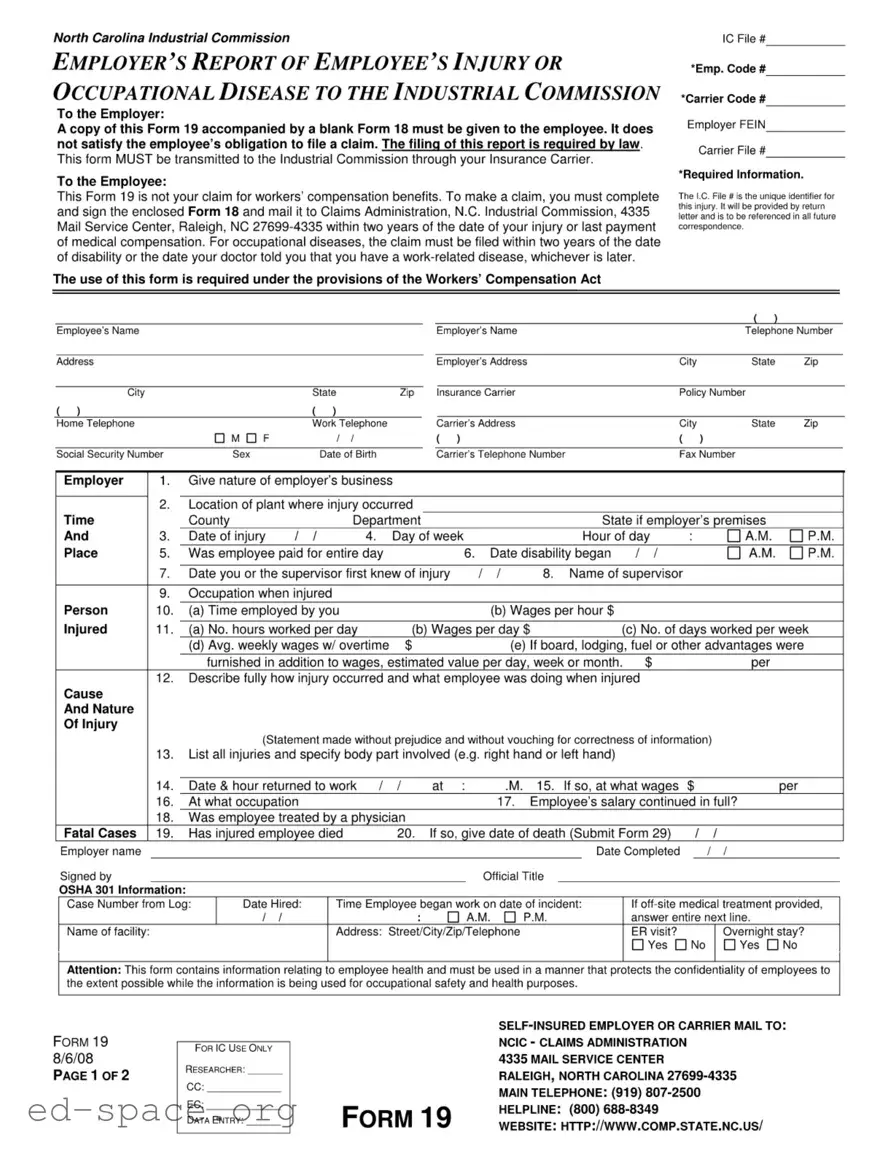
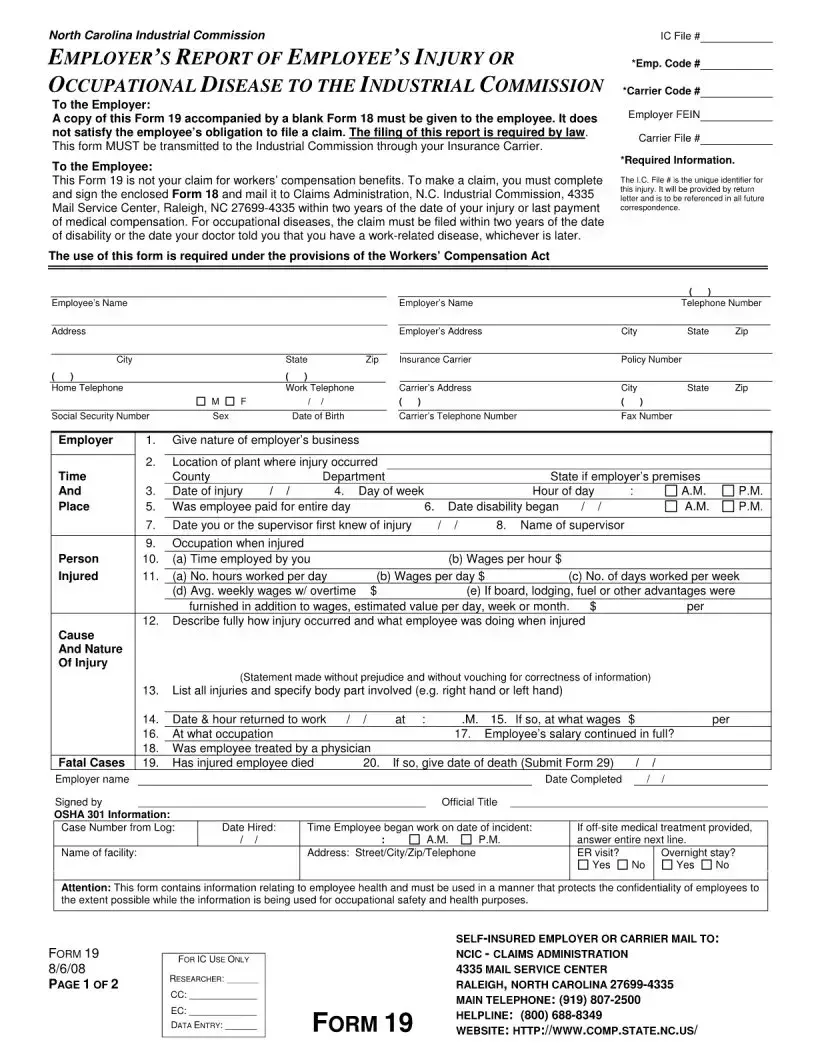
The North Carolina Form 19 serves as the Employer's Report of Employee's Injury or Occupational Disease, a crucial document in the state's workers' compensation process. Employers are legally required to complete and submit this form to the North Carolina Industrial Commission within five days of learning about an employee's injury or occupational disease. It must be sent through the employer's insurance carrier, ensuring that the claim is properly filed. Importantly, while this form documents the incident and provides essential details, it does not serve as a claim for benefits. Employees must complete a separate Form 18 to initiate their claim for workers' compensation benefits. This form requires comprehensive information, including the nature of the injury, the time and place of the incident, and details about the employee's work status and wages. It also includes sections for the employer's business information, the employee's personal details, and specifics regarding the injury itself. Properly filling out and submitting Form 19 is vital for both employers and employees to navigate the complexities of workers' compensation claims in North Carolina.
Document Preview

Form Specifications

Fact Name Details
Purpose of Form 19 This form serves as the Employer’s Report of an Employee's Injury or Occupational Disease, which must be submitted to the North Carolina Industrial Commission.
Filing Requirement Employers must transmit Form 19 through their Insurance Carrier within 5 days after knowledge of an accident. This filing is mandated by law under the Workers’ Compensation Act.
Employee's Responsibility Employees must complete and submit a Form 18 to file a claim for workers’ compensation benefits. Form 19 does not fulfill this requirement.
Governing Laws The use of Form 19 is governed by the North Carolina Workers’ Compensation Act, which outlines the obligations of both employers and employees regarding injury reporting and claims.

19 North Carolina: Usage Guidelines

Completing the North Carolina Form 19 is essential for employers to report an employee's injury or occupational disease. Following these steps will ensure that the form is filled out accurately and submitted correctly. Once completed, the form must be sent to the Industrial Commission through the employer's insurance carrier.

  1. Enter the I.C. File #, which will be provided by the Industrial Commission.
  2. Fill in the Employer Code # and Carrier Code #.
  3. Provide the Employer FEIN and Carrier File #.
  4. Complete the employee's Name, Address, City, and Home Telephone.
  5. Input the employee's Social Security Number.
  6. Fill out the Employer's Name, Employer's Address, and Zip Code.
  7. Provide the Insurance Carrier information including City, Policy Number, and Telephone Number.
  8. Include the State and Zip Code of the Insurance Carrier.
  9. Input the Work Telephone of the employer.
  10. Fill in the Carrier's Address and State and Zip Code.
  11. Indicate the Sex and Date of Birth of the employee.
  12. Complete the Carrier's Telephone Number and City.
  13. Provide the Nature of Employer’s Business.
  14. Specify the Location of Plant where the injury occurred.
  15. Record the Date of Injury.
  16. Indicate the Day of the Week and Hour of Day when the injury occurred.
  17. State whether the employee was paid for the entire day.
  18. Enter the Date Disability Began.
  19. Provide the Date you or the supervisor first knew of the injury.
  20. Fill in the Name of Supervisor.
  21. State the Occupation when Injured.
  22. Complete the Time Employed and No. of Hours Worked per Day.
  23. Input the Average Weekly Wages and any other compensation details.
  24. Describe how the injury occurred and what the employee was doing at the time.
  25. List all injuries and specify the body parts involved.
  26. Record the Date & Hour Returned to Work.
  27. Indicate the Wages at which the employee returned to work.
  28. State whether the employee's salary continued in full.
  29. Specify the Occupation at which the employee returned.
  30. Indicate if the employee was treated by a physician.
  31. For fatal cases, state whether the injured employee died and provide the Date of Death.
  32. Complete the OSHA 301 Information section.
  33. Fill in the Date Completed and Date Hired.
  34. Provide the Time Employee Began Work on the date of the incident.
  35. If applicable, complete the off-site medical treatment information.

Your Questions, Answered

What is the purpose of the Form 19 in North Carolina?

The Form 19, also known as the Employer’s Report of Employee's Injury or Occupational Disease, is a document that employers in North Carolina must complete when an employee suffers a work-related injury or illness. This form serves to notify the North Carolina Industrial Commission about the incident. It is essential for employers to file this form within five days of becoming aware of the injury. However, it is important to note that the Form 19 does not serve as a claim for workers' compensation benefits; employees must file a separate Form 18 for that purpose.

Who is responsible for submitting the Form 19?

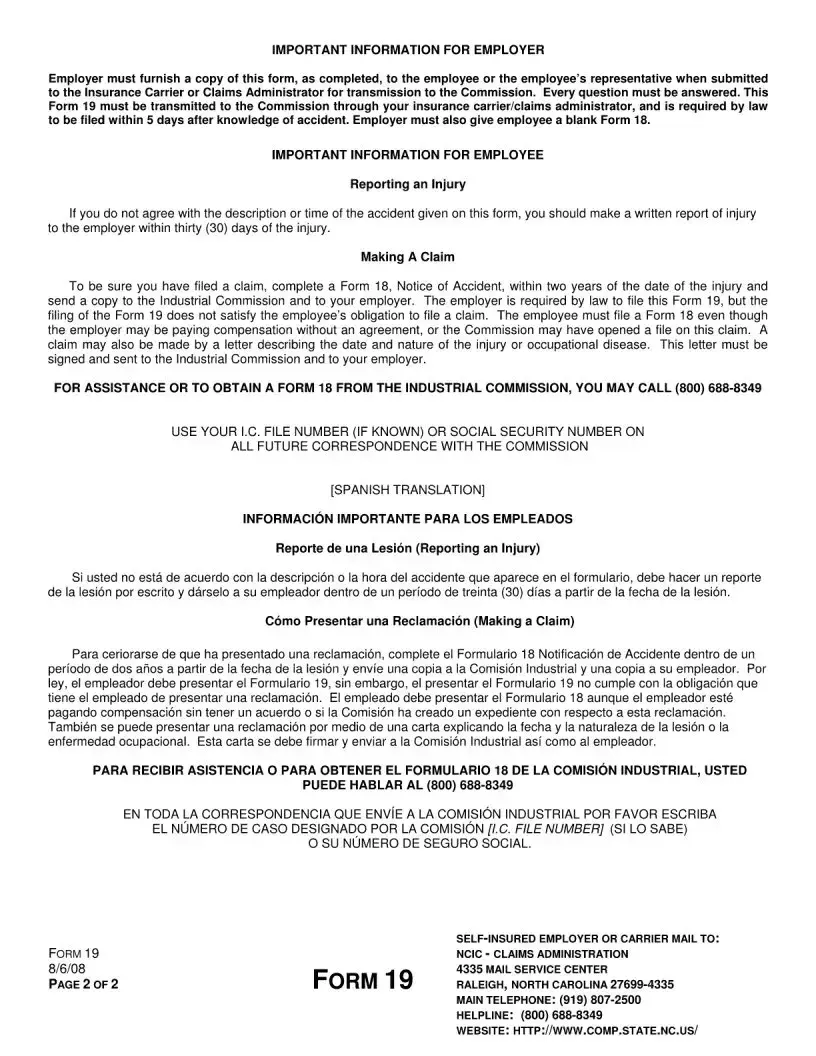
The employer is responsible for completing and submitting the Form 19 to the Industrial Commission through their insurance carrier or claims administrator. Upon submission, the employer must also provide a copy of the completed Form 19 to the affected employee or their representative. This requirement ensures that the employee is informed about the injury report and the subsequent steps needed to file a claim.

What should an employee do if they disagree with the information on the Form 19?

If an employee disagrees with the description or timing of the accident as reported on the Form 19, they should submit a written report of injury to their employer within thirty days of the incident. This written report should clearly outline the employee's perspective on the accident. It is crucial for the employee to document their disagreement promptly to ensure their concerns are officially recorded.

How does an employee file a claim for workers' compensation benefits?

What information is required on the Form 19?

The Form 19 requires several key pieces of information, including the employee's name, address, Social Security number, and details about the employer and insurance carrier. Additionally, the form asks for specifics about the injury, such as the date and time it occurred, the nature of the injury, and any medical treatment received. Accurate completion of this form is critical, as it serves as a formal report to the Industrial Commission.

What happens if an employer fails to file the Form 19?

If an employer fails to file the Form 19 within the required timeframe, they may face penalties under the Workers' Compensation Act. This failure can also negatively impact the employee's ability to receive timely benefits. It is essential for employers to adhere to the legal obligations surrounding the filing of this form to ensure compliance and support for their employees.

Common mistakes

  1. Failing to provide a copy of the Form 19 to the employee. Employers must give a completed copy to the injured employee or their representative.

  2. Not answering every question on the form. Each question must be addressed to avoid delays in processing.

  3. Missing the five-day filing deadline. The form must be submitted to the Industrial Commission within five days of the employer's knowledge of the injury.

  4. Confusing the Form 19 with the employee's claim. The Form 19 is not a claim for workers’ compensation benefits; employees must complete Form 18 to file a claim.

  5. Providing incorrect or incomplete information about the employee's injury. Accurate details about how the injury occurred are essential.

  6. Neglecting to include the I.C. File #. This unique identifier is crucial for all future correspondence regarding the injury.

  7. Overlooking the requirement to submit the form through an insurance carrier. The form must be transmitted via the employer's insurance carrier.

  8. Failing to inform the employee about their obligation to file a claim. Employees must complete and send Form 18 within two years of the injury.

Documents used along the form

The North Carolina Form 19 is essential for reporting an employee's injury or occupational disease. Along with this form, there are several other documents that play a crucial role in the workers' compensation process. Here’s a brief overview of four commonly used forms that accompany the Form 19.

  • Form 18: Notice of Accident - This form is completed by the injured employee to formally file a claim for workers' compensation benefits. It must be submitted within two years of the injury or the last medical payment. The employee sends this form to both the Industrial Commission and their employer.
  • Form 29: Report of Employee's Death - If the injury results in the employee's death, this form must be completed and submitted. It provides details about the circumstances of the death and is essential for the dependents to claim benefits.
  • OSHA Form 301: Injury and Illness Incident Report - Employers use this form to document work-related injuries and illnesses. It is crucial for compliance with OSHA regulations and helps track workplace safety issues.
  • Form 30: Application for Hearing - If there is a dispute regarding the claim, this form is used to request a hearing before the Industrial Commission. It outlines the issues in contention and is a critical step for resolution.

These forms work together with the Form 19 to ensure that both employers and employees fulfill their obligations under North Carolina's workers' compensation laws. Understanding each form's purpose can help streamline the claims process and ensure proper handling of workplace injuries.

Similar forms

The North Carolina Form 19 serves a specific purpose in the realm of workers' compensation, but it shares similarities with several other documents related to injury reporting and claims processing. Here’s a list of nine documents that are comparable to Form 19, along with an explanation of how they relate to it:

  • Form 18: Notice of Accident - This form is essential for employees to officially file a claim for workers' compensation benefits. Unlike Form 19, which is an employer's report, Form 18 must be completed by the employee and submitted to the Industrial Commission.
  • Form 29: Report of Fatality - In cases where an employee dies due to a workplace injury, Form 29 is required. It documents the fatality and is submitted by the employer, similar to how Form 19 is used for reporting injuries.
  • OSHA Form 301: Injury and Illness Incident Report - This document is used to record work-related injuries and illnesses. While Form 19 focuses on state requirements, OSHA Form 301 serves federal reporting needs and is also completed by employers.
  • Form 20: Employee's Claim for Compensation - This form is another claim document that employees may use to seek compensation. It differs from Form 19, which does not serve as a claim but is a report from the employer.
  • Form 30: Application for Hearing - If there is a dispute regarding a workers' compensation claim, Form 30 is used to request a hearing. This document is part of the claims process, while Form 19 is primarily for initial reporting.
  • Form 31: Agreement for Compensation - This form is used to formalize an agreement between the employer and employee regarding compensation for a work-related injury. It complements the information provided in Form 19.
  • Form 32: Termination of Compensation Agreement - Should compensation need to be terminated, this form is utilized. It is related to the claims process and follows the reporting done through Form 19.
  • Form 33: Request for Hearing on Claim - Similar to Form 30, this document is used to initiate a hearing regarding a workers' compensation claim, showing the progression from reporting an injury to seeking resolution.
  • Form 34: Notice of Change in Compensation - This form is used to notify the Industrial Commission of any changes in the compensation being provided to an injured employee, building on the initial reporting done in Form 19.

Each of these forms plays a vital role in the workers' compensation process, ensuring that both employers and employees fulfill their respective obligations under the law. Understanding these documents can help navigate the complexities of workplace injuries and claims effectively.

Dos and Don'ts

When filling out the North Carolina Form 19, it's important to follow specific guidelines to ensure accuracy and compliance. Here are some essential dos and don’ts:

  • Do provide complete and accurate information in every section of the form.
  • Do submit the form to your insurance carrier within five days of learning about the injury.
  • Do give a copy of the completed Form 19 to the employee or their representative.
  • Do include the I.C. File number, as it is crucial for future correspondence.
  • Don't leave any questions unanswered; every section must be filled out.
  • Don't assume that submitting Form 19 fulfills the employee's obligation to file a claim.
  • Don't forget to provide the employee with a blank Form 18 for their claim process.

By adhering to these guidelines, you can help ensure that the process goes smoothly for both the employer and the employee.

Misconceptions

Misconceptions about the North Carolina Form 19 can lead to confusion for both employers and employees. Here are nine common misunderstandings explained:

  • Form 19 is a claim for benefits. Many people think that submitting Form 19 is enough to file a claim for workers' compensation. In reality, this form is just a report and does not replace the need for Form 18.
  • Employers do not need to provide Form 18. Some believe that if an employer files Form 19, they do not need to give the employee a blank Form 18. However, employers are legally required to provide this form to the employee.
  • Filing Form 19 is optional. There is a misconception that filing Form 19 is not mandatory. In fact, it is required by law to be submitted within five days of learning about the injury.
  • Employees are not responsible for filing claims. Some employees think that once Form 19 is filed, they do not need to take any further action. They must still file Form 18 to ensure their claim is recognized.
  • All injuries are automatically covered. It is often assumed that all injuries reported on Form 19 will automatically qualify for compensation. Each claim must be evaluated based on specific circumstances.
  • There is no time limit for filing a claim. Many believe they can file a claim whenever they want. In reality, claims must be filed within two years of the injury or the date of the last medical payment.
  • Submitting Form 19 guarantees payment. Some think that just because Form 19 is submitted, compensation is guaranteed. This is not true; the claim must still be approved.
  • Form 19 can be submitted directly by the employee. There is a belief that employees can send Form 19 to the Industrial Commission themselves. However, it must be submitted through the employer's insurance carrier.
  • Form 19 provides complete information about the injury. Many assume that Form 19 contains all the necessary details about the injury. It is important for employees to provide additional information if they disagree with what's reported.

Understanding these misconceptions can help both employers and employees navigate the workers' compensation process more effectively.

Key takeaways

Here are key takeaways about filling out and using the North Carolina Form 19:

  • Form 19 is mandatory: Employers must complete and submit this form to the Industrial Commission.
  • Provide a copy to the employee: A completed Form 19 must be given to the injured employee or their representative.
  • Use the correct channels: Submit the form through your insurance carrier or claims administrator.
  • Timeliness is crucial: The form must be filed within 5 days of the employer's knowledge of the injury.
  • Not a claim for benefits: Form 19 does not serve as a claim for workers’ compensation; employees must file Form 18 for that purpose.
  • Accurate information is essential: Every question on the form must be answered completely to avoid delays.
  • Keep records: Reference the I.C. File # in all future correspondence regarding the injury.
  • Know the filing deadlines: Employees have two years from the injury date to file a claim using Form 18.
  • Report discrepancies: Employees should report any disagreements regarding the injury description or timing within 30 days.
  • Seek assistance if needed: For help or to obtain Form 18, contact the Industrial Commission at (800) 688-8349.

Ensure all parties understand their responsibilities to facilitate a smooth claims process.