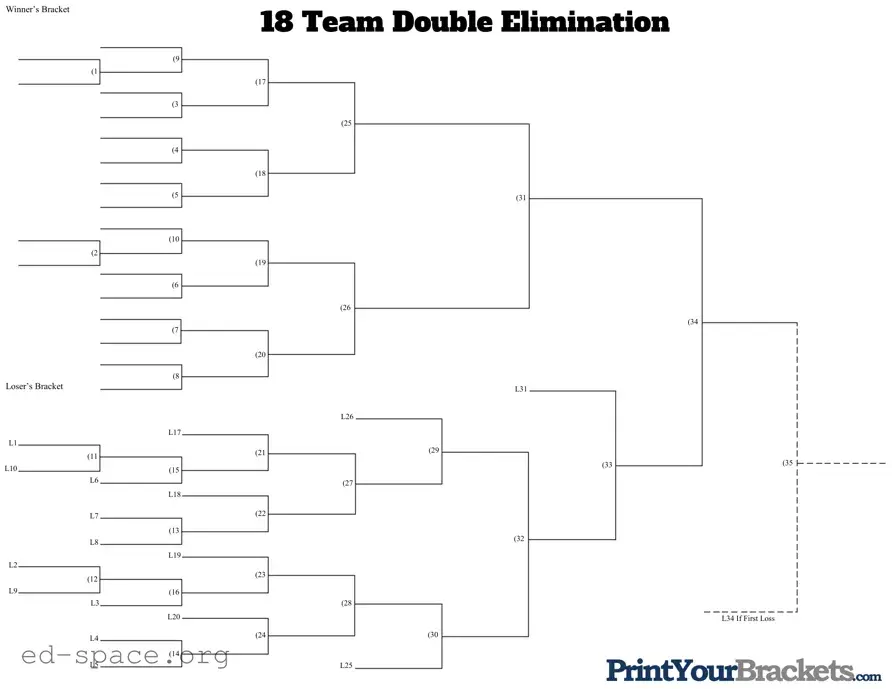
The 18 Double Elimination form is a popular structure used in tournament play, allowing teams a second chance even after their first loss. This format features two main brackets: the Winner’s Bracket and the Loser’s Bracket. Teams that win their matches continue advancing in the Winner’s Bracket, while those that lose are not immediately eliminated. Instead, they drop down to the Loser’s Bracket, where they have the opportunity to fight their way back into contention. The tournament culminates in a final showdown, where the last remaining team from the Winner’s Bracket faces off against the last team standing in the Loser’s Bracket. This design ensures that every team has the potential to recover from an early setback, making it an engaging experience for both players and spectators. The bracket layout is organized to clearly indicate matchups and progression, with teams labeled numerically for easy tracking. Overall, the 18 Double Elimination format balances competition and fairness, creating an exciting dynamic for tournaments of various sizes.

Winner’s Bracket
(9
(1
(3
(4
(5
(10
(2
|
(6 |
|
(7 |
Loser’s Bracket |
(8 |
|
|
|
L17 |
L1 |
|
|
(11 |
L10 |
(15 |
|
L6 |
|
L18 |
L7
(13
L8
L19
L2
(12
L9 |
(16 |
L3
L20
L4
(14
L5
18 Team Double Elimination
(17
(25
(18
(31
(19
(26
(34
(20
L31
L26
(21 |
(29 |
(33 |
(35 |
(27
(22
(32
(23
(28
L34 If First Loss
(24 |
(30 |
L25PrintYourBrackets.com
| Fact Name | Description |
|---|---|
| Structure | The 18 Double Elimination format consists of two brackets: the Winner's Bracket and the Loser's Bracket. |
| Teams | This format accommodates 18 teams competing in a series of matches. |
| Match Progression | Teams in the Winner's Bracket continue until they lose, while teams in the Loser's Bracket face elimination after their second loss. |
| Initial Matches | The first round features matches between the lowest-seeded teams to determine initial placements. |
| Loser's Bracket | Teams that lose in the Winner's Bracket drop into the Loser's Bracket, providing a second chance to compete. |
| Finals | The final match can feature a team from the Winner's Bracket facing a team from the Loser's Bracket, often requiring two wins for the Winner's Bracket team. |
| Governing Laws | State-specific laws govern the conduct of tournaments, including rules on eligibility and safety standards. |
| Seeding | Seeding is crucial, as it affects matchups and can impact the overall tournament outcome. |
| Time Constraints | Time limits may apply to matches, ensuring that the tournament progresses efficiently. |
| Eligibility | Eligibility criteria must be established, including age and skill level, to ensure fair competition. |
Filling out the 18 Double Elimination form is an important step in organizing your tournament. This form will help you track the progress of each team as they compete, ensuring that everyone has a fair chance to advance. Follow these steps carefully to complete the form accurately.
By following these steps, you will have a well-organized form that accurately reflects the tournament's progress. This will aid in keeping track of each team's journey through the competition.
What is an 18 Double Elimination tournament?
An 18 Double Elimination tournament is a format where each team must lose twice before being eliminated from the competition. This structure allows teams to have a second chance, ensuring that a single loss does not end their tournament journey.
How is the bracket structured?
The bracket consists of a Winner’s Bracket and a Loser’s Bracket. Teams that win their matches remain in the Winner’s Bracket, while teams that lose drop down to the Loser’s Bracket. If a team loses in the Loser’s Bracket, they are eliminated from the tournament.
How many teams can participate?
This format accommodates 18 teams. Each team will have the opportunity to compete in multiple matches, depending on their performance throughout the tournament.
What happens if a team loses a match?
If a team loses a match, they move to the Loser’s Bracket. They will continue to compete in this bracket until they lose again, at which point they will be eliminated from the tournament.
How are the matchups determined?
What is the significance of the Winner’s and Loser’s Brackets?
The Winner’s Bracket gives teams an advantage by allowing them to remain in the tournament longer without the threat of immediate elimination. The Loser’s Bracket provides a safety net, enabling teams to recover from a loss and continue competing.
How is the champion determined?
The champion of the tournament is the last team remaining in the Winner’s Bracket or the team that emerges from the Loser’s Bracket after defeating the final team in the Winner’s Bracket. This ensures that the champion has proven their skill against all competitors.
What if a match ends in a tie?
If a match ends in a tie, tournament rules will dictate the tiebreaker procedure. This may involve additional matches or specific criteria to determine the winner, ensuring that a clear outcome is reached.
Are there any specific rules for the tournament?
Yes, each tournament may have its own set of rules regarding game play, match duration, and conduct. It is essential for teams to review the specific regulations provided by the tournament organizers to ensure compliance.
When filling out the 18 Double Elimination form, individuals may encounter several common mistakes. Awareness of these pitfalls can lead to a smoother experience. Below is a list of seven mistakes to avoid:
Using nicknames or abbreviations instead of the official team names can lead to confusion. Always ensure that the full, official name of each team is used.
Failing to record match results promptly can result in delays and inaccuracies. It is important to fill in results immediately after each match.
Placing a team in the wrong bracket can disrupt the entire tournament flow. Verify that each team is positioned correctly in either the winner’s or loser’s bracket.
Neglecting to include player names or contact information can create difficulties in communication. Ensure all relevant player details are filled out completely.
Not adhering to the specified format for entries can lead to misunderstandings. Pay close attention to the required structure of the form.
Missing submission deadlines can result in disqualification. Always be aware of and adhere to all relevant timelines for form submission.
Overlooking errors due to haste can lead to significant issues later on. It is advisable to review all entries before finalizing the form.
By avoiding these common mistakes, participants can help ensure a successful and organized tournament experience.
When organizing a double elimination tournament, several forms and documents complement the 18 Double Elimination form. These documents help ensure that the tournament runs smoothly and efficiently. Below is a list of commonly used forms and documents in conjunction with the 18 Double Elimination form.
Using these documents alongside the 18 Double Elimination form can enhance the overall experience for participants and organizers alike. Each form serves a specific purpose, contributing to the smooth operation of the tournament and ensuring that everyone involved is informed and engaged.
The 18 Double Elimination form is a useful document in tournament organization, and it shares similarities with several other forms. Here’s a list of six documents that are comparable:
When filling out the 18 Double Elimination form, it’s important to follow certain guidelines to ensure accuracy and clarity. Here are seven things to keep in mind:
By adhering to these guidelines, you can help ensure that the tournament runs smoothly and that your team is properly represented.
When it comes to the 18 Double Elimination format, there are several misconceptions that can lead to confusion. Here are some of the most common myths, along with explanations to clarify the reality.
This is not true. In a double elimination format, a team must lose two matches before being eliminated from the tournament. This gives teams a second chance to compete for the title.
While the winner's bracket is crucial, the loser's bracket plays a significant role as well. Teams in the loser's bracket have the opportunity to fight their way back to the finals, making every match important.
This is generally the case, but in some formats, certain teams may start in the loser's bracket based on previous performance or seeding. It's important to check the specific tournament rules.
That’s a common misunderstanding. Teams that lose in the winner's bracket drop down to the loser's bracket, where they still have a chance to continue competing.
Not necessarily. If a team from the loser's bracket wins against the winner's bracket team in the finals, a second match may be required to determine the champion, since the winner's bracket team has only lost once.
While it may seem complex at first glance, the double elimination format is straightforward once you grasp the basic structure. Visual aids, like brackets, can help clarify the process.
This is false. Teams that lose early still have a chance to come back through the loser's bracket. Many champions have emerged from tough situations.
In fact, the double elimination format is designed to be fair. It allows teams to demonstrate their skill over multiple matches, giving them a chance to recover from an early loss.
Winning in the winner's bracket provides teams with a significant advantage, as they have a safety net in the loser's bracket. Additionally, they may have to play fewer matches overall, which can be a strategic benefit.
Filling out and using the 18 Double Elimination form can be straightforward if you keep a few key points in mind. Here are the essential takeaways:
By following these guidelines, you can effectively manage the tournament and ensure a smooth experience for all teams involved.