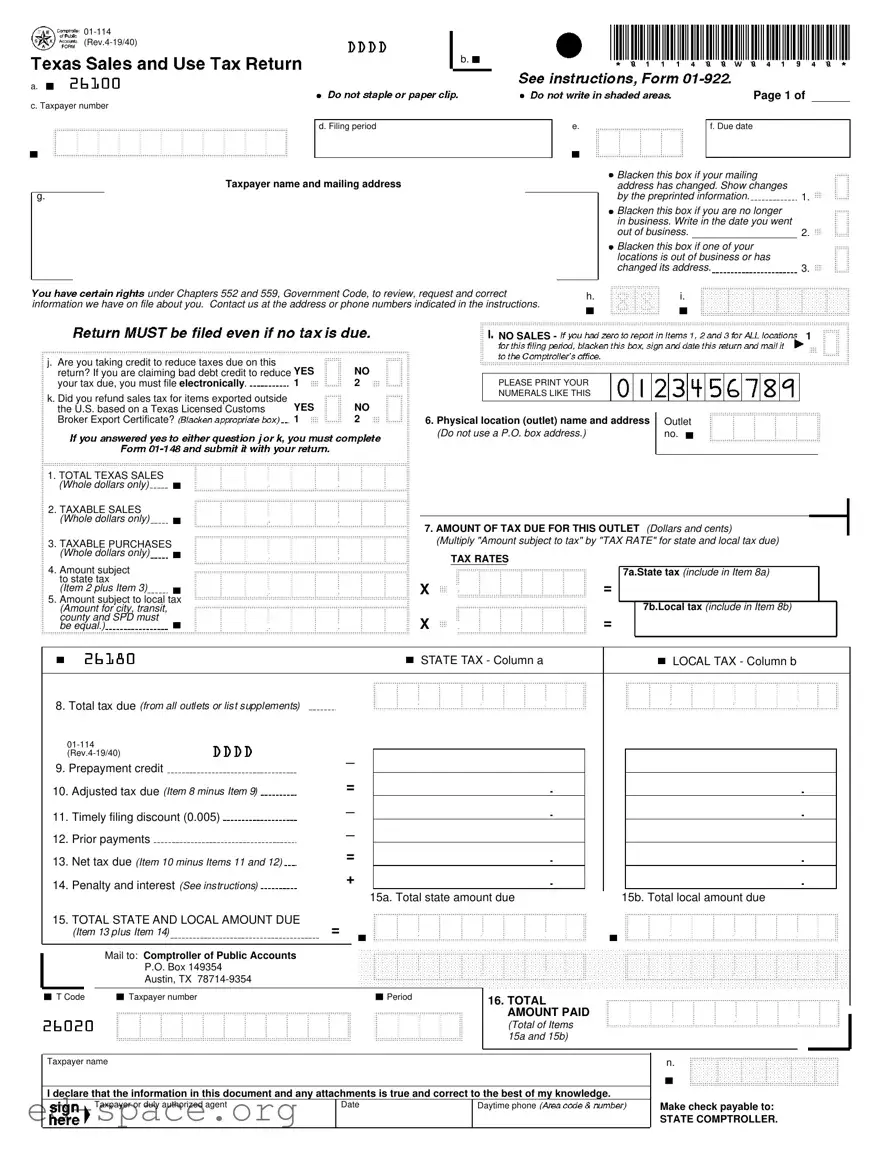
The Texas Form 1-114 is a crucial document for taxpayers engaged in business activities within the state. This form serves multiple purposes, including reporting total sales, taxable sales, and taxable purchases. Taxpayers must provide their identification number, name, and mailing address, ensuring that all information is accurate and up-to-date. A key feature of this form is the ability to indicate changes in business status, such as closing a business or altering a physical location. Additionally, it allows taxpayers to claim credits to reduce their tax liabilities, which must be submitted electronically. The form requires taxpayers to calculate their total tax due, incorporating both state and local tax rates, and provides a section for prepayment credits and prior payments. Ultimately, the 1-114 is not just a filing tool; it is a comprehensive declaration of a taxpayer's financial obligations to the state, and it must be completed with precision to avoid penalties and interest. Timely submission is essential, as the form includes a discount for early filing, making it imperative for taxpayers to be aware of their due dates.
01- 14
b.
a.
c. Taxp yer number
d. Filing period
Taxpayer name and mailing address
g.
under Chapt |
rs 552 and 559, G v rnment Cod , review, request and correct |
information we have n file about you. |
Contact us at the address or phone numbers indicated in the ins ruct ons. |
|
|
|
|
Page 1 of |
||
|
|
|
|
|
|
|
e. |
|
|
f. Due date |
|
|
|
|
|
|
|
|
|
|
|
Blacken this box if your mailing |
|
|
|||
|
address has ch nged. Sh w changes |
|
|
|||
|
by the preprinted information. |
1. |
|
|||
|
Blacken this box if you are no longer |
|
|
|||
|
in |
usiness. Write in the date you went |
|
|
||
|
out of busin ss. |
|
2. |
|
||
|
Blacken this box if one of your |
|
|
|||
|
locations is out of business or has |
|
|
|||
|
changed its ad ress. |
3. |
|
|||
|
|
|
|
|
|
|
. |
|
i. |
|
|
||
j. Are |
t king c |
it to reduce taxes due |
is |
|
|
return? If you are claiming |
d bt cred to reduce YES |
NO |
|||
your tax due, you |
ust file ele tronically. |
1 |
2 |
||
k. Did you refund sales tax f |
r items expor ed outside |
|
|||
the U.S. based |
a T xas Licen ed Cus oms |
YES |
NO |
||
Broker Export Certificate? |
|
1 |
2 |
||
1.TOTAL TEXAS SALES (Whole dollars only)
2.TAXABLE SALES (Whole dollars only)
3.TAXABLE PURCHASES (Whole dollars only)
|
l. NO SALES - |
1 |
|||||||||||
|
|
|
|
|
|
|
|
|
|
|
|
|
|
|
PLEASE PRINT YOUR |
|
|
|
|
|
|
|
|
|
|
|
|
|
NUMERALS LIKE THIS |
|
|
|
|
|
|
|
|
|
|
|
|
|
|
|
|
|
|
|
|
|
|
|
|
|
|
6. Physical location (outlet) name and address |
|
Outlet |
|||||||||||
|
|||||||||||||
(Do not use a P.O. box address.) |
|
no. |
|||||||||||
|
|
|
|
|
|
|
|
|
|
|
|
|
|
7.AMOUNT OF TAX DUE FOR THIS OUTLET (Dollars and cents)
(Multiply "Amount subject to tax" by "TAX RATE" for state and local tax due)
TAX RATES
4.Amount subject to state tax
(Item plus Item 3)
5.Amount subject to local tax (Amount for city, transit, county and SPD must
equal.)b
X |
= |
X |
= |
7a.State tax (include in Item 8a)
7b.Local tax (include in Item 8b)
be |
STATE TAX - Column a |
LOCAL TAX - Column b |
8.Total tax due (from all outlets or list supplements)
|
|
|
|
|
|
|
|
|
|
|
||
_ |
|
|
|
|
|
|
|
|
||||
9. Prepayment credit |
|
|
|
|
|
|
|
|
||||
= |
|
|
|
|
|
|
|
|
||||
10. Adjusted tax due (Item 8 minus Item 9) |
|
|
|
|
|
|
|
|
||||
11. Timely filing discount (0.005) |
_ |
|
|
|
|
|
|
|
|
|||
_ |
|
|
|
|
|
|
|
|
||||
|
|
|
|
|
|
|
|
|||||
12. Prior payments |
|
|
|
|
|
|
|
|
||||
= |
|
|
|
|
|
|
|
|
||||
|
|
|
|
|
|
|
|
|||||
13. Net tax due (Item 10 minus Items 11 and 12) |
|
|
|
|
|
|
|
|
||||
+ |
|
|
|
|
|
|
|
|
||||
14. Penalty and interest (See instructions) |
|
|
|
|
|
|
|
|
||||
|
|
|
|
|
|
|
|
|
|
|||
|
15a. Total state amount due |
15b. Total local amount due |
|
|||||||||
|
|
|
|
|
||||||||
15. TOTAL STATE AND LOCAL AMOUNT DUE |
= |
|
|
|
|
|
|
|
|
|
||
(Item 13 plus Item 14) |
|
|
|
|
|
|
|
|
|
|||
|
|
|
|
|
|
|
|
|
|
|
|
|
|
|
Mail to: Comptroller of Public Accounts |
|
|
|
|
|
|
|
|
|
|
|
|
|
|
|
|
|
|
|
|
|
|
|
|
|
P.O. Box 149354 |
|
|
|
|
|
|
|
|
|
|
|
|
Austin, TX |
|
|
|
|
|
|
|
|
|
|
|
|
|
|
|
|
|
|
|
|
|
|
|
T Code |
Taxpayer number |
|
|
Period |
16. TOTAL |
|
|
|
|
|
||
|
|
|
|
|
|
|
|
|
|
|
||
|
|
|
|
|
|
AMOUNT PAID |
|
|
|
|
|
|
|
|
|
|
|
|
|
|
|
|
|
||
|
|
|
|
|
|
(Total of Items |
|
|
|
|
|
|
|
|
|
|
|
|
15a and 15b) |
|
|
|
|
|
|
|
|
|
|
|
|
|
|
|
|
|
|
|
Taxpayer name
I declare that the information in this document and any attachments is true and correct to the best of my kn wledge.
Taxpayer or duly authorized agent |
Date |
Daytime phone |
|
|
|
n.
Make check payable to:
STATE COMPTROLLER.
| Fact Name | Details |
|---|---|
| Form Purpose | The 1-114 Texas form is used for reporting sales and use taxes in Texas. It is essential for businesses to accurately report their taxable sales and purchases. |
| Filing Requirements | Taxpayers must file this form electronically if they are claiming a debt credit to reduce their tax due. This requirement ensures efficient processing of tax returns. |
| Governing Laws | The form operates under Chapters 552 and 559 of the Texas Government Code. These laws govern the disclosure and correction of information maintained by the state. |
| Mailing Information | Completed forms should be mailed to the Comptroller of Public Accounts at P.O. Box 149354, Austin, TX 78714-9354. This ensures that submissions reach the appropriate state office. |
Completing the 1-114 Texas form requires careful attention to detail. Ensure that all information is accurate and that you follow the instructions closely. After filling out the form, it will need to be submitted to the appropriate address provided.
What is the 1 114 Texas form?
The 1 114 Texas form is a tax return used by businesses to report sales and use tax in Texas. It is specifically designed for taxpayers to calculate the amount of tax due for a specific filing period. The form collects information about total sales, taxable sales, and taxable purchases, among other details.
Who needs to file the 1 114 Texas form?
Any business operating in Texas that sells taxable goods or services is required to file the 1 114 form. This includes retailers, wholesalers, and service providers. If a business has no sales during the reporting period, it may still need to file the form indicating that there were no sales.
When is the 1 114 Texas form due?
The due date for filing the 1 114 Texas form typically aligns with the end of the reporting period. Businesses must file this form monthly, quarterly, or annually, depending on their tax liability. It is important to check the specific due date for each period to avoid penalties.
What information is required on the 1 114 Texas form?
The form requires several pieces of information, including the taxpayer number, filing period, taxpayer name, and mailing address. Additionally, businesses must report total sales, taxable sales, taxable purchases, and the amount of tax due. If there have been any changes in business status or address, those must also be indicated.
Can I claim a credit to reduce my taxes on the 1 114 Texas form?
Yes, taxpayers can claim certain credits to reduce their tax liability. However, if you are claiming a debt credit, you must file the form electronically. It is essential to follow the instructions carefully to ensure that the credit is applied correctly.
What should I do if my business address has changed?
If your business address has changed, you must blacken the designated box on the form and show the changes clearly alongside the preprinted information. This ensures that the Texas Comptroller's office has your current contact information.
How do I calculate the amount of tax due on the 1 114 Texas form?
The amount of tax due is calculated by multiplying the amount subject to tax by the applicable tax rate. The form provides specific lines for state and local tax calculations, which must be summed to determine the total tax due.
What happens if I do not file the 1 114 Texas form on time?
Failure to file the 1 114 Texas form by the due date may result in penalties and interest on the unpaid tax amount. It is crucial to file on time to avoid these additional charges. If a business cannot file on time, it may be beneficial to contact the Texas Comptroller's office for guidance.
Where should I send the completed 1 114 Texas form?
The completed 1 114 Texas form should be mailed to the Comptroller of Public Accounts at P.O. Box 149354, Austin, TX 78714-9354. Ensure that the form is sent well in advance of the due date to allow for processing time.
Overlooking the Taxpayer Number: Many individuals forget to include their taxpayer number. This number is crucial for identifying your account and ensuring that your submission is processed correctly. Without it, your form could be delayed or even rejected.
Incorrect Filing Period: Selecting the wrong filing period is a common mistake. Each form corresponds to a specific time frame for reporting sales. Double-check the dates to avoid potential penalties or issues with your tax calculations.
Failing to Update Address Changes: If your mailing address has changed, it’s essential to blacken the appropriate box and show the updates clearly. Not doing so can lead to miscommunication and important documents being sent to the wrong address.
Neglecting to Claim Prepayment Credits: If you have prepayment credits, ensure that you calculate and include them accurately. This can reduce your total tax due significantly. Forgetting this step may result in overpayment.
The 1-114 Texas form is essential for reporting sales and use taxes. Alongside this form, there are several other documents that are often required to ensure compliance with Texas tax laws. Each of these forms plays a specific role in the tax reporting process.
Understanding these documents can help streamline the tax filing process and ensure compliance with Texas regulations. Proper documentation is crucial for maintaining good standing with the state and avoiding potential issues down the line.
When filling out the 1-114 Texas form, follow these guidelines to ensure accuracy and compliance.
Understanding the 1-114 Texas form can be challenging. Here are ten common misconceptions about this form, along with clarifications to help you navigate it more easily.
By addressing these misconceptions, you can better understand the requirements and processes associated with the 1-114 Texas form. This understanding will help ensure compliance and facilitate smoother tax reporting.
Here are some key takeaways for filling out and using the 1-114 Texas form: